
DeepSeek is a Chinese artificial intelligence company and the name used for its family of AI models, official web and mobile assistant, developer API, downloadable model weights, and agent platform. For most people, DeepSeek means the free chatbot available through its website and mobile apps. For developers, it may instead mean an API model, a self-hosted model, or DeepSeek Harness.
DeepSeek became widely known after releasing models such as DeepSeek-V3 and the reasoning-focused DeepSeek-R1. Its current ecosystem is broader than either model, so the capabilities, cost, privacy implications, and setup requirements depend on which DeepSeek product you use.
DeepSeek can mean several different things
| Meaning | What it refers to | Who it is for |
|---|---|---|
| DeepSeek the company | The AI research and model-development company based in Hangzhou, China | Anyone researching the organization behind the technology |
| DeepSeek models | Language, reasoning, vision, coding, and multimodal model families developed by DeepSeek | Researchers, developers, and application providers |
| DeepSeek Web and app | The official consumer AI assistant for conversations, search, files, and supported visual tasks | General users, students, writers, and professionals |
| DeepSeek API | A paid developer platform for adding DeepSeek models and tools to software | Developers and businesses |
| Downloadable model weights | Model files that can be deployed on suitable third-party or local infrastructure | Technical users, researchers, and organizations |
| DeepSeek Harness | An open-source agent environment that connects models to files, commands, tools, plugins, and workspaces | Developers and advanced users building agent workflows |
These layers are related but not interchangeable. A third-party application can use a DeepSeek model without being operated by DeepSeek, while a locally hosted model may have different features and data-handling practices from the official app.
Who created DeepSeek?
DeepSeek was founded in 2023 by Liang Wenfeng and is based in Hangzhou, China. Its official services are operated by Hangzhou DeepSeek Artificial Intelligence Co., Ltd., according to the company’s current legal and privacy documents.
Liang also co-founded the quantitative investment firm High-Flyer. Reuters reported that DeepSeek initially developed with financial and technical support connected to High-Flyer before becoming globally prominent as an AI model developer.
DeepSeek describes itself as a research team focused on foundational model technology and the pursuit of artificial general intelligence. It also emphasizes the public release of model weights, research reports, and inference code.
How does DeepSeek work?
DeepSeek models are large language models. They are trained on large collections of data to recognize patterns in language, code, images, and other supported inputs. When a user submits a prompt, the model calculates which tokens—small units of text—are most likely to form a useful response.
This is generation rather than a simple database lookup. The model creates a response based on patterns learned during training, the current prompt, the conversation context, and any tools or external information available to the application.
Pretraining and post-training
During pretraining, a model learns broad language, coding, reasoning, and knowledge patterns from training data. During post-training, techniques such as supervised fine-tuning and reinforcement learning help the model follow instructions, improve particular skills, and produce more useful answers.
DeepSeek’s model mechanism and training disclosure explains that deployed models generate responses by predicting subsequent tokens. It also warns that the most likely sequence of words is not always the most factually accurate one.
Reasoning models and thinking modes
A reasoning model is optimized to spend more computation analyzing a problem before presenting an answer. DeepSeek-R1 became well known for mathematics, coding, and logical reasoning, but it is a historical model family within the larger DeepSeek ecosystem rather than the definition of DeepSeek itself.
Current DeepSeek API models provide selectable thinking behavior. More reasoning effort can help with difficult tasks, but it may also increase response time, output length, and usage cost. A visible reasoning process should not be treated as proof that an answer is correct.
Mixture-of-experts architecture
Several DeepSeek model generations use a mixture-of-experts architecture. Instead of activating the entire network for every token, the system routes parts of a request through a selected subset of specialized components.
This design can reduce the amount of computation required during inference while allowing the total model to contain more parameters. It does not mean that every DeepSeek model has the same architecture, and a lower number of active parameters does not automatically make one model better than another.
What are the current DeepSeek products and models?
DeepSeek changes its models and routing frequently. The official API changelog states that the web assistant and mobile app currently use DeepSeek-V4.1-Flash-1017, an updated multimodal model with visual understanding and additional optimization for project-development and agent tasks.
| Product or model family | Current role |
|---|---|
| DeepSeek-V4.1-Flash-1017 | The current model used by the official web and mobile assistant and available through the API as deepseek-flash |
| DeepSeek API models | Models for developers using supported OpenAI-compatible and Anthropic-compatible interfaces, structured output, tool calls, and other documented features |
| DeepSeek-R1 | An influential earlier reasoning-model family with downloadable weights and distilled variants |
| Janus and Janus-Pro | Separate multimodal research models that combine visual understanding with image-generation capabilities |
| DeepSeek Harness | An open-source agent environment for coding, document work, research, automation, and plugin development |
| Older DeepSeek releases | Historical or retired models that may still appear in older tutorials, comparisons, and third-party services |
Developers should check the live DeepSeek model catalog before building an integration. Model aliases, routing, supported modalities, context limits, and availability can change after an article or tutorial is published.
What can DeepSeek do?
DeepSeek can perform many common generative-AI tasks, but the exact feature set depends on the model, interface, account, tools, and deployment method.
- Answer questions: Explain concepts, compare ideas, and provide step-by-step guidance.
- Write and rewrite: Draft emails, reports, outlines, articles, summaries, and other text.
- Translate and simplify: Translate between languages or rewrite difficult material in clearer language.
- Help with coding: Explain code, find possible bugs, generate functions, and suggest tests or improvements.
- Work through reasoning tasks: Assist with mathematics, logic, planning, and structured problem solving.
- Search the web: Use supported search tools to find more recent information and retrieve web content.
- Analyze images: The current Flash model can describe images, read screenshots, and examine charts or diagrams.
- Process files: Work with supported uploaded files through the official assistant or API.
- Power applications: Developers can connect DeepSeek models to websites, software, coding tools, and agent systems through the API.
- Run agent workflows: DeepSeek Harness can connect a model to local workspaces, commands, plugins, and external tools.
Do not assume that every feature is available in every DeepSeek model. For example, the current Flash model supports image understanding, while another API model or an older locally deployed model may accept only text.
Can DeepSeek generate images?
The standard DeepSeek assistant and current general API catalog focus on text output and visual understanding rather than documented native image-file generation. DeepSeek’s separate Janus model family, including Janus-Pro, supports text-to-image generation through its own code, model files, and hosted demonstrations.
This distinction matters: uploading an image for analysis is not the same as asking the main chatbot to render a new PNG or JPG. A third-party website using the DeepSeek name may also connect to an unrelated image model, so verify which provider and model actually create the output.
How can you access DeepSeek?
| Access method | Best for | What to know |
|---|---|---|
| DeepSeek Web | General conversations, search, writing, reasoning, files, and supported image analysis | Runs as a hosted DeepSeek service and follows DeepSeek’s consumer privacy policy |
| Official iOS and Android apps | Using the assistant on a phone or tablet | Download only through official links or verified app-store listings |
| DeepSeek API Platform | Building software, automations, and agent integrations | Requires an API key and is billed separately from the free consumer assistant |
| Official model repositories | Research, self-hosting, fine-tuning, and private infrastructure | Requires technical expertise and suitable computing resources |
| DeepSeek Harness | Working with files, repositories, commands, tools, and plugins | Still in preview and should be used cautiously in controlled environments |
| Third-party services | Accessing DeepSeek through another platform | The third party controls the interface, feature set, pricing, and much of the data handling |
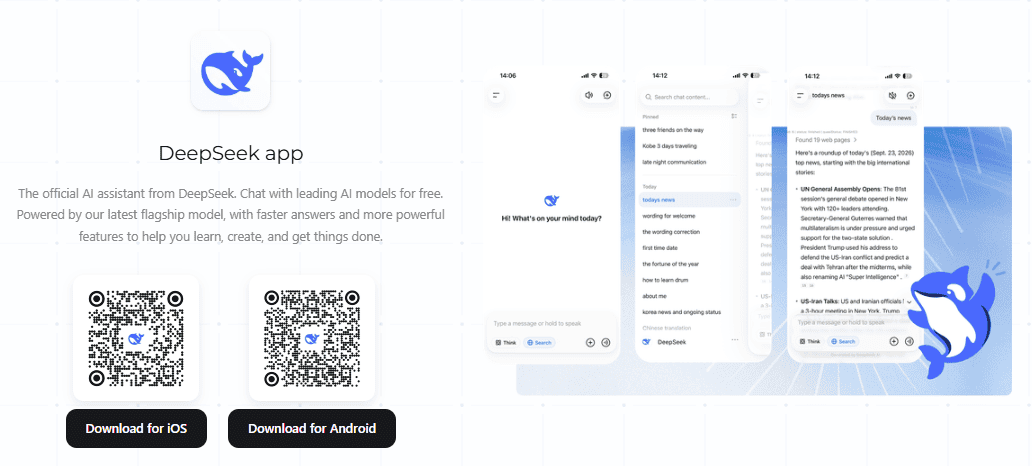
Use official links when creating an account, downloading an app, obtaining model weights, or purchasing API credit. An unofficial service may use the DeepSeek name without being operated, endorsed, or secured by DeepSeek.
Is DeepSeek free?
DeepSeek currently presents its official consumer web and mobile assistant as free to use. That does not mean every DeepSeek product, deployment, or third-party service is free.
| DeepSeek option | How cost works |
|---|---|
| Official web and mobile assistant | Currently offered as a free consumer service, subject to availability, usage controls, and future changes |
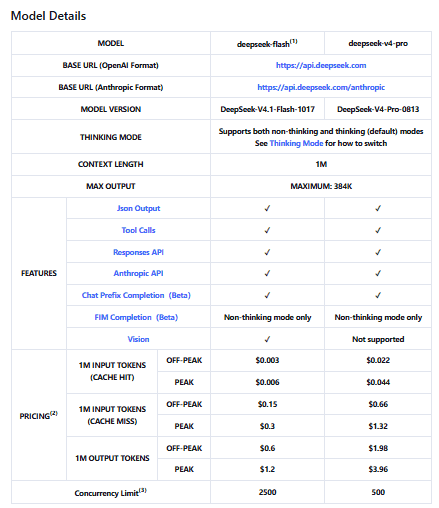
| DeepSeek API | Paid according to model input, cached input, output, and applicable tool usage |
| Search and Fetch APIs | Billed separately per successful request under the current API pricing structure |
| Downloadable model weights | May be free to download under the applicable license, but deployment requires hardware or cloud infrastructure |
| Local deployment | Creates costs for GPUs, memory, storage, electricity, engineering, and maintenance |
| DeepSeek Harness | The open-source software may be available without a license fee, while model APIs, search tools, plugins, and external services may cost money |
| Third-party DeepSeek service | Uses the third party’s prices, limits, subscription rules, and billing terms |
The official API pricing page lists rates per one million tokens and separates cache-hit, cache-miss, input, output, peak, and off-peak charges. Check that page immediately before estimating a project because prices and model routing can change.
Is DeepSeek open source?
DeepSeek is often described as open source, but the accurate answer depends on the specific model or product. The company has publicly released model weights, inference code, and technical reports for many important model families, frequently under the MIT License.
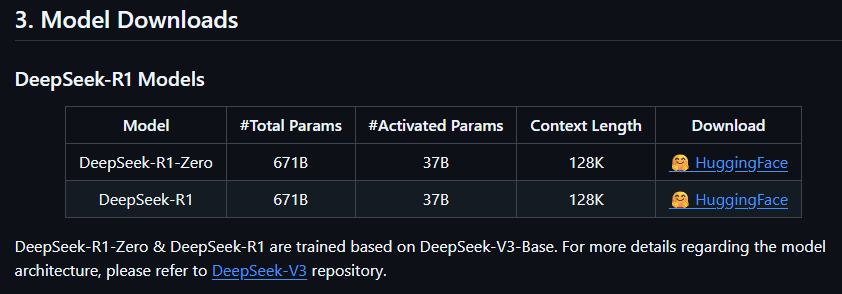
For example, the official DeepSeek-R1 repository states that its code and primary model weights are licensed under MIT. Some distilled R1 models are based on Qwen or Llama models and remain subject to additional base-model license terms.
The hosted DeepSeek website and mobile app are not the same thing as the downloadable model weights. Public model files do not make the hosted account system, infrastructure, interface, search engine, or every proprietary service component open source.
| Term | What it means |
|---|---|
| Open-source code | Source code is published under a license that defines how it can be used and modified |
| Open model weights | The learned numerical parameters can be downloaded and run with suitable software and hardware |
| Published technical report | The company explains parts of the architecture, training, and evaluation process |
| Hosted service | The provider operates the model and interface on its own infrastructure |
| Self-hosted deployment | The user or organization operates the model on local or cloud infrastructure it controls |
Always check the license attached to the exact model you plan to use. Do not assume that one DeepSeek model’s license automatically applies to every model, derivative, dataset, application, or third-party deployment.
Can DeepSeek run locally?
Selected DeepSeek model weights can be downloaded and run outside DeepSeek’s hosted service. Local deployment may provide more control over infrastructure, logging, access, and data flow, but it requires suitable hardware and technical setup.
The required resources vary significantly by model size, numerical precision, quantization, context length, batch size, and inference software. Smaller distilled models may run on consumer hardware, while the largest model releases can require multiple high-memory GPUs or a substantial server cluster.
Running a model on your own computer also does not automatically guarantee complete privacy. The application, model manager, plugins, update service, web tools, or other integrations may still connect to external servers unless they are configured and audited for offline operation.
Why did DeepSeek become important?
DeepSeek became globally prominent because its model releases combined several developments that were important to researchers, developers, and the AI market:
- Downloadable model weights: Major releases could be studied, deployed, and adapted outside the official service.
- Reasoning research: DeepSeek-R1 demonstrated how reinforcement learning could be used to develop strong reasoning behavior.
- Efficient architectures: DeepSeek published work on mixture-of-experts routing, attention efficiency, and methods intended to lower inference requirements.
- Competitive API pricing: The company used lower-cost API access to attract developers and agent platforms.
- Technical transparency: Model cards, repositories, and research reports allowed independent developers to inspect and deploy important releases.
- Market impact: R1 and V3 challenged assumptions about how much compute and spending were required to build competitive AI systems.
Claims about model-training cost require careful interpretation. A reported compute cost for one training run does not include every expense involved in research, data preparation, failed experiments, salaries, hardware acquisition, infrastructure, and post-training.
Is DeepSeek safe to use?
DeepSeek is neither automatically safe nor automatically unsafe for every user. The appropriate decision depends on the access method, the sensitivity of the information, the organization’s policies, the applicable laws, and the consequences of an incorrect answer or data disclosure.
The current DeepSeek Privacy Policy says that the official services may collect account information, prompts, chat history, voice input, uploaded files, photos, feedback, device and network information, usage logs, and approximate location derived from an IP address.
The policy also states that personal data collected through the covered services is directly collected, processed, and stored in the People’s Republic of China. DeepSeek says users may have the right to opt out of using their personal data for model training or technology optimization and can manage, copy, or delete chat history through available settings.
Privacy depends on how you access the model
| Access method | Privacy consideration |
|---|---|
| Official web or mobile app | DeepSeek operates the interface and processes data under its consumer privacy policy |
| Official API | DeepSeek processes API requests, while the developer operating the downstream application is responsible for explaining its own end-user data practices |
| Locally hosted model | Inference may stay on controlled infrastructure, but external tools, software, updates, and telemetry must still be reviewed |
| DeepSeek Harness | Local workspaces may be combined with official or custom model providers, plugins, web tools, and MCP servers that create separate data flows |
| Third-party chatbot | The third-party provider controls its interface, logging, retention, and privacy practices |
Practical precautions
- Do not enter passwords, private keys, API credentials, or authentication tokens.
- Do not upload confidential business documents without authorization.
- Avoid submitting health records, legal files, financial data, customer information, or other sensitive personal data.
- Check your employer’s AI-use and data-classification policies before using DeepSeek for work.
- Review the privacy policy of any third-party DeepSeek interface separately.
- Verify important outputs using original documents, official sources, and qualified experts.
- Use local deployment only after reviewing the complete software and network configuration.
How accurate is DeepSeek?
DeepSeek can provide useful answers, code, explanations, and analysis, but it can also produce false, outdated, incomplete, biased, or fabricated information. A confident tone, detailed reasoning, or a plausible citation does not guarantee factual accuracy.
Accuracy can vary according to the selected model, prompt, language, subject, available tools, and whether the application has access to current web information. Search tools can provide fresher sources, but they do not eliminate interpretation errors, weak sources, or fabricated conclusions.
For medical, legal, financial, cybersecurity, employment, or other high-stakes decisions, treat DeepSeek as an assistant rather than a final authority. Verify the output against primary sources and seek appropriately qualified professional advice.
DeepSeek vs. ChatGPT
DeepSeek and ChatGPT are both AI assistants, but comparing them requires matching equivalent products rather than comparing one company’s downloadable model with another company’s consumer application.
| Area | DeepSeek | ChatGPT |
|---|---|---|
| Developer | Hangzhou DeepSeek Artificial Intelligence Co., Ltd. | OpenAI |
| Consumer assistant | DeepSeek Web and mobile app | ChatGPT web, desktop, and mobile applications |
| Core everyday tasks | Chat, writing, reasoning, coding, search, files, and visual understanding | Chat, writing, reasoning, coding, search, images, files, audio, data analysis, and other integrated tools |
| Image generation | Not documented as a native feature of the standard assistant; Janus-Pro is a separate model family | Image generation and editing are integrated into supported ChatGPT experiences |
| Downloadable models | Many major DeepSeek releases provide public model weights | OpenAI separately provides gpt-oss open-weight models, while ChatGPT remains a hosted product |
| Local deployment | Available for selected downloadable models | Available for OpenAI’s separate open-weight model families, not the hosted ChatGPT product itself |
| API | DeepSeek API with current model, cache, search, and fetch pricing | OpenAI API with a separate model catalog, tools, and pricing structure |
| Data policy | Depends on the official service, API, local deployment, Harness setup, or third-party host | Depends on the ChatGPT plan, API, business product, or third-party deployment |
The official ChatGPT capabilities overview lists tools for text, images, files, audio, data, and memory. DeepSeek places greater emphasis on publicly released model weights and lower-cost model access, while ChatGPT currently provides a broader integrated consumer feature set.
Neither option is universally better. The right choice depends on the required features, model quality for the specific task, privacy requirements, local-deployment needs, budget, and the surrounding software ecosystem.
Who should use DeepSeek?
| DeepSeek may be a good fit for | Use caution or consider another option when |
|---|---|
| People who want a free general AI assistant | The task involves confidential, regulated, or highly sensitive data |
| Students who need explanations, summaries, or study support | The answer must be guaranteed factually correct |
| Writers and professionals working with non-sensitive content | Your organization has not approved the service |
| Developers seeking a competitively priced model API | You require specific regional hosting, compliance, or service-level commitments |
| Researchers studying downloadable AI models | You need a feature that the selected DeepSeek model does not support |
| Technical users experimenting with self-hosted models | You lack the hardware or expertise needed to secure and maintain a local deployment |
| Developers building agent workflows with DeepSeek Harness | You need a security-audited, production-ready autonomous agent platform |
Frequently asked questions
Is DeepSeek a company, model, or chatbot?
It can refer to all three. DeepSeek is the company, DeepSeek models are the underlying AI systems, and DeepSeek Web and the mobile app are consumer chatbot interfaces built around those models.
Is DeepSeek-R1 still DeepSeek’s main model?
DeepSeek-R1 remains an important reasoning-model family, but it is not the whole DeepSeek ecosystem or the current model used by the official assistant. DeepSeek’s changelog says the current web and app model is DeepSeek-V4.1-Flash-1017.
Can I download DeepSeek?
You can download the official mobile apps and selected model weights. The mobile app is designed for ordinary users, while downloaded model weights require compatible inference software, adequate hardware, and technical configuration.
Does DeepSeek use conversations for training?
DeepSeek’s privacy policy says personal data and user inputs may be used to improve services and train or optimize its technology. The policy also states that users may have the right to opt out of this processing and can manage their chat history through available settings.
What is DeepSeek Harness?
DeepSeek Harness is an open-source agent environment that connects an AI model to local files, workspaces, commands, tools, plugins, and persistent sessions. It is separate from the normal DeepSeek chatbot and is currently preview software rather than a security-audited production platform.
The bottom line
DeepSeek is best understood as an AI ecosystem rather than one chatbot or model. It includes a Chinese AI research company, consumer assistant, evolving model families, a paid developer API, downloadable model weights, and an open-source agent platform.
Its main advantages include accessible consumer use, competitive API options, public model releases, local-deployment possibilities, and ongoing research into reasoning and efficient model architectures. Its limitations include factual errors, changing model availability, feature differences across deployments, and privacy considerations when using hosted services.
For everyday non-sensitive tasks, the official web or mobile assistant is the simplest starting point. Developers can use the API, researchers can explore public model weights, and advanced users can evaluate DeepSeek Harness. In every case, verify important answers and understand which service is processing your data.
Official sources checked
Information verified on November 6, 2026. DeepSeek changes its models, features, prices, and policies frequently, so check the current official documentation before making technical, financial, or data-governance decisions.