

Published: November 7, 2026.
The DeepSeek V3 family is a useful name for the official sequence of V3.x models released between the original DeepSeek-V3 in December 2024 and DeepSeek-V3.2 in December 2025. The lineage includes base checkpoints, post-trained assistant models, a hybrid thinking model, an experimental sparse-attention release, a stable agent-focused model, and a high-compute reasoning variant.
DeepSeek-V3.2 is the latest stable release in the V3 lineage. DeepSeek-V3.2-Speciale is its reasoning-focused companion, while DeepSeek-V3.2-Exp remains useful mainly for studying the introduction of DeepSeek Sparse Attention. The official weights remain downloadable, but the V3 family is no longer the model generation currently served by DeepSeek’s official API.
For a new self-hosted V3 deployment, DeepSeek-V3.2 is usually the most complete checkpoint to evaluate. For DeepSeek’s current hosted capabilities, use the live API model list rather than an old V3 tutorial, because the official service has moved to the V4 generation.
What does “DeepSeek V3 family” mean?
DeepSeek does not currently present “DeepSeek V3 Family” as a single API product or permanent official model name. The phrase is best treated as editorial shorthand for the official V3.x lineage published through DeepSeek’s verified repositories, model cards, release announcements, and technical reports.
In this guide, the family includes these official releases:
deepseek-ai/DeepSeek-V3-Basedeepseek-ai/DeepSeek-V3deepseek-ai/DeepSeek-V3-0324deepseek-ai/DeepSeek-V3.1-Basedeepseek-ai/DeepSeek-V3.1deepseek-ai/DeepSeek-V3.1-Terminusdeepseek-ai/DeepSeek-V3.2-Exp-Basedeepseek-ai/DeepSeek-V3.2-Expdeepseek-ai/DeepSeek-V3.2deepseek-ai/DeepSeek-V3.2-Speciale
DeepSeek-R1 is closely related because it was developed from the V3 base architecture, but it is a separate reasoning-model branch. DeepSeek-V4 and V4.1 are later generations, not members of the V3 family. OCR, Coder, Math, Janus, and community quantizations are also separate model lines or third-party derivatives.
DeepSeek V3 family timeline
| Release | Date | Type | Main change |
|---|---|---|---|
| DeepSeek-V3-Base | December 26, 2024 | Base checkpoint | Original V3 pretraining foundation |
| DeepSeek-V3 | December 26, 2024 | Post-trained assistant | Supervised fine-tuning and reinforcement-learning stages added to the base model |
| DeepSeek-V3-0324 | March 24, 2025 | Post-training update | Stronger reasoning, coding, front-end generation, writing, and tool use |
| DeepSeek-V3.1-Base | August 21, 2025 | Long-context base checkpoint | Continued pretraining and extended long-context training |
| DeepSeek-V3.1 | August 21, 2025 | Hybrid assistant model | One checkpoint supporting thinking and non-thinking modes |
| DeepSeek-V3.1-Terminus | September 22, 2025 | Stabilization update | Better language consistency and stronger code and search agents |
| DeepSeek-V3.2-Exp-Base | September 29, 2025 | Experimental base checkpoint | Base model incorporating DeepSeek Sparse Attention |
| DeepSeek-V3.2-Exp | September 29, 2025 | Experimental assistant model | Introduced sparse attention for more efficient long-context processing |
| DeepSeek-V3.2 | December 1, 2025 | Stable reasoning and agent model | Added scaled reinforcement learning and thinking during tool use |
| DeepSeek-V3.2-Speciale | December 1, 2025 | High-compute reasoning variant | Prioritized difficult reasoning tasks over efficiency and tool support |
The dates above describe the original release sequence. They do not mean that every checkpoint remains available through DeepSeek’s current web app or official API. Downloadable weights and hosted-service availability must be checked separately.
How the V3 model lineage fits together
The family is easier to understand when base checkpoints are separated from post-trained models.
Original line:
- DeepSeek-V3-Base is the original pretrained foundation.
- DeepSeek-V3 is the post-trained assistant derived from that foundation.
- DeepSeek-V3-0324 retains the same core model structure while updating post-training and behavior.
V3.1 line:
- DeepSeek-V3.1-Base was built from the original V3 base checkpoint through additional long-context pretraining.
- DeepSeek-V3.1 is the hybrid thinking and non-thinking model post-trained from V3.1-Base.
- DeepSeek-V3.1-Terminus is a stabilization and agent-performance update based on the V3.1 line.
V3.2 line:
- DeepSeek-V3.2-Exp-Base is the experimental base checkpoint that incorporates DeepSeek Sparse Attention.
- DeepSeek-V3.2-Exp is the experimental post-trained release built on the Terminus lineage.
- DeepSeek-V3.2 uses the V3.2 sparse-attention structure and adds more extensive reasoning and agentic post-training.
- DeepSeek-V3.2-Speciale uses the same general model structure but allocates more inference effort to difficult reasoning.
The official V3.2 model tree points to DeepSeek-V3.2-Exp-Base as its base. DeepSeek did not publish a separate official checkpoint named DeepSeek-V3.2-Base in the model collection checked for this article.
The architecture shared across the DeepSeek V3 family
The original DeepSeek-V3 model card describes a Mixture-of-Experts language model with 671 billion parameters in the main model and approximately 37 billion parameters activated for each token.
That design established the core architecture inherited by later V3 releases:
- DeepSeekMoE routes each token through a limited selection of specialized experts instead of activating every expert simultaneously.
- Multi-head Latent Attention, or MLA, compresses key-value representations to reduce the memory cost of long-context inference.
- Auxiliary-loss-free load balancing helps distribute traffic across experts without relying on a conventional auxiliary balancing loss.
- Multi-Token Prediction, or MTP, trains the model to predict more than one future token and can support speculative decoding.
- FP8 training reduces numerical precision in selected operations to improve large-scale training efficiency.
Why 37B active parameters does not make V3 a 37B model
The 37B figure refers to the subset of parameters used for a particular token. It does not mean the remaining experts can be discarded during normal deployment.
A complete inference system still needs access to the wider model weights so that different tokens can be routed to different experts. The active-parameter count describes computational sparsity, not the download size, storage requirement, or total amount of model memory.
This is why a full V3-family checkpoint remains a frontier-scale deployment even though only a smaller subset of its experts participates in each token calculation.
Why some pages report 671B and others report 685B
DeepSeek documents the main V3 model as having 671B parameters. The official Hugging Face package can be described as approximately 685B because it also includes a 14B Multi-Token Prediction module.
| Reported figure | What it represents |
|---|---|
| 671B | The main DeepSeek-V3 language model |
| 37B | The approximate parameters activated for each token |
| 14B | The additional Multi-Token Prediction module |
| About 685B | The packaged main model plus the MTP module |
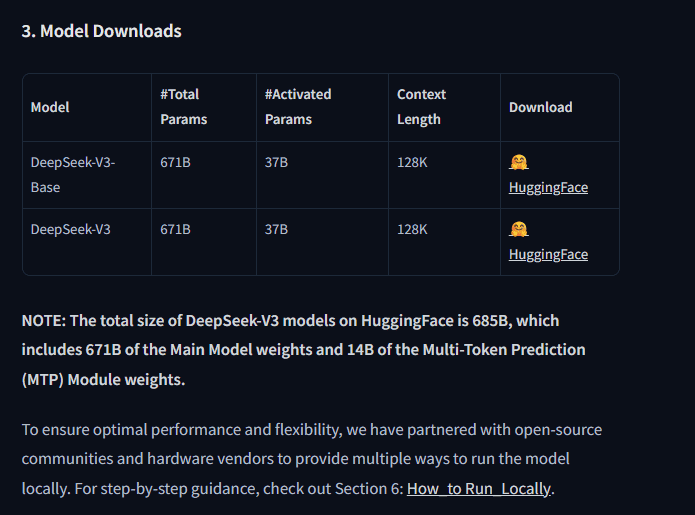
These figures are not competing estimates of the same quantity. They count different parts of the release.
Training tokens are not model parameters
The original V3 was pretrained on 14.8 trillion tokens. V3.1-Base then received roughly 840 billion additional tokens of continued long-context training: 630B tokens in a 32K extension phase and 209B tokens in a 128K phase.
Those 840B tokens are training examples processed by the model. They do not increase the model from 671B to 840B parameters. V3.1 remains a 671B main model with approximately 37B parameters activated for each token.
DeepSeek-V3-Base and DeepSeek-V3
The original DeepSeek-V3 release arrived on December 26, 2024. It established the architecture used throughout the early V3 line: 671B main-model parameters, 37B activated parameters, DeepSeekMoE, MLA, auxiliary-loss-free routing, and Multi-Token Prediction.
DeepSeek-V3-Base is the pretrained foundation. It is appropriate for researchers or organizations that want to perform custom instruction tuning, reinforcement learning, domain adaptation, or architecture analysis.
DeepSeek-V3 is the post-trained assistant checkpoint. It is the more appropriate of the two for direct conversation, instruction following, coding, and general text generation.
The original V3 line supports a 128K context in its official open-weight documentation. It is a text-input, text-output model family; it does not provide native image understanding.
What changed in DeepSeek-V3-0324?
DeepSeek-V3-0324 is a post-training update released on March 24, 2025. Its core model structure is the same as the original DeepSeek-V3, so it should not be treated as a new base architecture.
DeepSeek reported improvements in:
- General reasoning.
- Front-end code generation and executable web interfaces.
- Chinese writing and long-form style.
- Translation and rewriting.
- Search-oriented prompting.
- Function calling and tool use.
V3-0324 is also a licensing milestone. The repository and model weights were released under the MIT License, unlike the original V3 weights, which remain governed by a separate DeepSeek Model License.
Choose V3-0324 when reproducing a pre-hybrid V3 deployment that needs stronger post-training than the December 2024 release and a permissive MIT-licensed checkpoint.
DeepSeek-V3.1 introduced hybrid thinking
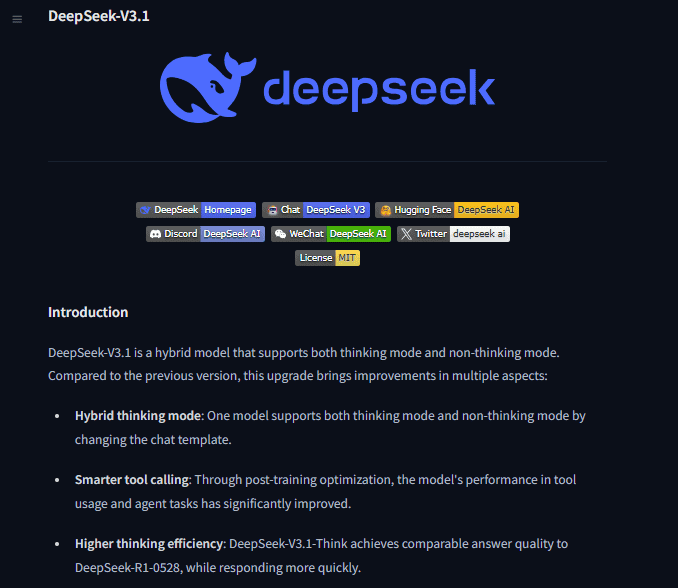
DeepSeek-V3.1 was released on August 21, 2025. It was the first V3 checkpoint designed to support both thinking and non-thinking behavior from the same model weights.
The mode is selected through the model’s chat template:
- Non-thinking mode produces a direct answer without beginning a visible reasoning segment.
- Thinking mode prompts the model to perform a longer reasoning process before producing the final response.
This is different from maintaining one general chat checkpoint and a completely separate reasoning checkpoint. V3.1 uses one post-trained model with different prompting behavior.
V3.1-Base extended long-context training
DeepSeek-V3.1-Base was developed from the original V3 base checkpoint through additional long-document training. DeepSeek expanded both the 32K and 128K training phases and updated the tokenizer and chat-template resources.
The checkpoint retains the 671B main-model and 37B activated-parameter structure. It is useful when an organization wants a long-context V3 base model for its own post-training rather than DeepSeek’s finished assistant behavior.
V3.1 changed tool and agent behavior
The open model card documents ordinary tool calling in non-thinking mode and specialized trajectories for search-agent workflows that use reasoning. This distinction matters because a generic function-calling client may not reproduce the same behavior as DeepSeek’s hosted search framework.
Applications upgrading from V3-0324 also need to account for the updated tokenizer and chat template. Reusing an older prompt formatter can cause missing mode tokens, malformed reasoning boundaries, or incorrect tool-call output.
What is DeepSeek-V3.1-Terminus?
DeepSeek-V3.1-Terminus was released on September 22, 2025 as the final stabilization update to the V3.1 line.
It did not introduce a new base architecture. Instead, DeepSeek focused on issues reported after the original V3.1 launch:
- Reducing unexpected Chinese-English language mixing.
- Reducing abnormal or random characters.
- Improving Code Agent performance.
- Improving Search Agent behavior.
- Making outputs more stable across the published evaluations.
The model retains V3.1’s hybrid thinking design and MIT licensing. For a project that must remain on the V3.1 chat template or architecture, Terminus is generally the more mature V3.1 checkpoint to evaluate.
The official model card also documents a checkpoint-specific FP8 formatting issue involving self_attn.o_proj. Deployment teams should follow the current model and framework documentation rather than assuming that every tensor follows the same UE8M0 scaling format.
DeepSeek-V3.2-Exp introduced sparse attention
DeepSeek-V3.2-Exp was released on September 29, 2025. DeepSeek described it as an experimental step toward a more efficient architecture rather than the final stable V3.2 release.
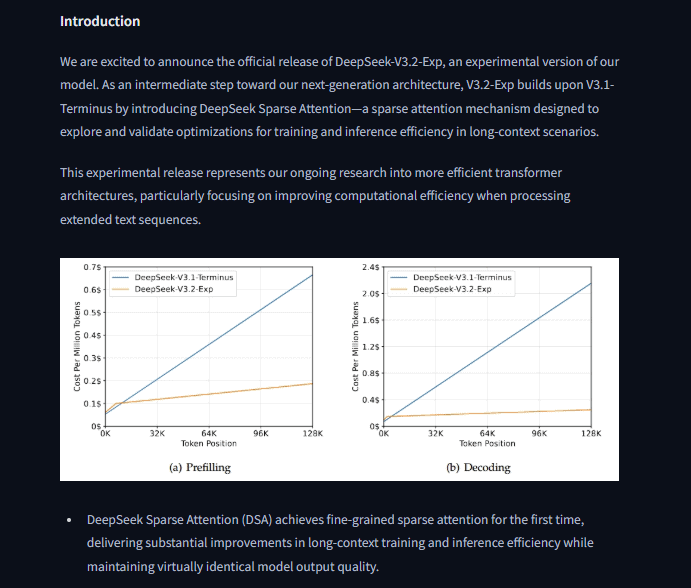
The model was developed from V3.1-Terminus and introduced DeepSeek Sparse Attention, or DSA, to reduce the cost of processing long contexts.
DeepSeek aligned the experimental model’s training setup with V3.1-Terminus so the impact of sparse attention could be evaluated without presenting every performance difference as a new capability gain. The published results showed broadly similar benchmark performance, with the intended improvement centered on long-context efficiency.
V3.2-Exp remains useful for:
- Studying DSA before the stable V3.2 post-training changes.
- Testing sparse-attention kernels.
- Reproducing DeepSeek’s experimental long-context work.
- Comparing dense MLA attention with sparse token selection.
It is not the strongest default for a new production deployment because the stable V3.2 checkpoint followed it two months later.
Use the updated V3.2-Exp inference code
DeepSeek reported in November 2025 that earlier inference-demo code contained a Rotary Position Embedding discrepancy in the sparse-attention indexer. The implementation was corrected.
Anyone reproducing V3.2-Exp should use the current repository revision rather than copying an older inference script from an archived tutorial.
How DeepSeek Sparse Attention works
Conventional full attention allows each query token to consider every earlier token. As the context grows, that becomes increasingly expensive in computation and memory movement.
DSA adds a lightweight indexer that scores earlier tokens and selects a smaller, relevant subset for the main attention calculation. The model does not simply use a fixed sliding window; the selected tokens depend on the current query and the learned indexer.
The practical goal is to retain useful long-range information while avoiding full attention over the complete history at every layer and token position.
DSA should not be interpreted as an automatic intelligence upgrade. Its direct purpose is long-context efficiency. Output quality still depends on pretraining, post-training, prompt structure, inference settings, and the task.
DeepSeek-V3.2 became the stable agent model
DeepSeek-V3.2 was released on December 1, 2025 as the official successor to V3.2-Exp. It retains the sparse-attention structure while adding substantially more post-training for reasoning and agent workflows.
DeepSeek highlighted three major components:
- DeepSeek Sparse Attention for long-context efficiency.
- A scaled reinforcement-learning framework for stronger reasoning.
- A large agent-task synthesis pipeline covering tool use and complex interactive environments.
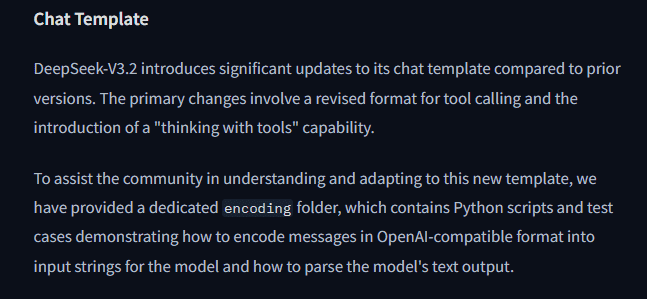
The most important behavioral change is thinking during tool use. Earlier hybrid releases could reason and use tools, but V3.2 was the first V3 model DeepSeek described as integrating reasoning directly across tool interactions.
The standard V3.2 checkpoint supports:
- Thinking mode.
- Non-thinking mode.
- Tool calls in non-thinking mode.
- Tool calls while maintaining a thinking workflow.
- Agent-oriented search and coding tasks.
The V3.2 chat format differs from previous versions. The official repository supplies dedicated encoding and parsing code rather than a normal Jinja chat template. DeepSeek also warns that the included parser expects well-formed output and is not production-safe without additional recovery and validation logic.
V3.2 introduces a developer role for specific search-agent scenarios in its self-hosted encoding format. DeepSeek’s official hosted API did not accept that role during the V3.2 service period, so local prompt construction and historical API behavior were not identical.
What is DeepSeek-V3.2-Speciale?
DeepSeek-V3.2-Speciale is the high-compute reasoning variant released alongside standard V3.2.
It is designed for difficult mathematical, scientific, and competitive-programming tasks where the user is willing to accept longer reasoning traces, higher output-token consumption, and greater latency.
Speciale is not simply “V3.2 with every feature improved.” The official model card states that it does not support tool calling. Standard V3.2 is therefore the more suitable model for agents, search workflows, coding tools, and applications that need external actions.
At launch, Speciale was available through a temporary official API endpoint that expired on December 15, 2025. Its open weights remain available, but the temporary hosted endpoint should not appear in current application code.
Thinking, non-thinking, and tool support by version
| Model | Thinking mode | Non-thinking mode | Tool-use position |
|---|---|---|---|
| DeepSeek-V3 | No dedicated hybrid mode | Yes | General assistant and function-oriented prompting |
| DeepSeek-V3-0324 | No dedicated hybrid mode | Yes | Improved function calling and tool use |
| DeepSeek-V3.1 | Yes | Yes | General tool calls documented for non-thinking mode; specialized reasoning search trajectories also provided |
| DeepSeek-V3.1-Terminus | Yes | Yes | Retains V3.1 modes with improved code and search agents |
| DeepSeek-V3.2-Exp | Yes | Yes | Experimental sparse-attention successor using the V3.1-style access pattern |
| DeepSeek-V3.2 | Yes | Yes | Supports tool use in both modes, including thinking through tool interactions |
| DeepSeek-V3.2-Speciale | Yes | Not its intended role | Tool calling is not supported |
Self-hosted behavior depends on using the correct tokenizer, chat encoder, parser, and mode-selection logic for the selected checkpoint. A runtime that can load the weight files does not automatically reproduce the official prompt format or tool behavior.
Are DeepSeek V3 models still available through the official API?
No V3-family model is currently listed in DeepSeek’s official API model catalog. The current list exposes deepseek-flash, which maps to the V4.1 Flash line, and deepseek-v4-pro.
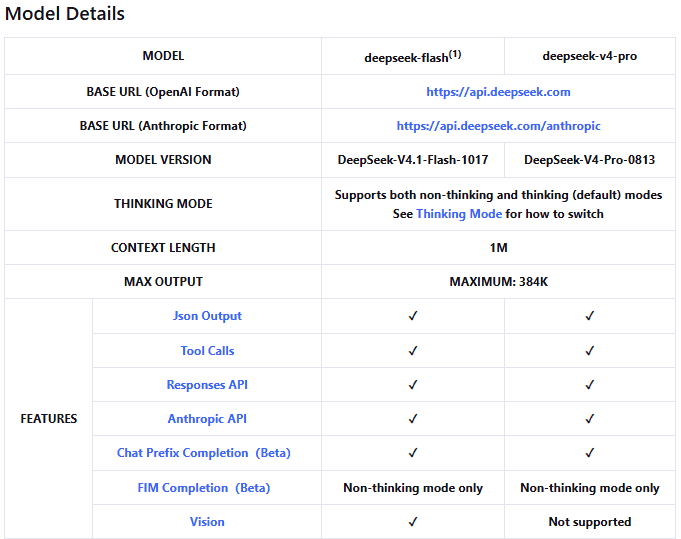
Historical V3 API names changed their underlying model several times:
deepseek-chatoriginally routed to a non-reasoning V3 assistant.- It was updated to V3-0324 in March 2025.
- During V3.1, Terminus, V3.2-Exp, and V3.2, it represented the non-thinking mode of the current release.
deepseek-reasonerrepresented the corresponding thinking mode after the hybrid model transition.- When V4 launched in April 2026, both legacy aliases temporarily routed to V4-Flash.
- DeepSeek discontinued the legacy aliases on July 24, 2026.
API aliases should therefore never be treated as permanent model names. An old statement such as “deepseek-chat is V3.2” was true during a particular release period, but it is not a current API instruction.
Check the live DeepSeek API model list before writing application code or estimating current capabilities.
Open weights remain available after API retirement
Hosted retirement does not remove the official model weights. The major V3 checkpoints listed in this article remain available through DeepSeek’s verified Hugging Face organization.
This means a developer can still:
- Download an official V3 checkpoint.
- Run it on self-managed infrastructure.
- Reproduce historical research.
- Fine-tune or adapt permitted releases.
- Maintain an application that depends on a fixed V3 checkpoint.
- Compare V3 behavior with newer model generations.
A third-party provider may also continue hosting a V3 model. That does not make the provider an official DeepSeek API, and the provider may use a different precision, quantization, context limit, prompt format, or checkpoint revision.
DeepSeek V3 vs. DeepSeek R1
DeepSeek-R1 and R1-Zero were developed from the DeepSeek-V3 base architecture, but they are not V3.x releases.
| Category | DeepSeek V3 line | DeepSeek R1 line |
|---|---|---|
| Starting point | Original V3 base and its later continuations | Reasoning-focused post-training built from V3-Base |
| Original goal | General assistant, coding, writing, and tool use | Long-form reasoning and reinforcement-learning research |
| Reasoning evolution | Hybrid thinking added in V3.1 and expanded in V3.2 | Reasoning is the defining purpose of the branch |
| Model naming | V3, V3.1, V3.2 | R1, R1-Zero, R1 revisions, and distilled models |
| Family membership | Members of the V3 lineage | Related branch, not part of the V3.x naming sequence |
V3-0324 incorporated reasoning-oriented improvements associated with DeepSeek’s R1 work, and V3.1 later brought thinking directly into the V3 line. That technical exchange does not make R1 and V3 the same checkpoint.
DeepSeek V3 vs. DeepSeek V4
DeepSeek-V4 is the successor generation to V3. It is not another V3-family checkpoint.
The V4 generation introduced a different long-context architecture, a 1-million-token service context, new hosted model identities, and later a V4.1 Flash model with native visual understanding. DeepSeek’s official web app and API have moved to that newer generation.
V3 remains relevant when a project needs:
- A fixed open checkpoint for reproducibility.
- Compatibility with an existing V3 integration.
- Research into MLA, DeepSeekMoE, MTP, or DSA.
- The V3.2 agentic chat format.
- A specific V3 license or deployment stack.
- Comparisons against the original DeepSeek architecture.
A new application that wants DeepSeek’s current hosted performance, native image input, or current API support should evaluate the V4-generation models instead of assuming that V3.2 is still the official service default.
Context length and input modalities
The official V3 and V3.1 model cards describe 128K-class context support. Later V3.2 configuration files may expose a larger internal maximum-position value, while provider-facing limits and output limits can differ.
For deployment planning, verify four separate values:
- The checkpoint’s configured maximum positions.
- The runtime’s supported context length.
- The provider’s input limit.
- The provider’s maximum generated output.
A large configured context does not mean the entire window is economical to use. KV-cache memory, attention implementation, concurrency, and output length all affect the practical limit.
The V3-family checkpoints are text models. File upload, PDF handling, or webpage processing in an application normally requires external extraction or preprocessing before text is passed to the model. Native image understanding belongs to later DeepSeek model lines rather than the V3 checkpoints described here.
Can the DeepSeek V3 family run locally?
The official weights can be self-hosted, but “locally” should not be confused with “on a normal laptop.” The full V3-family checkpoints are extremely large sparse MoE models.
DeepSeek and framework maintainers document deployment routes involving technologies such as:
- DeepSeek’s reference inference code.
- SGLang.
- vLLM.
- Hugging Face Transformers.
- TensorRT-LLM.
- Multi-GPU tensor, pipeline, data, or expert parallelism.
The correct infrastructure depends on the exact checkpoint, numerical precision, context length, batch size, framework, and parallelism strategy. Activated parameters alone cannot be used to calculate the hardware requirement.
Community GGUF, AWQ, GPTQ, NVFP4, or other quantized conversions may reduce storage and memory requirements, but they are not the official DeepSeek weight packages unless DeepSeek is the publisher. Quantization can also affect output quality, reasoning behavior, and framework compatibility.
For an ordinary desktop or laptop, a smaller DeepSeek-R1 distilled model is more realistic than any full V3-family checkpoint. Those distilled models are separate from the V3 family and should not be labeled “DeepSeek V3 8B” or “V3 32B.”
DeepSeek V3 family licenses
The V3 family does not use one universal license across every historical checkpoint.
| Checkpoint | Repository code | Model weights |
|---|---|---|
| Original DeepSeek-V3-Base and DeepSeek-V3 | MIT License | DeepSeek Model License with use-based restrictions |
| DeepSeek-V3-0324 | MIT License | MIT License |
| DeepSeek-V3.1-Base and V3.1 | MIT License | MIT License |
| DeepSeek-V3.1-Terminus | MIT License | MIT License |
| DeepSeek-V3.2-Exp-Base and V3.2-Exp | MIT License | MIT License |
| DeepSeek-V3.2 and V3.2-Speciale | MIT License | MIT License |
The original V3 model license permits commercial use, modification, derivatives, redistribution, and hosted access, but it also contains use-based restrictions and downstream notice obligations. It should not be treated as identical to MIT.
Later MIT releases generally provide broader permissive rights, subject to preserving the required copyright and permission notice. Organizations should still review the exact checkpoint license, dependencies, deployment framework, and applicable laws before commercial use. This article is not legal advice.
Which DeepSeek V3 model should you use?
| Your goal | Best V3 starting point | Why |
|---|---|---|
| Study the original architecture | DeepSeek-V3-Base | It is the original pretrained foundation |
| Reproduce the December 2024 assistant | DeepSeek-V3 | It preserves the initial post-trained release |
| Use the strongest pre-hybrid V3 update | DeepSeek-V3-0324 | It improves reasoning, coding, and tool use without changing the core structure |
| Perform custom long-context post-training | DeepSeek-V3.1-Base | It contains the extended long-context pretraining without the final assistant tuning |
| Use one checkpoint for thinking and direct answers | DeepSeek-V3.1 | It introduced hybrid thinking and non-thinking modes |
| Maintain a mature V3.1 integration | DeepSeek-V3.1-Terminus | It corrects language issues and improves agent behavior |
| Research sparse attention | DeepSeek-V3.2-Exp | It isolates the experimental DSA transition more clearly |
| Deploy the most complete stable V3 agent model | DeepSeek-V3.2 | It combines DSA, reasoning, and thinking during tool use |
| Prioritize difficult reasoning without tools | DeepSeek-V3.2-Speciale | It allocates more inference effort to complex reasoning |
| Build on the current official DeepSeek API | Use a current V4-generation model | V3 is no longer listed in the official API catalog |
| Run DeepSeek on consumer hardware | Use a smaller distilled model outside the V3 family | The full V3 checkpoints require server-class infrastructure |
For most current V3-specific projects, DeepSeek-V3.2 is the strongest general starting point because it is the final stable V3 release, supports both response modes, and adds thinking during tool use. Choose an older version only when its architecture, prompt format, license, or historical behavior is part of the requirement.
Official sources checked
- DeepSeek Transparency Center
- DeepSeek Research & News index
- Original DeepSeek-V3 model card
- DeepSeek-V3-0324 model card
- DeepSeek-V3.1 model card
- DeepSeek-V3.1-Terminus model card
- DeepSeek-V3.2-Exp model card
- DeepSeek-V3.2 model card and technical report
- DeepSeek-V3.2-Speciale model card
- DeepSeek API change log
- Current DeepSeek API model list
- Current DeepSeek-V4.1-Flash announcement
Model availability, API status, licenses, and official documentation checked on November 6, 2026.