

Published: November 7, 2026.
DeepSeek R1 is DeepSeek’s first-generation reasoning-model family, built from DeepSeek-V3-Base and post-trained to spend more computation on multi-step problems in mathematics, coding, science, and logic. The original DeepSeek-R1 and the research-focused R1-Zero were released on January 20, 2025.
As of November 6, 2026, the latest official R1-specific full checkpoint is DeepSeek-R1-0528, released on May 28, 2025. Its official weights remain available for downloading and self-hosting, along with a smaller official model named DeepSeek-R1-0528-Qwen3-8B.
R1 is no longer a current model in DeepSeek’s official hosted API. The historical deepseek-reasoner model name was retired on July 24, 2026, and the current API lists V4-generation models instead. DeepSeek’s web and app products have also moved to newer models, so the DeepThink interface label should not be treated as a permanent synonym for R1.
Use DeepSeek-R1-0528 when you specifically need the most recent full R1 checkpoint. For ordinary local hardware, an official distilled model such as DeepSeek-R1-0528-Qwen3-8B is far more realistic. For a new hosted application, follow DeepSeek’s current API model list rather than an old R1 tutorial.
What is DeepSeek R1?
DeepSeek R1 is a text-based large language model designed to solve problems that benefit from extended reasoning. Instead of immediately producing a short answer, it can generate a longer sequence of intermediate steps, evaluate possible approaches, correct mistakes, and then return a final response.
The model was developed from DeepSeek-V3-Base. It therefore inherits the large Mixture-of-Experts architecture used by DeepSeek-V3, but its defining difference is its reasoning-focused post-training process.
DeepSeek’s peer-reviewed R1 research paper was published in Nature in September 2025. The paper describes how reinforcement learning encouraged behaviors such as self-verification, reflection, and exploration of alternative solution paths.
R1 is best suited to tasks where working through several dependent steps can improve the answer. It is not automatically the best choice for every prompt: a short factual question, simple rewrite, classification task, or high-volume low-latency workflow may be handled more efficiently by a non-reasoning model.
DeepSeek R1 versions and release timeline
The term “DeepSeek R1” may refer to several related but different releases. Keeping them separate prevents common mistakes involving benchmarks, hardware, prompting, and API availability.
| Release | Date | What it is | Current role |
|---|---|---|---|
| DeepSeek-R1-Lite-Preview | November 20, 2024 | A web-only reasoning preview that preceded the formal release | Historical preview; no official downloadable weights were announced at launch |
| DeepSeek-R1-Zero | January 20, 2025 | A research model post-trained with reinforcement learning without preliminary SFT | Useful for studying emergent reasoning behavior |
| DeepSeek-R1 | January 20, 2025 | The original user-oriented R1 model with a multi-stage training pipeline | Historical full checkpoint with public weights |
| Six R1-Distill models | January 20, 2025 | Smaller dense Qwen- and Llama-based models trained on R1-generated data | More practical than full R1 for local deployment |
| DeepSeek-R1-0528 | May 28, 2025 | A post-training update to the full R1 model | Latest verified full R1-specific checkpoint |
| DeepSeek-R1-0528-Qwen3-8B | May 28, 2025 | An official dense 8B model based on Qwen3-8B and post-trained with R1-0528 reasoning data | Most practical recent official R1-related model for smaller deployments |
No later official R1-specific checkpoint or officially released DeepSeek-R2 was identified in DeepSeek’s current Research & News index. Later DeepSeek models gained reasoning modes, but they should not be renamed R1 revisions unless DeepSeek explicitly releases them under that model line.
R1-Zero vs. R1 vs. R1-0528
| Category | R1-Zero | Original R1 | R1-0528 |
|---|---|---|---|
| Starting model | DeepSeek-V3-Base | DeepSeek-V3-Base | Same underlying R1/V3 architecture |
| Primary purpose | Research into reasoning learned through RL | Readable, user-aligned reasoning | Improved reasoning, coding, tools, and output control |
| Preliminary SFT before reasoning RL | No, during the R1-Zero post-training experiment | Yes, using cold-start reasoning data | Built through additional post-training optimization |
| Readability | Known issues with repetition and language mixing | Improved through SFT and alignment stages | Further improved, according to DeepSeek |
| System prompt guidance | Research-oriented | Original guidance recommended avoiding a system prompt | System prompts are officially supported |
Forcing <think> | Uses structured reasoning during training | Original guidance recommended forcing a thinking start in some deployments | No longer required by the official model card |
| JSON and function calling | Not its intended role | Not a primary documented capability at launch | Added and evaluated by DeepSeek |
| Best audience | AI researchers | Reproduction and original-R1 users | Users needing the most recent full R1 checkpoint |
R1-0528 is described by DeepSeek as a minor version upgrade, not a completely new base architecture. The main changes came from additional inference-time compute and post-training optimizations rather than replacing the underlying Mixture-of-Experts model.
Why DeepSeek R1 is called a reasoning model
A conventional instruction model often attempts to answer immediately. A reasoning model is trained to allocate more generated tokens to exploring the problem before settling on its final response.
During R1 development, DeepSeek rewarded correct results on verifiable tasks such as mathematics and programming. The model learned behaviors that included checking earlier steps, reconsidering an approach, trying alternatives, and increasing its response length for more difficult problems.
This behavior can improve performance on complex tasks, but it has costs. Longer reasoning increases latency and output-token consumption, and a long answer can still contain a flawed assumption or an incorrect final conclusion.
Visible reasoning is generated text, not a guaranteed explanation
Self-hosted R1 templates may expose a reasoning section inside <think> tags. Hosted providers may expose a separate reasoning field, summarize it, transform it, or hide it.
The visible trace should not be treated as a complete or perfectly faithful record of every internal computation. It is model-generated text and can contain omissions, post-hoc explanations, or mistakes even when the final answer is correct.
Applications should therefore validate the final result rather than treating the reasoning trace as proof. They should also avoid depending on hidden reasoning fields as a permanent API contract.
How DeepSeek R1 was trained
R1 was not trained through one reinforcement-learning step. The final model used a multi-stage pipeline combining supervised fine-tuning, reinforcement learning, rejection sampling, reasoning data, non-reasoning data, and human-preference alignment.
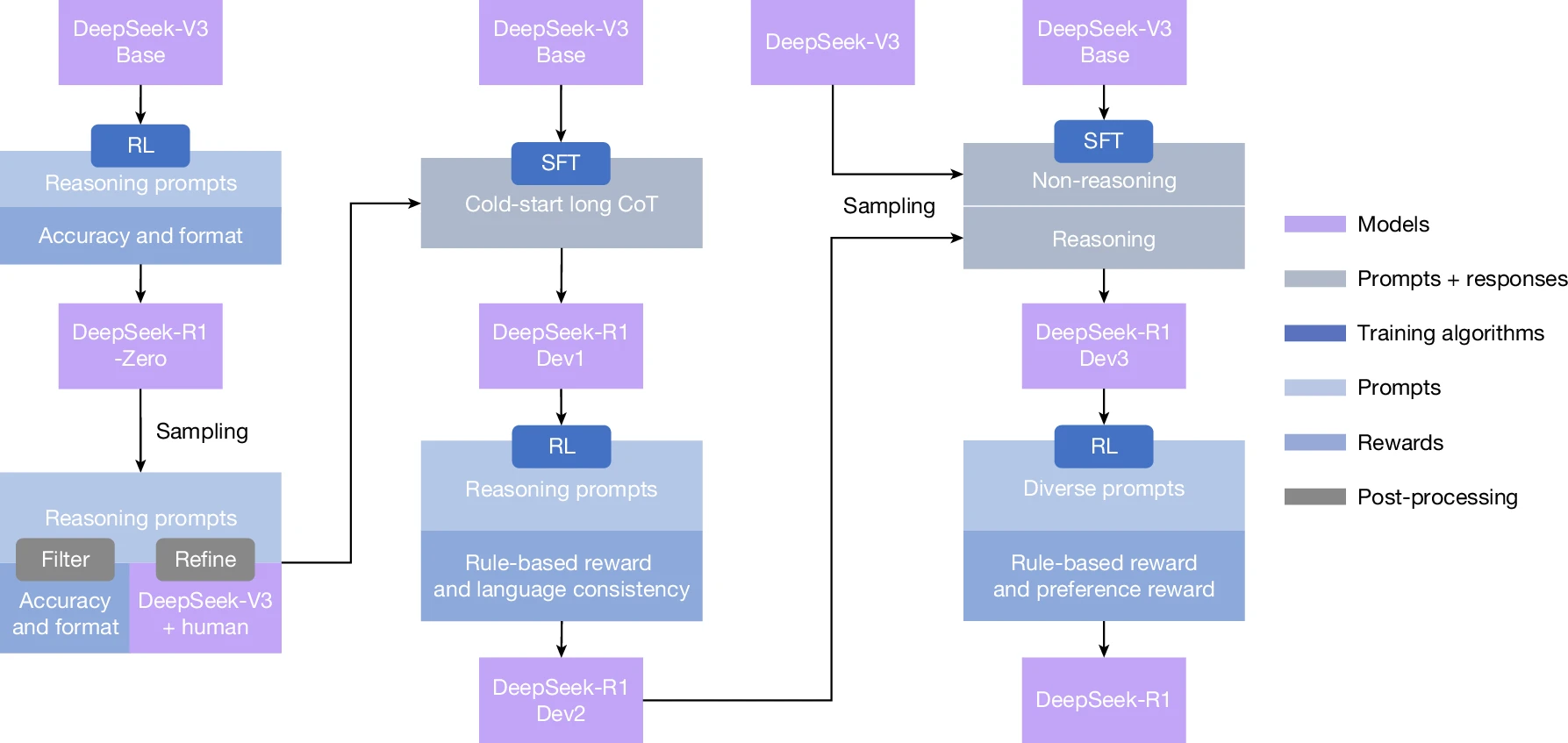
1. Start from DeepSeek-V3-Base
Both R1-Zero and R1 start from the pretrained DeepSeek-V3-Base model. This distinction matters because the base model had already learned language, code, mathematics, and general knowledge during pretraining.
When DeepSeek says R1-Zero was trained without preliminary supervised fine-tuning, it refers to the reasoning-model post-training experiment. It does not mean the underlying base model was created from random weights using reinforcement learning alone.
2. Train R1-Zero with GRPO and verifiable rewards
DeepSeek used Group Relative Policy Optimization, or GRPO. For each prompt, the training process generates a group of candidate answers, scores them, and improves the model based on how each answer performs relative to the group.
GRPO avoids the separate value model typically used in PPO-style reinforcement learning. DeepSeek used rule-based accuracy rewards for tasks with verifiable answers, such as numerical results or code that can be checked against tests, plus format rewards for the required response structure.
R1-Zero demonstrated that reasoning behaviors could emerge during this RL stage. It also exposed practical weaknesses: repetitive passages, difficult-to-read reasoning, Chinese-English mixing, and weaker performance on ordinary writing or open-domain tasks.
3. Add cold-start reasoning examples
For the final R1 pipeline, DeepSeek collected thousands of higher-quality reasoning examples. These examples were designed to make the reasoning more conversational, readable, consistently formatted, and aligned with the language used in the question.
The model was first fine-tuned on this cold-start data before the first R1 reinforcement-learning stage. This gave the training process a more usable starting behavior than R1-Zero’s raw reasoning style.
4. Apply reasoning-oriented reinforcement learning
The first R1 RL stage continued to reward correct reasoning outcomes while adding a language-consistency reward. DeepSeek reported that this improved readability and reduced language mixing, although the paper also notes that alignment constraints can create small tradeoffs on some benchmarks.
5. Use rejection sampling and mixed supervised data
DeepSeek generated multiple reasoning trajectories and retained outputs that reached correct answers and passed quality filters. The revised paper describes approximately 600,000 reasoning samples, combined with about 200,000 non-reasoning examples covering tasks such as writing, factual questions, translation, and software engineering.
This mixed dataset was used for another supervised fine-tuning stage. Its purpose was to preserve complex reasoning while restoring strong general-assistant behavior.
6. Run a second reinforcement-learning stage
The final RL stage combined verifiable reasoning rewards with model-based helpfulness and safety rewards. This stage attempted to improve reasoning while making the model more useful and better aligned with human preferences.
The resulting model is therefore not “pure RL from beginning to end.” That description applies only to the specific R1-Zero post-training experiment, not to the final DeepSeek-R1 pipeline.
DeepSeek R1 architecture and parameter counts
The official DeepSeek-R1 repository lists both R1-Zero and the original R1 as models with 671 billion parameters in the main network and approximately 37 billion parameters activated for each token.
| Specification | What it means |
|---|---|
| 671B main-model parameters | The total parameters in the main DeepSeek-V3-based language model |
| 37B activated per token | The approximate subset used to process an individual token |
| Approximately 14B MTP module | Additional Multi-Token Prediction weights included in the distributed package |
| Approximately 685B packaged parameters | The main model plus the additional MTP module |
| 128K documented context | The context length listed for the original R1 and R1-Zero release |
| Text input and output | R1 is not a native image-understanding model |
Why 37B active parameters does not make R1 a 37B model
R1 uses a sparse Mixture-of-Experts architecture. Different tokens can be routed to different experts, so only part of the model performs computation for a particular token.
The serving system still needs access to the wider set of experts because future tokens may be sent to different parts of the model. The 37B active figure therefore does not equal the download size, total memory requirement, or dense-model equivalent.
Multi-head Latent Attention
Multi-head Latent Attention, or MLA, compresses key-value representations used during attention. Its practical purpose is to reduce the KV-cache burden compared with storing full representations for every attention head.
This improves long-context efficiency, but a long context still consumes substantial memory. A documented 128K window does not mean every self-hosted deployment can allocate that context economically.
Multi-Token Prediction
The Multi-Token Prediction module trains the model to predict additional future tokens. It can support speculative decoding, where drafted tokens are checked by the main model to improve generation efficiency.
This separate module explains why some sources report approximately 685B parameters while DeepSeek describes the main model as 671B. The figures count different portions of the same distributed package.
What changed in DeepSeek-R1-0528?
DeepSeek-R1-0528 is a post-training upgrade to the original full model. DeepSeek reported stronger performance on difficult math, programming, and general reasoning tasks, along with reduced hallucinations, improved front-end code generation, JSON output, and function calling.
The model was also trained to spend more tokens on difficult problems. In DeepSeek’s AIME evaluation, the average response increased from about 12,000 tokens for the previous R1 version to about 23,000 tokens for R1-0528.
That additional inference effort is not free. It can improve performance on difficult problems while increasing latency and token usage.
Author-reported benchmark changes
The following figures come from the official R1-0528 model card. DeepSeek used a maximum generation length of 64K tokens, temperature 0.6, top-p 0.95, and 16 sampled responses for benchmarks requiring sampling.
| Benchmark | Original R1 | R1-0528 | Metric |
|---|---|---|---|
| GPQA Diamond | 71.5 | 81.0 | Pass@1 |
| AIME 2025 | 70.0 | 87.5 | Pass@1 |
| LiveCodeBench, August 2024–May 2025 | 63.5 | 73.3 | Pass@1 |
| Aider Polyglot | 53.3 | 71.6 | Accuracy |
| SimpleQA | 30.1 | 27.8 | Correct answers |
The table shows why “R1-0528 improved everything” would be inaccurate. The model produced substantial gains on several reasoning and coding evaluations, but its author-reported SimpleQA result was lower.
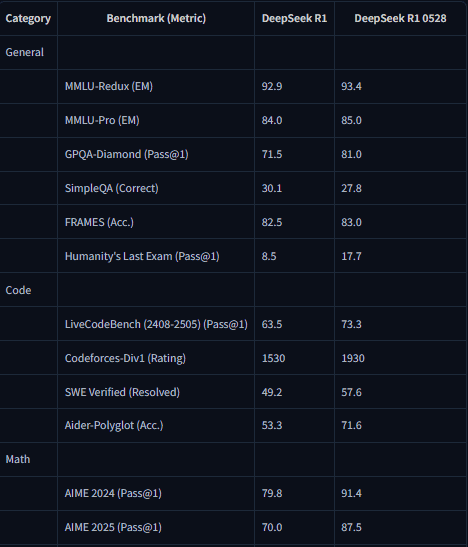
These are benchmark results under specific sampling and token settings. They do not guarantee the same accuracy on a user’s codebase, research question, legal document, financial analysis, or scientific problem.
DeepSeek R1 distilled models
DeepSeek released smaller dense models so developers could access some R1-style reasoning behavior without deploying the 671B Mixture-of-Experts model.
These are not compressed copies of full R1. Each model starts from a separate Qwen or Llama base model and is fine-tuned on reasoning examples generated by R1.
| Official model | Base architecture | Reasoning source | Practical position |
|---|---|---|---|
| DeepSeek-R1-Distill-Qwen-1.5B | Qwen2.5-Math-1.5B | Original R1 | Smallest official R1 distill |
| DeepSeek-R1-Distill-Qwen-7B | Qwen2.5-Math-7B | Original R1 | Entry-level local reasoning model |
| DeepSeek-R1-Distill-Llama-8B | Llama 3.1 8B Base | Original R1 | Small Llama-based alternative |
| DeepSeek-R1-Distill-Qwen-14B | Qwen2.5 14B | Original R1 | Middle ground between size and quality |
| DeepSeek-R1-Distill-Qwen-32B | Qwen2.5 32B | Original R1 | Stronger model requiring more capable hardware |
| DeepSeek-R1-Distill-Llama-70B | Llama 3.3 70B Instruct | Original R1 | Workstation- or server-oriented dense model |
| DeepSeek-R1-0528-Qwen3-8B | Qwen3 8B Base | R1-0528 | Recent official 8B option for local and smaller deployments |
Distillation is different from quantization
Distillation transfers behavior from a larger teacher model into a smaller base model through additional training. The resulting model has a different architecture and parameter count from the teacher.
Quantization stores an existing model’s weights at lower numerical precision. A quantized 8B model remains an 8B model, while an R1-distilled 8B model is a separately trained checkpoint rather than the full R1 model reduced to eight billion parameters.
Many GGUF, AWQ, GPTQ, MLX, and other low-precision R1 packages are created by community publishers. They may be useful, but they must not be described as official DeepSeek weights unless DeepSeek is the verified publisher.
Is DeepSeek R1 still available?
R1 remains available as downloadable open weights, but its status differs across each access method.
| Access method | Current R1 status | What to know |
|---|---|---|
| Official Hugging Face account | Available | R1-Zero, R1, R1-0528, and the official distills remain downloadable |
| Official GitHub repository | Available | Contains the paper, model links, license, evaluation details, and usage guidance |
| DeepSeek web and app | Superseded | The current web and app model was updated to V4.1-Flash-1017 |
| Official DeepSeek API | Not currently listed | The current catalog lists deepseek-flash and deepseek-v4-pro |
deepseek-reasoner | Retired | The legacy alias became inaccessible after July 24, 2026 |
| Third-party APIs | Provider-dependent | A provider may host R1, but it is not the official DeepSeek API |
| Self-hosted endpoint | Available | You operate the weights and serving framework on your own infrastructure |
The official DeepSeek API model and pricing page should be treated as the current source of truth for hosted model names. It currently lists V4-generation offerings, not an R1 endpoint.
The deepseek-reasoner name did not always mean R1
At the January 2025 launch, deepseek-reasoner selected the original R1 model. On May 28, 2025, the same alias was upgraded to R1-0528.
DeepSeek later reassigned the alias to the thinking modes of V3.1, V3.1-Terminus, V3.2-Exp, and V3.2. In April 2026 it temporarily routed to the thinking mode of V4-Flash before being fully retired on July 24, 2026.
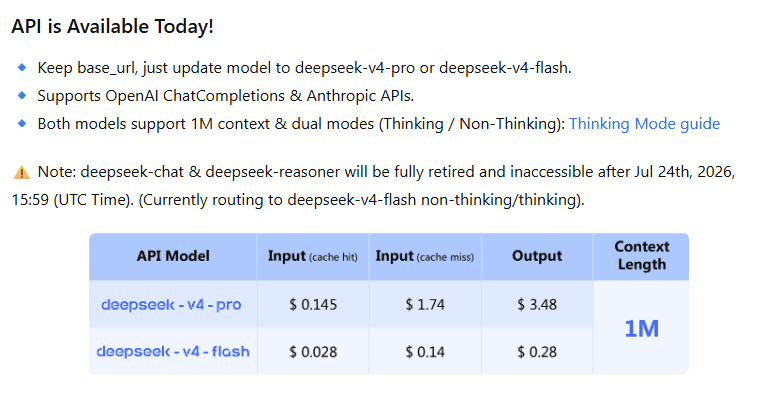
This history demonstrates why an API alias should not be treated as a permanent checkpoint name. Always verify its current mapping through the official DeepSeek API changelog.
DeepThink is a feature name, not a permanent model ID
At R1’s launch, users accessed the model through the DeepThink option in DeepSeek Chat. The interface label remained useful as DeepSeek introduced later reasoning-capable models.
DeepSeek stated in October 2026 that its official web and app models had been updated to DeepSeek-V4.1-Flash-1017. Therefore, selecting a current thinking or DeepThink mode should not be described as selecting R1 unless the product explicitly identifies that checkpoint.
Can DeepSeek R1 run locally?
Yes, but the answer changes completely depending on whether “R1” means the full model or an official distilled model.
Full R1 is a server-class model
The official DeepSeek-R1-0528 repository is approximately 689 GB before runtime memory, KV cache, temporary buffers, and parallel-serving overhead are considered.
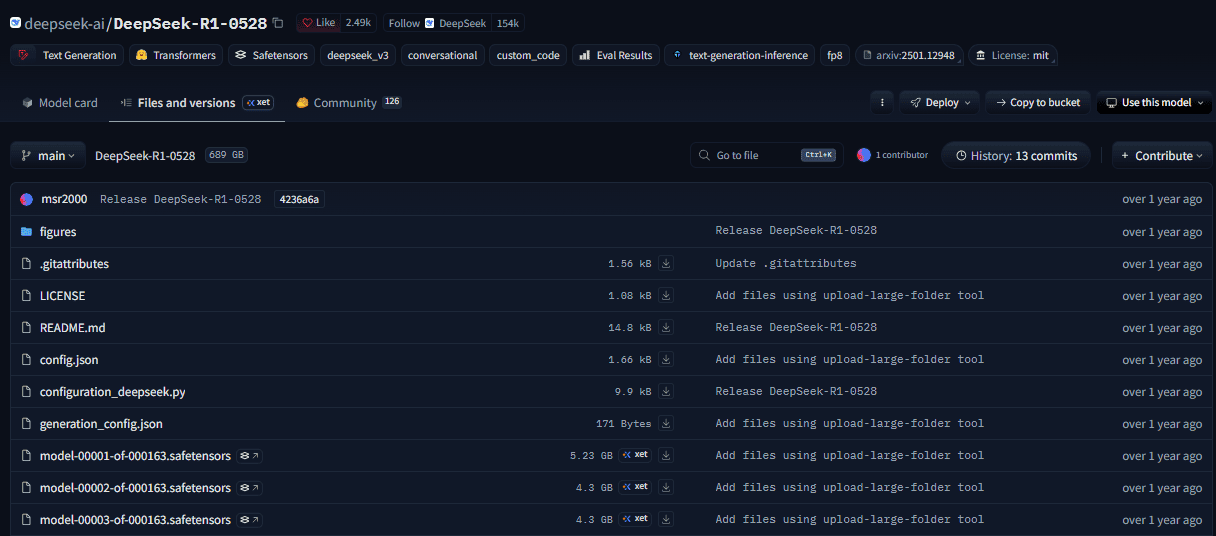
Deploying it normally requires specialized multi-GPU or distributed infrastructure. The fact that only 37B parameters are activated per token does not make the full checkpoint suitable for a typical 37B-model setup.
Current model pages expose integration routes for frameworks such as Transformers, vLLM, and SGLang. Production deployment still requires checking support for the exact model revision, numerical format, tensor or expert parallelism, context length, and serving configuration.
The official 8B model is the realistic recent option
The official DeepSeek-R1-0528-Qwen3-8B repository is approximately 16.4 GB in its published high-precision form. It uses the Qwen3-8B architecture and DeepSeek’s R1-0528 tokenizer configuration.
A reputable quantized conversion may reduce storage and memory use further, but the exact requirement depends on the quantization, runtime, context length, KV cache, batch size, and GPU offloading. Download size alone is not an exact RAM or VRAM requirement.
Local does not automatically mean private
Self-hosting can keep prompts and outputs within infrastructure you control, but privacy still depends on the runtime, logs, chat-history storage, network bindings, plugins, connected tools, and optional cloud features.
A local server should remain bound to the loopback address unless network access is required. Do not expose an unauthenticated R1 endpoint directly to the public internet.
Is DeepSeek R1 open source and free to use?
DeepSeek describes R1 as open source. The official repository and R1 model weights use the MIT License, and DeepSeek states that the series supports commercial use, modification, derivative works, and distillation.
The MIT License requires its copyright and permission notice to remain in copies or substantial portions. It also provides the software and model without warranty.
Distilled checkpoints require an additional base-model review:
- The Qwen2.5-based distills originate from models licensed under Apache 2.0.
- The Llama-based distills are connected to the applicable Llama 3.1 or Llama 3.3 license.
- DeepSeek-R1-0528-Qwen3-8B uses the Qwen3-8B architecture, whose upstream model is licensed under Apache 2.0.
- Community conversions may add separate packaging, attribution, or distribution considerations.
Running the model on your own hardware does not create a per-token DeepSeek API charge. It still creates infrastructure, electricity, storage, maintenance, and engineering costs.
From a strict reproducibility perspective, “open weights” is the more precise description of what is guaranteed by the public release. The weights, model code, inference resources, research paper, and selected data samples are public, but DeepSeek’s complete internal training infrastructure and full training corpus are not reproduced in the released package.
This section provides general information rather than legal advice. Organizations redistributing or commercially deploying a checkpoint should review the exact model, base-model, runtime, and dependency licenses with qualified counsel.
How much did DeepSeek R1 cost to train?
The widely repeated claim that “R1 was trained for about $5.6 million” mixes different stages of DeepSeek’s model development. That figure is derived from the reported DeepSeek-V3 base-model pretraining compute and an assumed hourly GPU price; it is not a complete accounting of the R1 research program.
The revised R1 research paper separately reports:
| R1-related work | Reported H800 GPU-hours | Rental-equivalent estimate used in the paper |
|---|---|---|
| R1-Zero reinforcement learning | 101,000 | $202,000 |
| SFT data creation | 5,000 | $10,000 |
| Final R1 reinforcement learning | 41,000 | $82,000 |
| Total reported R1-specific work | 147,000 | $294,000 |
The dollar figures use an assumed rental rate of $2 per H800 GPU-hour. They do not represent DeepSeek’s complete organizational cost and exclude the original V3 base-model pretraining, earlier research, infrastructure ownership, salaries, unsuccessful experiments, and other development expenses.
DeepSeek R1 vs. V3 and current DeepSeek models
| Model line | Main role | Relationship to R1 | Current position |
|---|---|---|---|
| DeepSeek-V3 | General text, coding, writing, and instruction following | R1 was built from V3-Base using reasoning-focused post-training | Historical architecture and open weights |
| DeepSeek-R1 | Long-form reasoning for math, code, and complex logic | Separate reasoning branch based on V3-Base | Open weights remain available; no current official API endpoint |
| DeepSeek-V3.1 and V3.2 | Hybrid thinking, direct answers, tools, and agents | Later V3 models with reasoning modes, not new R1 revisions | Superseded for official hosted use |
| DeepSeek-V4 and V4.1 | Current hosted reasoning, agents, long context, and multimodal support | Later architecture generation, not part of R1 | Current official web, app, and API generation |
R1 remains relevant for open-weight reasoning research, reproducing 2025 results, studying RL-based post-training, generating synthetic reasoning data, and deploying a fixed model revision.
A new application that wants DeepSeek’s current hosted capabilities should use the current API catalog. A later model with a thinking mode is not automatically “R1,” even when it provides similar multi-step reasoning behavior.
Where DeepSeek R1 is most useful
- Mathematics: multi-step calculations, proofs, contest-style problems, and checking alternative approaches.
- Programming: difficult debugging, algorithm design, code explanation, and competitive-programming problems.
- Scientific reasoning: structured analysis of technical questions when the supporting facts are supplied or independently verified.
- Planning: breaking a complex objective into dependent stages and evaluating tradeoffs.
- Reasoning research: studying GRPO, reinforcement learning, chain-of-thought behavior, and model self-correction.
- Distillation: generating or studying reasoning trajectories for smaller models, subject to license and quality controls.
- Reproducible self-hosting: deploying a fixed open-weight checkpoint instead of relying on a changing API alias.
When R1 is the wrong default
- Simple factual questions: long reasoning can add latency without improving the answer.
- Short classification or extraction: a smaller direct model may be faster and cheaper.
- Native image input: R1 is a text model and does not directly understand images.
- Current hosted agents: newer DeepSeek models provide more current tool and agent support.
- Consumer deployment of full R1: the 671B checkpoint requires server-class infrastructure.
- High-volume routing: long outputs can increase compute time and serving cost.
- High-stakes decisions: reasoning-style output does not replace expert review or source verification.
DeepSeek R1 limitations
R1’s ability to generate long reasoning traces can make incorrect answers appear persuasive. A polished derivation may contain an invalid step, fabricated fact, incorrect citation, or mistaken assumption.
- Hallucinations: R1 can invent facts, sources, APIs, package names, or technical details.
- Overthinking: it may spend excessive tokens on a simple task or complicate an otherwise direct answer.
- Incorrect intermediate steps: a long solution can contain hidden contradictions or mathematical errors.
- Premature commitment: the model may select a flawed interpretation and continue building on it.
- Repetition: original R1 and especially R1-Zero can repeat phrases or reasoning loops under poor settings.
- Language consistency: R1-Zero was documented to mix languages; the final R1 pipeline reduced but did not make all language issues impossible.
- Prompt sensitivity: output changes with model revision, chat template, system prompt, temperature, and reasoning format.
- Quantization effects: a low-precision conversion can change reasoning quality and output stability.
- Provider differences: third-party services may use different revisions, context limits, quantizations, and moderation layers.
- No calibrated confidence: a confident response is not a reliable probability that the answer is correct.
Do not allow an unverified R1 response to make medical, legal, financial, tax, cybersecurity, compliance, or engineering-safety decisions. Preserve the underlying sources, validate calculations independently, and require qualified human review where an error could cause harm.
Which DeepSeek R1 model should you use?
| Your goal | Recommended starting point | Reason |
|---|---|---|
| Study reasoning learned through RL without preliminary SFT | DeepSeek-R1-Zero | It is the research checkpoint designed for that experiment |
| Reproduce the January 2025 model | DeepSeek-R1 | It preserves the original released behavior and benchmark context |
| Use the latest full R1 checkpoint | DeepSeek-R1-0528 | It is the most recent verified full R1-specific release |
| Run a recent official R1-related model on smaller hardware | DeepSeek-R1-0528-Qwen3-8B | It is an official dense 8B model trained from R1-0528 reasoning data |
| Use the smallest official R1 distill | DeepSeek-R1-Distill-Qwen-1.5B | It has the lowest parameter count in the original distill set |
| Balance local model size and stronger reasoning | An official 7B, 8B, or 14B distill | These are more practical than full R1 for consumer hardware |
| Run a larger dense reasoning model | R1-Distill-Qwen-32B or R1-Distill-Llama-70B | They offer more capacity but require substantially more infrastructure |
| Build a new application with DeepSeek’s official hosted API | Use a currently listed V4-generation model | R1 and deepseek-reasoner are no longer current official API options |
| Need native image understanding or current agent tools | Evaluate a current DeepSeek model | R1 is text-only and predates the current hosted tool stack |
DeepSeek-R1-0528 is the correct choice when the project specifically requires the latest full R1 behavior. DeepSeek-R1-0528-Qwen3-8B is the more realistic recent option for many local users, while the current V4-generation API is the correct starting point for a new hosted DeepSeek integration.
Official sources checked
- Official DeepSeek-R1 release announcement
- Official DeepSeek-R1-0528 announcement
- Official DeepSeek-R1 GitHub repository
- Official DeepSeek-R1 model card
- Official DeepSeek-R1-Zero model page
- Official DeepSeek-R1-0528 model card
- Official DeepSeek-R1-0528-Qwen3-8B model card
- Peer-reviewed DeepSeek-R1 paper in Nature
- Current DeepSeek-R1 research paper and supplementary details
- Official DeepSeek API changelog
- Current DeepSeek API model list and pricing
- Current DeepSeek-V4.1-Flash announcement
Model availability, API status, licenses, and official documentation checked on November 6, 2026.