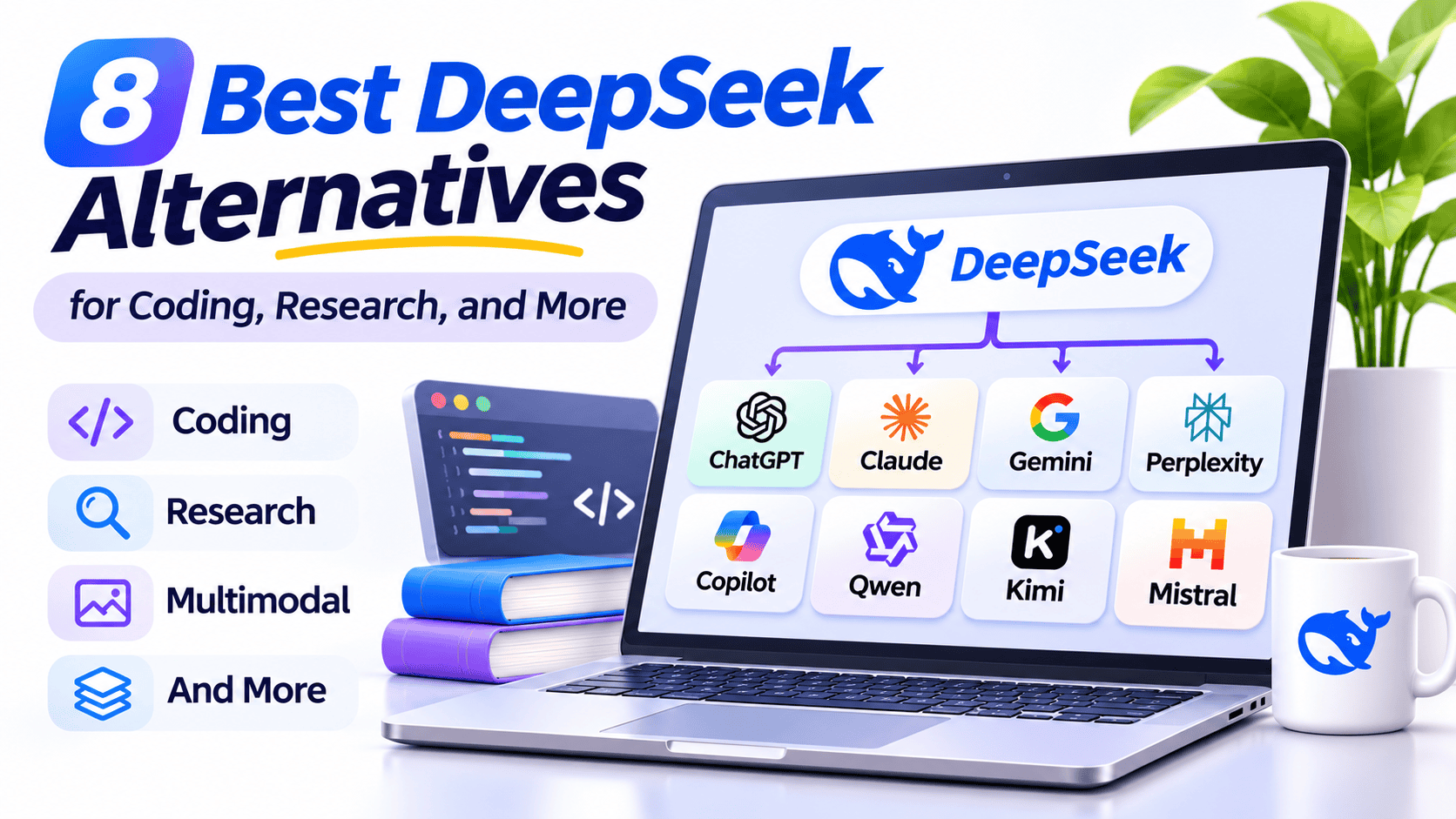

The best DeepSeek alternative depends on what you are trying to replace. ChatGPT is the strongest all-around alternative for users who want one assistant for writing, coding, research, files, images, voice, and custom workflows. Claude is a better fit for code and document-heavy knowledge work, Gemini is strongest inside Google’s ecosystem, and Perplexity is the clearest choice for source-backed web research.
Developers and local-AI users have different priorities. Qwen offers the closest combination of a free assistant, inexpensive API access, multimodal tools, and downloadable models. Kimi focuses on long-context coding and agentic work, while Mistral provides competitive APIs, open-weight models, coding tools, and private-deployment options. For maximum local control, a runtime such as LM Studio or Ollama can be paired with a suitable open-weight model, although the runtime itself is not a replacement model.
Published: November 5, 2026. AI models, free-plan limits, subscriptions, API prices, data policies, and regional availability can change.
Quick recommendations: Choose ChatGPT for the broadest general-purpose replacement, Claude for coding and polished knowledge work, Gemini for Google apps and multimodal files, Perplexity for cited research, Microsoft Copilot for Microsoft 365, Qwen for free multimodal use and attainable open models, Kimi for million-token agent workflows, and Mistral for flexible APIs and private deployment.
The best DeepSeek alternatives at a glance
| Alternative | Type | Best for | Ongoing free access | Main trade-off |
|---|---|---|---|---|
| ChatGPT | Assistant and first-party API | Best overall replacement | Yes, with limits | Closed models; API billing is separate from ChatGPT plans |
| Claude | Assistant, API, and coding agent | Coding, writing, and complex documents | Yes, with limits | No first-party image or video generation; closed weights |
| Gemini | Assistant, API, and Google Cloud platform | Google apps and multimodal work | Yes, with limits | Highest limits and models require paid plans; Gemini weights are not downloadable |
| Perplexity | Research and search assistant | Current web research with citations | Yes, with limits | Not a direct self-hosted model replacement |
| Microsoft Copilot | Assistant and productivity suite | Word, Excel, PowerPoint, Outlook, and Teams | Yes, with limits | Most valuable when you already use Microsoft 365 |
| Qwen | Assistant, API, and open-weight family | Free multimodal use, low-cost APIs, and local models | Yes | Products, regions, hosted models, and licenses must be checked separately |
| Kimi | Assistant, agents, coding product, API, and open weights | Long-context coding and agentic workflows | Limited free use; advanced access is plan-dependent | Advanced plans and regional pricing are more complicated; flagship weights are extremely large |
| Mistral Vibe | Assistant, coding agent, API, and open-weight family | Flexible deployment and European-vendor preference | Yes, with limits | Smaller consumer ecosystem; personal data-sharing controls require attention |
What counts as a DeepSeek alternative?
DeepSeek is not one product. It includes a consumer assistant, mobile apps, a desktop coding and agent tool, first-party APIs, web-search services, and downloadable model weights. A useful alternative must replace the specific DeepSeek layer you use.
- Hosted AI assistant: A web, desktop, or mobile product that replaces DeepSeek Chat for everyday questions, writing, research, files, or coding.
- First-party model API: A provider-hosted model that can replace
deepseek-flashor another DeepSeek endpoint inside an application. - Enterprise AI platform: A managed service with administration, regional processing, retention controls, identity management, and contractual support.
- Open-weight model: A downloadable checkpoint that can be hosted on hardware you control.
- Local runtime: Software such as LM Studio or Ollama that loads and serves models. It is not itself the intelligence model.
- Multi-model gateway: A service such as OpenRouter that exposes models from several providers through one API. It adds routing and billing rather than replacing DeepSeek with one model.
- Coding agent: A tool that combines a model with repository access, file editing, terminal commands, tests, and approval controls.
These categories should not be ranked as if they are interchangeable. A local runtime cannot be declared “smarter” than DeepSeek, and a research assistant cannot replace every low-level API feature. The correct comparison starts with the job you need the alternative to perform.
What are you replacing in DeepSeek?
DeepSeek remains a demanding baseline for competitors. Its official consumer app is free, and DeepSeek’s October 17, 2026 changelog says the web and mobile products use DeepSeek V4.1 Flash-1017.
The current DeepSeek API documentation lists a 1-million-token context window, a maximum output of 393,216 tokens, text and image input, tool calling, JSON output, OpenAI-format access, and an Anthropic-format endpoint. The official V4.1 Flash model repository publishes the weights under the MIT License.
DeepSeek V4.1 Flash also remains inexpensive. Its first-party cache-miss prices are $0.15 per million input tokens and $0.60 per million output tokens during off-peak periods, or $0.30 and $1.20 during peak periods. This means a replacement should solve a real limitation rather than merely have a more familiar brand name.
Common reasons to consider an alternative include:
- Native audio or video support
- Better integration with Google or Microsoft productivity apps
- A research workflow built around visible citations
- Business administration and contractual data controls
- A smaller open model that fits attainable hardware
- A coding agent with mature repository and terminal workflows
- A provider with a required processing region
- A second provider for resilience and fallback routing
- An organizational policy that does not permit DeepSeek
1. ChatGPT: best overall DeepSeek alternative
ChatGPT is the most complete general-purpose replacement for someone who wants one product rather than a collection of specialist tools. The free tier supports text conversations and limited access to web search, uploads, data analysis, image creation, voice, and research features. Model availability and usage limits can change by plan and rollout.
ChatGPT Plus costs $20 per month and adds broader model access, larger tool allowances, projects, scheduled tasks, custom GPTs, expanded research, and more coding usage. OpenAI also offers higher-priced Pro, Business, and Enterprise plans. API usage is billed separately and is not included simply because a user pays for ChatGPT Plus.
ChatGPT is a strong choice when the same person needs to move among writing, coding, spreadsheet analysis, images, voice, web research, custom assistants, and long-running computer tasks. OpenAI’s current model catalog also spans high-capability reasoning, economical high-volume models, image generation, realtime speech, transcription, and specialized developer tools.
Where ChatGPT is better than DeepSeek
- Broader consumer tools and media-generation features
- Projects, custom GPTs, scheduled tasks, and memory
- Integrated coding products through Codex and ChatGPT Work
- A wider first-party model and tool catalog
- Business and enterprise workspace options
Where DeepSeek still has an advantage
- Much lower first-party pricing than OpenAI’s highest-capability API models
- Downloadable current flagship weights under the MIT License
- A maximum API output that exceeds OpenAI’s current general-purpose model limits
- A simpler free experience for users focused mainly on chat, code, and reasoning
On personal ChatGPT plans, content sharing for model improvement can be disabled through ChatGPT Data Controls. OpenAI states that ChatGPT Business, Enterprise, Edu, and API content is not used to train its models by default.
2. Claude: best for coding and polished knowledge work
Claude is one of the strongest alternatives for developers, writers, analysts, and professionals who spend most of their time working with code, documents, research, and carefully structured deliverables.
Claude has a free plan. Claude Pro costs $20 per month when billed monthly and includes more usage, Projects, Research, extended thinking, access to more models, Google Workspace connections, and Claude Code in the terminal. Higher Max, Team, and Enterprise tiers are available for heavier use and organizational controls.
Anthropic’s current Claude 5.5 family includes Opus, Sonnet, and Haiku tiers. The company positions Opus 5.5 for demanding agentic coding and knowledge work, Sonnet 5.5 for capable everyday professional tasks, and Haiku 5.5 for faster high-volume use. These are provider descriptions rather than proof that one Claude model will outperform every competitor on every workload.
Where Claude is better than DeepSeek
- A mature coding workflow through Claude Code
- Strong project organization for document and knowledge work
- Research and connected-workspace features on paid plans
- Commercial products with business administration and privacy commitments
- A product experience designed around long, iterative professional tasks
Where DeepSeek still has an advantage
- Lower first-party API prices for many text and coding workloads
- Open current flagship weights
- First-party image understanding at its economical Flash price
- A free consumer product without requiring a paid coding subscription for basic chat use
Claude does not provide the same first-party image- and video-generation ecosystem as ChatGPT, Gemini, or Qwen. It is most compelling when the output is code, analysis, writing, spreadsheets, presentations, or other knowledge-work deliverables. Anthropic states that inputs and outputs from Claude for Work and its API are not used for training by default.
3. Gemini: best for Google apps and multimodal files
Gemini is the clearest DeepSeek alternative for people whose work already lives in Gmail, Drive, Docs, Sheets, Chrome, Android, Google Search, or Google Cloud.
Gemini can be used without a paid Google AI plan. In the United States, Google lists Google AI Plus at $9.99 per month and Google AI Pro at $19.99 per month. The plans bundle Gemini access with storage and benefits across other Google products, so the value is broader than chatbot usage alone.
Gemini has a major multimodal advantage. Supported products and models can work with combinations of text, images, audio, video, PDFs, code, and large files. Gemini also combines Google Search grounding, Deep Research, media generation, and integrations with Google productivity apps.
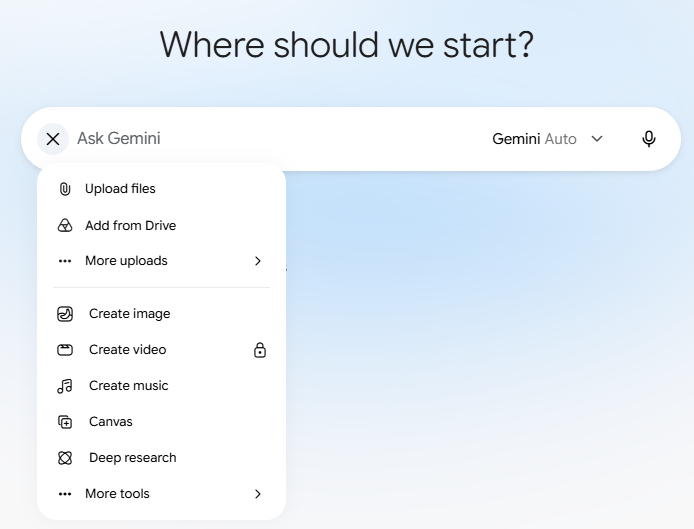
According to Google’s current Gemini Apps limits documentation, personal accounts without an AI plan receive a 32,000-token context window, while Google AI Pro and Ultra receive up to 1 million tokens. Usage remains compute-based and can vary with task complexity and capacity.
Where Gemini is better than DeepSeek
- Native audio, video, image, PDF, and text workflows
- Gmail, Docs, Sheets, Drive, Android, Chrome, and Google Search integration
- Deep Research and Search grounding
- Media-generation tools across Google products
- Vertex AI and Google Cloud deployment options
Where DeepSeek still has an advantage
- Lower-cost first-party text and image API access in many scenarios
- Downloadable flagship weights
- Longer maximum generated output
- A simpler choice when Google integrations and media features are unnecessary
Gemini models are proprietary. Google’s separate Gemma family provides downloadable open models, but Gemma should not be described as a self-hosted version of Gemini.
4. Perplexity: best for cited web research
Perplexity is the most direct alternative for users who primarily open DeepSeek to search the current web, collect sources, compare claims, and produce research reports.
The free Standard plan provides basic searches with citations and limited access to file uploads and advanced searches. Perplexity Pro costs $20 per month and adds broader model selection, more research usage, file analysis, and content-creation tools. Enterprise plans add administration, connectors, and stronger data controls.
Perplexity is not one foundation model. It is a research and orchestration product that can use models from several providers. This is an advantage for current-information tasks because the product is designed around retrieval and visible sourcing, but it also means Perplexity is not a direct replacement for downloading DeepSeek weights or calling one fixed model through a low-level API.
Where Perplexity is better than DeepSeek
- Citations are central to the product experience
- Research modes are designed for multi-source web investigations
- Users can access several model providers through one research interface
- Premium business-data sources are available on eligible plans
- Enterprise products support governed internal knowledge search
Where DeepSeek still has an advantage
- Direct access to one provider’s model and API behavior
- Open weights and self-hosting
- Lower-level developer controls for custom agents
- Better value when the task does not need repeated web retrieval
Use Perplexity when the primary deliverable is a source-backed answer or report. Use a model API or coding agent instead when the main work involves structured application logic, repository editing, long tool loops, or local deployment.
5. Microsoft Copilot: best for Microsoft 365 users
Microsoft Copilot is the practical alternative for people who work primarily in Word, Excel, PowerPoint, Outlook, OneNote, Teams, Windows, and Edge.
The free Copilot product supports general chat, web-grounded answers, writing assistance, summarization, and image creation. Signing in enables additional features such as chat history, longer conversations, and voice, subject to current limits.
Microsoft 365 Personal costs $9.99 per month in the United States and includes desktop productivity apps, 1 TB of cloud storage, and higher Copilot usage for the subscription owner. Business plans combine Copilot with Microsoft 365 data, agents, administration, and enterprise protection.
Where Microsoft Copilot is better than DeepSeek
- Native access inside Word, Excel, PowerPoint, Outlook, and Teams
- Web-grounded chat built into Microsoft products
- Business agents grounded in organizational files, messages, meetings, and people
- Microsoft identity, administration, and security integration
- A familiar workflow for organizations already licensed for Microsoft 365
Where DeepSeek still has an advantage
- A direct first-party model API
- Open-weight deployment
- Lower-cost custom inference
- Less dependence on one productivity-suite ecosystem
Copilot should not be selected as a DeepSeek API replacement unless the actual requirement is Microsoft productivity automation. Its value comes from the suite and work-data integrations rather than from being a drop-in model endpoint.
6. Qwen: best free multimodal and open-model alternative
Qwen Studio is the closest structural alternative to DeepSeek because the Qwen ecosystem spans a free consumer assistant, first-party hosted APIs, coding tools, specialized media models, and downloadable model weights.
Qwen Studio is free and includes web search, Deep Research, image generation and editing, video generation, web development, artifacts, and multimodal understanding across text, images, audio, and video. The interface can route tasks to specialized capabilities, so a feature available in Qwen Studio should not automatically be attributed to every individual Qwen checkpoint.
For developers, Qwen models are available through Alibaba Cloud Model Studio and QwenCloud. The current Qwen3.8 Flash price for the US deployment scope in Virginia is $0.15 per million input tokens and $0.47 per million output tokens. Pricing, built-in tools, and availability can differ by region and deployment scope.
Qwen also offers more attainable local choices than DeepSeek’s current flagship. The official Qwen3.8-27B checkpoint uses the Apache 2.0 License. Its much larger 2.4-trillion-parameter flagship uses a separate Qwen3.8-Max license, demonstrating why license claims must be checked checkpoint by checkpoint.
Where Qwen is better than DeepSeek
- Broader free multimodal and media-generation features
- A larger range of model sizes for local and private deployment
- Specialized coding, audio, vision, image, video, embedding, and reranking models
- A US regional deployment scope through Alibaba Cloud Model Studio
- Enterprise Zero Data Retention for eligible supported API deployments
Where DeepSeek still has an advantage
- A simpler MIT-licensed story for its current flagship weights
- A substantially longer maximum first-party API output
- A more straightforward model list for developers who do not need specialized media families
- Less regional complexity in its published first-party API price table
Qwen is the best fit when one organization wants a free assistant, an economical hosted model, and smaller open checkpoints under the same broader ecosystem. Verify the exact model, region, endpoint, license, and retention policy before production deployment.
7. Kimi: best for long-context agents and coding
Kimi K3.1 Pro is a compelling DeepSeek alternative for long-horizon coding, large repositories, research, document work, and autonomous agent tasks.
Kimi’s product family includes the main Kimi assistant, Kimi Work, Kimi Code, Deep Research, office-file tools, website building, scheduled tasks, plugins, Agent Swarm, and Kimi Claw. K3.1 Pro and its Highspeed variant are available through Kimi products and the Kimi API.
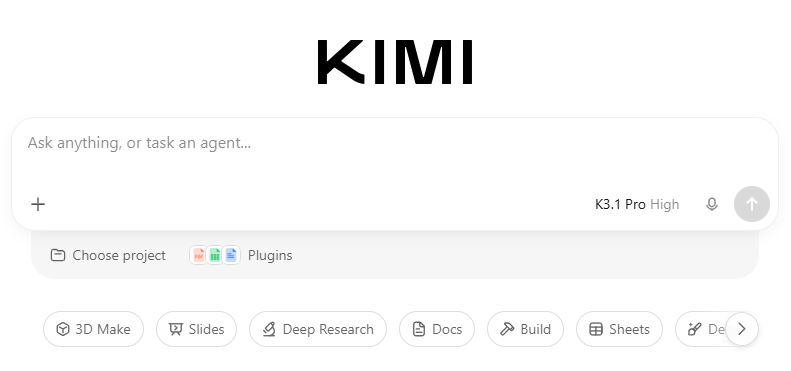
K3.1 Pro provides a 1-million-token context window and supports text and image input. Moonshot also released the official K3.1 Pro weights. The repository is approximately 1.56 TB and contains a 2.8-trillion-parameter mixture-of-experts model, so “open weight” does not mean practical desktop deployment.
Kimi publishes consumer memberships in Chinese yuan, starting with Andante at ¥49 per month. Higher plans provide more agent credits, parallel tasks, Kimi Code access, and expanded long-context allowances. Pricing, payment availability, and plan names should be checked for the user’s region before purchase.
Where Kimi is better than DeepSeek
- A broader integrated agent-product family
- Long-context coding and repository workflows
- Parallel agent and research features on eligible plans
- Dedicated products for office work, coding, websites, plugins, and scheduled tasks
- API data that Moonshot says is not used for model training
Where DeepSeek still has an advantage
- Simpler free consumer positioning
- Clearer public first-party API pricing
- MIT-licensed current flagship weights
- A smaller current flagship repository than Kimi K3.1 Pro, although both require serious infrastructure
Kimi is most attractive when the objective is not merely chatbot replacement but a transition to long-running coding or knowledge-work agents. Teams considering its API should distinguish consumer memberships, Kimi Code subscriptions, and token-based platform billing, which are separate products.
8. Mistral Vibe: best for flexible deployment and a European vendor
Mistral Vibe, formerly known as Le Chat, combines general chat, professional work, and agentic coding in one product. It is a strong option for users who want a European AI vendor, competitive API prices, open-weight models, and private enterprise deployment.
Vibe has a free plan with limited chat, web search, image generation, coding sessions, and access to Mistral Studio. Mistral Pro costs $14.99 per month, while Team and Enterprise plans add collaboration, administration, and private deployment options.
Mistral also offers economical developer models. Mistral Small 4 combines instruction following, reasoning, coding, and multimodal input in an Apache 2.0 model with a 256,000-token context window. Its standard API price is $0.15 per million input tokens and $0.60 per million output tokens.
Where Mistral is better than DeepSeek
- A unified chat, work, and coding product
- A broad set of open-weight and specialized models
- OCR, audio, transcription, speech, moderation, and coding APIs
- Private enterprise deployment and customization options
- Competitive cached-input and batch discounts
Where DeepSeek still has an advantage
- A 1-million-token context in its current first-party general model
- A 393,216-token maximum output
- A highly capable flagship consumer experience at no subscription cost
- A simpler choice when specialized document, audio, and deployment services are unnecessary
Mistral’s consumer privacy settings require attention. Its current help documentation says Vibe interactions may be used for training by default unless the user opts out, while Vibe Enterprise customers are opted out by default. Vibe and API data-sharing controls are separate.
Local alternatives: LM Studio or Ollama plus an open model
LM Studio and Ollama are often listed as DeepSeek alternatives, but neither is a foundation model. They are runtimes that download, manage, and serve models on your computer or server.
This route is appropriate when the real goal is to keep prompts and files on controlled hardware, work offline, avoid per-token cloud billing, or expose a local API to other applications. LM Studio provides a desktop interface and local server, while Ollama emphasizes command-line, API, and integration workflows.
Both companies state that prompts processed through local models remain on the user’s machine. Cloud models, web search, plugins, connectors, telemetry, and external tools can change that privacy boundary, so the complete workflow still needs review.
Possible model families include Qwen, Mistral, Gemma, gpt-oss, and smaller specialized checkpoints. Choose the exact model before estimating hardware. The family name alone does not reveal whether the model fits your machine.
Check these factors before running a model locally
- Exact checkpoint and version
- Model license and commercial-use terms
- Full precision or quantization format
- Download size
- Required RAM, VRAM, or unified memory
- Context length and KV-cache requirements
- CPU or GPU offloading
- Expected tokens per second
- Number of concurrent users
- Tool, image, and structured-output support
- Logging, backups, access control, and network security
Do not confuse active parameter count with storage size. A mixture-of-experts model may activate only a fraction of its parameters for each token while still requiring the full checkpoint to be stored and distributed across hardware.
OpenRouter: best for a multi-provider fallback strategy
OpenRouter is not a DeepSeek model alternative. It is a gateway that exposes hundreds of models from many providers through one chat interface and API.
This can be useful when a developer wants to replace direct DeepSeek dependency with a routing layer. An application can pin explicit model versions, select providers, apply budget controls, and configure fallback routes without maintaining a separate integration for every vendor.
OpenRouter’s free plan includes access to a limited set of free models. Its Standard plan charges a 5.5% fee when credits are purchased rather than marking up each model’s listed inference price. Provider-side retention and model policies still matter, although OpenRouter supports policy-based routing and Zero Data Retention options.
A gateway adds convenience and resilience but also introduces another service into the data path. Organizations should review the gateway, selected provider, model host, region, retention policy, and contractual terms rather than evaluating OpenRouter alone.
Low-cost API alternatives compared
The following representative first-party prices were checked on November 6, 2026. These models are not capability-equivalent, and the table excludes search, tools, storage, taxes, reserved throughput, retries, and third-party gateway fees.
| Model | Input per 1M tokens | Output per 1M tokens | Context | Important qualification |
|---|---|---|---|---|
| OpenAI GPT-6 Luna | $0.10 | $0.50 | 1.05M | Efficient closed model with OpenAI tools; 128K maximum output |
| Qwen3.8 Flash, US deployment | $0.15 | $0.47 | 1M | Price applies to the US deployment scope in Virginia; region matters |
| Mistral Small 4 | $0.15 | $0.60 | 256K | Apache 2.0 model with reasoning, coding, and multimodal capabilities |
| DeepSeek V4.1 Flash, off-peak | $0.15 | $0.60 | 1M | Off-peak cache-miss price; maximum output is 384K |
| DeepSeek V4.1 Flash, peak | $0.30 | $1.20 | 1M | Peak windows apply on specified weekdays and UTC hours |
Raw token price is only one component of production cost. A model with a lower rate can become more expensive if it generates unnecessary reasoning tokens, needs more retries, fails tool calls, or creates more human correction work. Evaluate cost per accepted result, not merely cost per million tokens.
Which alternative is best for privacy?
No hosted consumer chatbot should be called private based only on the provider’s home country. Privacy depends on the exact product, plan, settings, processing region, retention period, connected tools, and contractual terms.
- ChatGPT: Personal accounts can opt out of model training. Business, Enterprise, Edu, and API content is excluded from training by default.
- Claude: Anthropic states that Claude for Work and API inputs and outputs are not used for training by default.
- Gemini: Consumer data practices depend on Gemini activity settings. Google’s API pricing documentation distinguishes free-tier data that may improve products from paid-tier data that is not used for that purpose.
- Perplexity: Enterprise plans state that customer data is not used for training. Perplexity describes its API as having no data logging or storage.
- Qwen: Qwen Studio interactions may be used for service improvement, with an opt-out process. Alibaba Cloud Model Studio normally retains API prompts and responses for up to 30 days, while eligible enterprise customers can apply for ZDR in regions including US Virginia.
- Kimi: Kimi’s consumer policy permits de-identified content to be used for model optimization, with a request-based opt-out. Kimi states that API inputs and outputs are not used for training.
- Mistral: Personal Vibe data may be used for training unless the user opts out. Enterprise customers are opted out by default.
- Local models: LM Studio and Ollama state that locally processed prompts remain on the device, but external search, cloud models, connectors, and logging can still transmit data.
For confidential or regulated information, use an organizationally approved business or API product with verified retention terms, or deploy an appropriate model inside controlled infrastructure. Do not place passwords, private keys, medical records, legal files, unreleased code, or regulated customer information into a free consumer chatbot.
Does US policy require a DeepSeek alternative?
It does for some federal environments. On October 20, 2026, the Department of Homeland Security published a Federal Register notice concerning DeepSeek. The order excludes covered DeepSeek products and services from federal civilian agency procurements and requires removal from covered federal civilian executive branch information systems, subject to an exception process.
This is not the same as a nationwide prohibition on private consumer use. A private individual or ordinary commercial business is not automatically banned from using DeepSeek under that order. Government contractors, vendors, schools, employers, state organizations, and regulated companies may have additional policies.
Selecting another provider does not automatically make a product approved for government or regulated use. The replacement still needs security, privacy, procurement, data-residency, and supply-chain review.
How to choose the right DeepSeek replacement
- Choose ChatGPT when you want the broadest single consumer and developer ecosystem.
- Choose Claude when code, writing, documents, and long professional workflows dominate.
- Choose Gemini when your work depends on Google apps, audio, video, PDFs, or large multimodal files.
- Choose Perplexity when visible web citations and current research are the main requirement.
- Choose Microsoft Copilot when Word, Excel, PowerPoint, Outlook, and Teams are your daily workspace.
- Choose Qwen when you need a free multimodal assistant, inexpensive hosted inference, and smaller open checkpoints.
- Choose Kimi when long-context coding, research agents, and complex multi-step execution matter more than simple chat.
- Choose Mistral when you want competitive APIs, open models, coding tools, or private deployment from a European vendor.
- Choose LM Studio or Ollama with an open model when local control and offline use outweigh setup complexity.
- Choose OpenRouter when the real goal is model routing, provider fallback, and reduced vendor lock-in.
When should you stay with DeepSeek?
An alternative is not automatically an upgrade. Staying with DeepSeek can remain the better decision when:
- The free consumer assistant already handles your text, image, coding, and search needs.
- Your application benefits from DeepSeek V4.1 Flash’s low token prices.
- You need a maximum output of up to 393,216 tokens.
- You rely on both OpenAI-format and Anthropic-format first-party endpoints.
- You need MIT-licensed current flagship weights.
- Your existing prompts, tools, evaluation suite, and caching are already optimized for DeepSeek.
- Moving would increase cost without solving a measured problem.
The best reason to switch is a verified requirement: better media support, specific productivity integrations, stronger research sourcing, smaller local models, enterprise controls, regional hosting, or organizational policy. Brand popularity alone is not a migration strategy.
How to test an alternative before switching
- Define the DeepSeek workflow being replaced. Separate consumer chat, API inference, coding agents, research, and local deployment.
- Create a representative evaluation set. Use 20 to 50 real tasks rather than generic prompts.
- Keep inputs and success criteria consistent. Use the same files, instructions, tools, and output requirements.
- Test several times. Model outputs and tool behavior can vary between runs.
- Measure accepted results. Track factual accuracy, passing tests, instruction following, source quality, retries, and human correction time.
- Record the full cost. Include subscriptions, input and output tokens, reasoning tokens, search calls, storage, gateway fees, local hardware, and engineering work.
- Test failure cases. Include long inputs, ambiguous requests, tool errors, unavailable sources, and rate limits.
- Review data handling. Check retention, training use, regional processing, administrator controls, and connected services.
- Run both systems in parallel. Avoid deleting the existing workflow before the replacement has proved reliable.
- Keep a fallback provider. Provider diversity is useful when uptime and continuity matter.
Do not assume that chat history, memories, projects, files, custom assistants, or prompts can be imported automatically. Verify each migration feature before committing to a new platform.
Frequently asked questions
What is the best DeepSeek alternative overall?
ChatGPT is the best overall alternative for most users because it combines general chat, coding, research, images, voice, files, data analysis, custom workflows, and a large developer platform. It does not replace DeepSeek’s low-cost API or downloadable flagship weights.
What is the closest alternative to DeepSeek?
Qwen is the closest structural alternative because it offers a free multimodal assistant, first-party APIs, coding tools, specialized models, and open-weight checkpoints. DeepSeek has a simpler current flagship license and a longer maximum API output.
What is the best free DeepSeek alternative?
Qwen Studio is the strongest free alternative when multimodal input, Deep Research, image generation, video generation, and web tools matter. ChatGPT, Claude, Gemini, Perplexity, Microsoft Copilot, and Mistral Vibe also provide ongoing free access with limits.
Which DeepSeek alternative is best for coding?
Claude is a strong hosted choice because Claude Code combines capable models with repository and terminal workflows. ChatGPT and Kimi are also serious options for long-running coding agents. Qwen and Mistral are better candidates when open weights or smaller local models are required. Production teams should test all finalists on their own repositories.
What is the best private DeepSeek alternative?
A fully local workflow using LM Studio or Ollama with an approved open-weight model offers the greatest direct control over prompts and files. Privacy still depends on logging, plugins, web search, backups, access controls, and network configuration. For hosted use, select a business or API product with verified retention and training terms.
Is Ollama a DeepSeek alternative?
Ollama is a model runtime, not a competing language model. It can run DeepSeek checkpoints or alternatives such as Qwen and Mistral models. It replaces the hosting layer, not the underlying intelligence by itself.
Can I replace the DeepSeek API without rewriting my application?
An OpenAI-compatible alternative may let you reuse the SDK, message format, and much of the request code, but compatibility is rarely complete. Verify authentication, base URL, model IDs, tool schemas, structured output, streaming, error handling, image formats, token accounting, and rate-limit behavior.
Is DeepSeek banned in the United States?
No nationwide consumer ban is established by the federal order reviewed here. The October 20, 2026 order applies to covered federal civilian executive branch systems and procurements. Other organizations may impose separate restrictions.
Sources checked
- DeepSeek: API changelog, models and pricing, consumer products, V4.1 Flash model card, and privacy policy.
- OpenAI: ChatGPT pricing, free-tier documentation, API model catalog, and data-use policy.
- Anthropic: Claude pricing, current Claude models, and commercial data-training policy.
- Google: Google AI plan pricing, Gemini limits, Gemini API model documentation, and Gemini Apps Privacy Hub.
- Perplexity and Microsoft: Perplexity plan guide, Perplexity pricing, Microsoft Copilot plan comparison, and Microsoft 365 Copilot pricing.
- Qwen and Alibaba Cloud: Qwen Studio, Qwen3.8 repository, Qwen3.8-27B model card, Model Studio pricing, and Model Studio retention policy.
- Kimi and Mistral: Kimi K3.1 Pro announcement, Kimi K3.1 Pro model card, Kimi memberships, Kimi API data policy, Mistral pricing, and Mistral API pricing.
- Local and multi-model tools: LM Studio privacy policy, Ollama privacy policy, and OpenRouter pricing and routing controls.
- US policy: Federal Register notice regarding DeepSeek in federal civilian systems and procurements.