
Published: November 7, 2026.
Use DeepSeek for writing by giving it a specific job: organize your notes, draft a section, or revise an existing passage. Supply the facts and examples it should work from, explain who will read the text, and define what a successful result looks like.
For a first attempt, choose a short piece you can judge yourself, such as an email or an article introduction. Work through planning, drafting, and editing separately so you can catch an incorrect assumption before it spreads through the whole document.
The workflow below includes a reusable writing brief, an illustrative before-and-after example, and prompts for common writing tasks. It also explains what to check before you submit private material or publish the result.
Where DeepSeek fits in your writing process
A useful way to evaluate DeepSeek is to start with a task whose requirements you can explain and whose result you can check. For factual writing, prepare the evidence first. For creative work, define the scene, characters, and constraints. Use the following as a menu of tasks to try.
| Writing task | What to provide | What to check |
|---|---|---|
| Outline an article | The reader’s question, your angle, and source notes | Each section advances the topic; headings do not repeat one another. |
| Draft a blog or business text | Approved facts, audience, purpose, and desired action | The draft adds no unsupported benefits, promises, or experience. |
| Rewrite or proofread | The original passage and the level of editing you want | Names, numbers, conditions, and meaning remain intact. |
| Develop a story or scene | Character goals, setting, point of view, and established facts | Dialogue and actions fit the characters and existing story. |
| Get feedback on an essay | Your draft, assignment requirements, and permitted AI uses | The feedback helps you improve your reasoning and stays within the assignment’s rules. |
Set a different standard for each task. A brainstorming list needs useful possibilities. A client email needs an accurate commitment and a clear next step. A factual article needs evidence for its claims. Fluent wording alone does not tell you whether any of those requirements have been met.
How to start writing with DeepSeek
1. Open the official service and check the access route
Start with DeepSeek’s official web chat, which is linked from the DeepSeek homepage, or use the app linked on the official download page. Create an account or sign in using the options displayed; the Terms of Use describe registration by email or a supported third-party account.
Is DeepSeek free for writing? DeepSeek advertises free chat in its official app. Its API is a separate service with usage-based charges for input and output tokens, as explained in the official API pricing documentation. You can begin with the consumer chat workflow without setting up an API integration.
If you use another company’s writing app that offers DeepSeek models, check that company’s pricing and features. Its subscription, document editor, export options, and usage limits belong to that product. They are not evidence of what the official DeepSeek app includes.
2. Give it a writing brief
Replace a broad instruction such as “write a great article” with the information a human editor would need. State the reader’s problem, the material available, the tone, and the result you want. Separate facts that must remain unchanged from choices the model may make.
Help me write the following piece in American English.

Purpose: [WHAT THIS TEXT SHOULD ACCOMPLISH]
Audience: [WHO WILL READ IT AND WHAT THEY ALREADY KNOW]
Format and approximate length: [EMAIL, ARTICLE SECTION, ANNOUNCEMENT, ETC.]
Tone: [TWO OR THREE SPECIFIC QUALITIES]
Source material: [PASTE APPROVED NOTES OR EXCERPTS]
Facts and qualifications to preserve: [LIST THEM]
Avoid: [UNWANTED CLAIMS, LANGUAGE, OR CONTENT]

Use the supplied material for factual claims. Do not invent statistics, quotations, sources, personal experience, or product benefits.
If an essential detail is missing, ask a focused question before drafting. Otherwise, produce the requested text.
For example, “friendly, direct, and specific; use contractions; avoid sales language” gives clearer direction than “make it engaging.” If the piece is for publication, include the reader’s main question and the action or understanding they should leave with.
3. Approve the structure before drafting a long piece
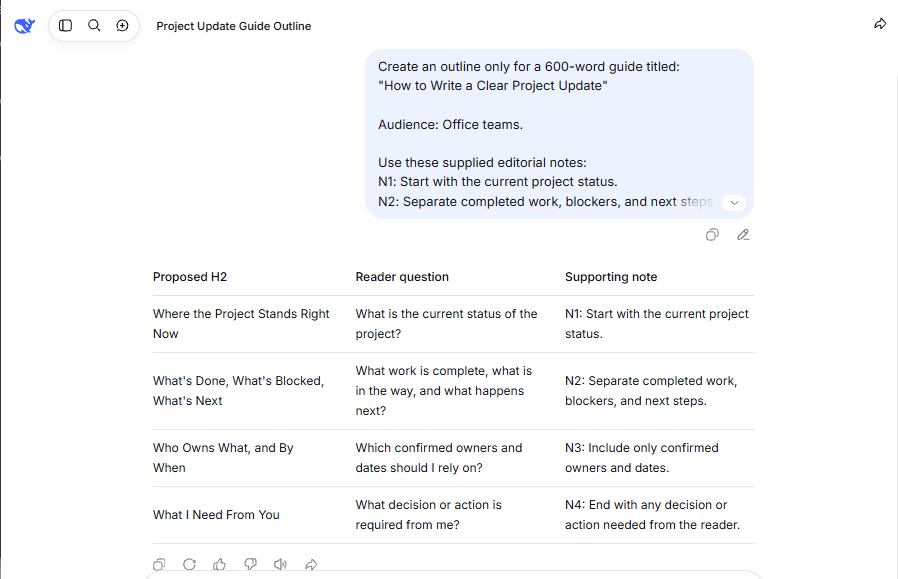
For an article, ask for a proposed outline first. Require each heading to answer a different reader question and identify the notes or sources that support it. Remove sections that repeat the introduction, depend on missing evidence, or drift away from the reader’s goal.
Then request one section at a time when that makes review easier. Keep a copy of the approved outline and source notes in your own document. This gives you a stable reference when you change direction or start another conversation.
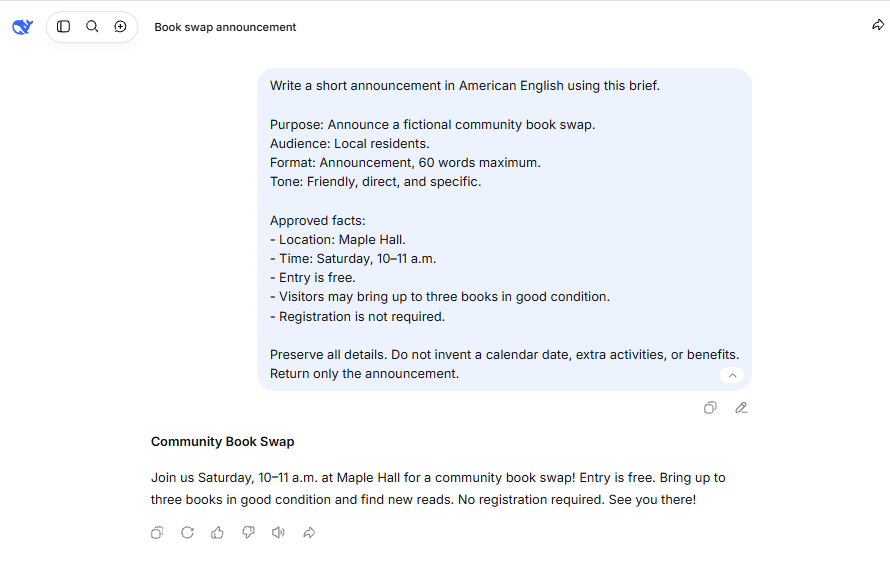
For a short email or announcement, an outline may be unnecessary. Ask for the complete short draft and check it against the brief.
4. Revise in focused passes
Choose the kind of edit before asking for it. “Improve this” leaves room for changes you may not want.
- Proofreading: fix spelling, grammar, and punctuation while preserving the wording where possible.
- Clarity editing: shorten confusing sentences and remove repetition without changing meaning.
- Structural editing: identify missing explanations, weak transitions, or sections in the wrong order.
- Voice editing: adjust tone and phrasing against your own sample and stated preferences.
Request one pass, inspect it, and then decide what comes next. Keep the previous version so you can compare changes. For example, an edit must not turn “may reduce processing time” into “reduces processing time” or replace an estimate with a guarantee.
A worked example: turn rough notes into a clearer announcement
This is an illustrative editing example. The event and both drafts below were created for this guide. They are not outputs from a live DeepSeek test.
Supply the facts and the first request
Imagine you need a short neighborhood announcement. These are the only approved details:
Event: Seed-starting workshop
Organizer and location: Maple Street Community Garden
Date: May 9
Time: 10–11 a.m.
Price: Free
Eligibility: Adults only
Capacity: 12 participants
Included: Seeds and starter pots
Registration: Contact the garden coordinator by May 5
A suitable first request would be:
Using only the event notes above, write a neighborhood announcement of no more than 80 words. Use a friendly, straightforward tone. Include the registration deadline and the adult-only capacity. Do not invent instructor qualifications or additional activities.
Check the draft against the notes
Consider this deliberately flawed illustrative draft:
Join Maple Street Community Garden’s free seed-starting workshop on May 9, from 10 to 11 a.m. Our expert instructors will guide gardeners of every age through the session. Seeds and starter pots are included. Reserve your spot with the garden coordinator by May 5!
The dates and supplied materials match, but three details need attention:
- “Expert instructors” is unsupported. The notes provide no information about instructors or their qualifications.
- “Every age” changes eligibility. The event is for adult participants.
- The capacity is missing. Readers need to know that participation is limited to 12 adults.
This is why a prompt that says “use only these facts” still needs a comparison against the original material.
Ask for a targeted revision
Revise the announcement to remove the unsupported instructor claim. State that the workshop is limited to 12 adult participants. Preserve the event name, location, date, time, price, included materials, and registration deadline. Keep it concise and use no exclamation marks.
An improved illustrative version is:
Join a free seed-starting workshop at Maple Street Community Garden on May 9, from 10 to 11 a.m. Seeds and starter pots are provided. The workshop is limited to 12 adult participants. Register with the garden coordinator by May 5.
The revision improves accuracy and usefulness: it restores the capacity, keeps the age restriction, and removes an invented credential. The point is to compare the text with the brief, rather than judge it only by how polished it sounds.
DeepSeek writing prompts for specific jobs
Use these templates when you already know what you want to accomplish. Replace the bracketed fields with your own material, and include only text you have permission to submit.
Draft an article section from supplied sources
Use this when your research is ready and you need help turning it into a readable explanation.
Write a [APPROXIMATE LENGTH]-word section about [QUESTION] for [AUDIENCE].

Use only the source excerpts below for factual claims. Label the excerpts S1, S2, and so on in your working notes.

Source excerpts:
[PASTE EXCERPTS WITH THEIR ORIGINAL URLs]

Explain the answer in plain American English. Preserve qualifications and disagreements between sources. Do not add statistics or examples presented as real unless the sources support them.

After the draft, provide a separate claim-to-source list. Flag any point the sources do not establish.
Check: Open the original sources and confirm that each supports the sentence assigned to it. The claim-to-source list is a review aid, not proof. Remove the working labels from the finished piece and retain appropriate source links.
Rewrite a paragraph without changing its meaning
Use this for a passage that is accurate but difficult to read.
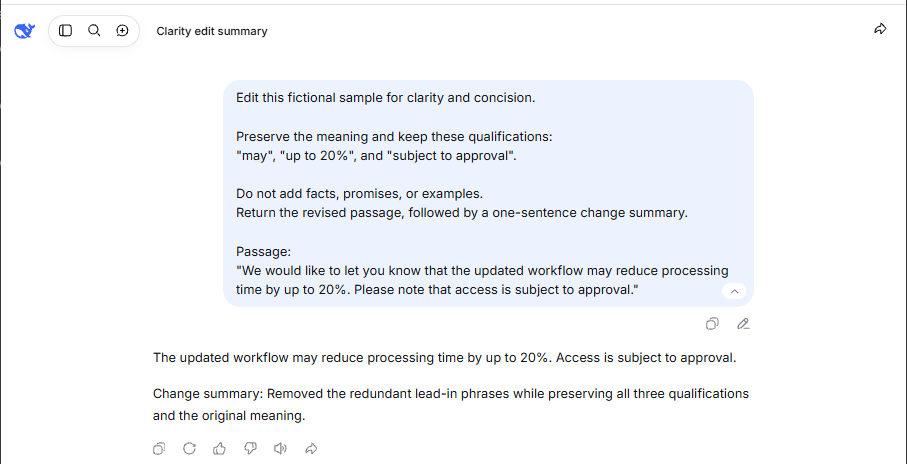
Edit the passage below for clarity and concision.

Preserve the author’s position, names, numbers, dates, exceptions, and degree of certainty. Do not add examples, explanations, promises, or factual claims. Keep necessary technical terms.

Return the revised passage, followed by a short change summary. If something is ambiguous, ask about it rather than choosing a meaning.

Passage:
[PASTE TEXT]
Check: Compare every qualification. Words such as “may,” “usually,” “up to,” and “subject to approval” can carry essential meaning. Confirm that shortening the passage has not removed them.
Bring a draft closer to your own voice
Use a sample you wrote or are authorized to use. Describe the qualities you want to keep, such as short sentences, understated humor, or a direct opening.
Use my writing sample to identify a short style guide covering sentence length, vocabulary, tone, and use of examples.

Apply that guide to the draft below. Preserve all facts and the intended meaning. Do not copy distinctive phrases from the sample or invent personal anecdotes.

Return the revised draft and briefly identify the main style changes.

My writing sample:
[PASTE SAMPLE]

Draft:
[PASTE DRAFT]
Check: Read the revision aloud. Replace phrases you would never use, and confirm that it has not added a personal opinion or experience you did not supply. Keep the resulting style guide for later drafts.
Write a professional email with a clear next step
Give the model the relationship, the purpose, and the action you need from the recipient.
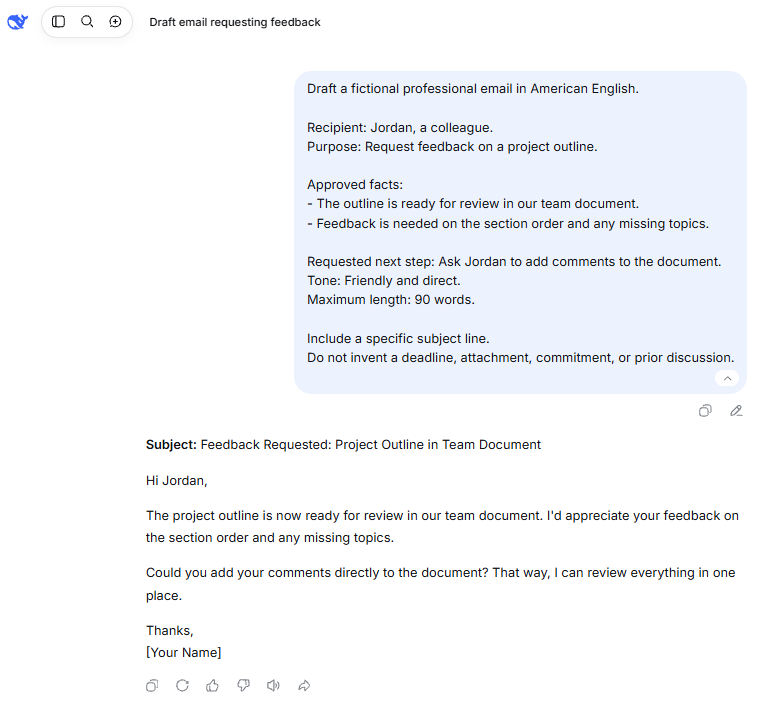
Draft a professional email in American English.

Recipient and relationship: [DETAILS]
Purpose: [GOAL]
Facts to communicate: [APPROVED FACTS]
Requested next step: [ACTION]
Tone: [TONE]
Maximum length: [WORD LIMIT]

Include a specific subject line. Do not invent deadlines, commitments, discounts, attachments, or prior conversations. If a necessary detail is missing, ask before drafting.
Check: Verify the recipient, requested action, and every commitment. If the message mentions an attachment or deadline, make sure it exists and is correct.
Get structural feedback before rewriting
Use this when the draft feels disorganized and you want a diagnosis before making changes.
Review the structure of this draft for [AUDIENCE] and [PURPOSE]. Do not rewrite it yet.

Identify:
1. The main point readers are likely to take away.
2. Any paragraph that repeats another.
3. Missing explanations or unsupported jumps in the argument.
4. A clearer order, if needed.

Quote a short passage for each criticism so I can locate the issue. Distinguish a factual gap from a stylistic preference.

Draft:
[PASTE DRAFT]
Check: Decide whether the suggested order serves your purpose. For academic work, use the assignment’s AI rules and grading criteria to decide which kinds of feedback are permitted.
Develop a creative scene while preserving continuity
Set the scene’s purpose before requesting prose. Specify what each character wants, what has already happened, and what must remain unresolved.
Write a scene of approximately [LENGTH] words.

Point of view and tense: [DETAILS]
Setting: [DETAILS]
Character goals: [DETAILS]
Established story facts: [DETAILS]
What should change by the end: [DETAILS]
What must remain unresolved: [DETAILS]

Use the characters and constraints supplied. Do not add backstory, abilities, or relationships that contradict them. After the scene, list any new story facts you introduced so I can accept or reject them.
Check: Review the character motivations and new details separately from the prose. A vivid line may still conflict with an earlier chapter.
For a book or other long project, maintain a continuity document with character facts, terminology, timeline, decisions, and unresolved questions. Supply the relevant parts with each section request and update it yourself after accepting changes. Treat it as your project record; do not assume that a new conversation will recover earlier decisions.
Check the draft before you send or publish it
Run a final review against the brief and underlying material. A second AI review can suggest issues, but it does not independently establish that the text is correct.
- Match the facts. Compare names, dates, quantities, eligibility rules, conditions, and commitments with the approved notes.
- Verify external claims. Open the source, find the supporting passage, and check whether its scope matches the claim. A pasted URL alone does not establish that the model accessed the page.
- Inspect quotations and references. Confirm that quoted words appear in the original and that each cited source exists. A plausible title or formatted citation is not enough.
- Check meaning and voice. Look for removed qualifications, added opinions, invented personal experience, and wording that sounds unlike you.
- Read for usefulness. Cut repeated introductions and conclusions. Make sure the reader can understand the point or take the intended next step.
If an output is too generic, add a concrete example or a more specific audience. If it is repetitive, identify the overlapping passages and ask for one combined explanation. If it introduces unsupported claims, remove them and return to the approved source material before asking for another draft.
For writing about medical, legal, financial, or other consequential matters, have the relevant qualified reviewer check the substance. A clear rewrite does not establish that the underlying advice is sound.
Protect your drafts and check the publication terms
Before submitting private or client material
DeepSeek’s Privacy Policy describes collecting inputs such as prompts, uploaded files, and chat history, and using data to improve its services and models. It also states that personal data are collected, processed, and stored in China.
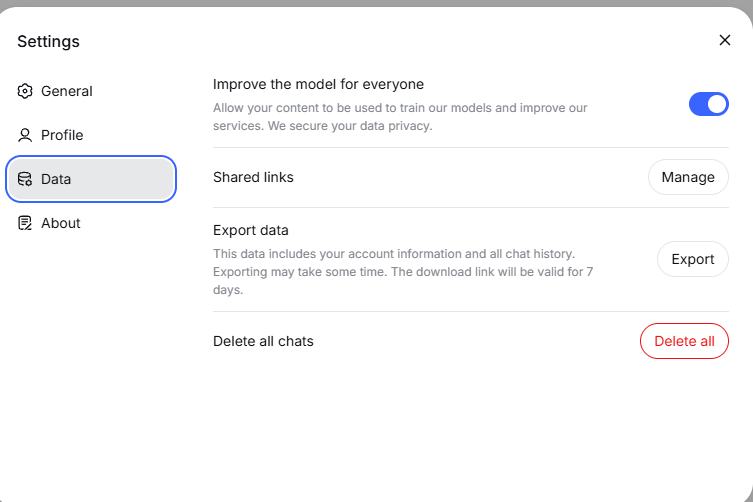
The Terms of Use identify “Improve the model for everyone” as the control for opting out of the described use of inputs and outputs to improve the service. A training opt-out does not establish zero retention or confidentiality.
Before submitting an unpublished manuscript, client brief, or internal document, check whether your agreement or workplace policy permits it. Remove unnecessary personal and confidential details. If permission is unclear, use a fictional example or a short, approved excerpt to test the workflow.
A third-party service offering DeepSeek models has its own data-handling arrangements. Read the policy of the service receiving your text instead of assuming that every DeepSeek-powered product works the same way.
Before publishing or using output commercially
Section 4.2 of DeepSeek’s Terms of Use assigns any rights DeepSeek has in outputs to the user, subject to applicable law and its terms. It also says outputs may not be unique. Do not treat generated text as automatically plagiarism-free or free of third-party rights concerns.
Section 3.1 requires users publishing or disseminating generated outputs to verify their authenticity and accuracy and clearly indicate that they are AI-generated. That is a requirement in DeepSeek’s terms; your publisher, client, or school may have additional rules.
Check that you have permission to use the material you supplied, retain necessary attribution, and follow the rules that apply to the actual destination of the text.
When to choose another tool or a human editor
Choose according to the writing job. If you need tracked changes, document comments, a particular export format, or a shared approval process, check those features in the product you would actually use. A model’s writing ability and an application’s document workflow are separate considerations.
If you are comparing DeepSeek with ChatGPT, Claude, or another assistant, give each the same nonconfidential brief and source material. Compare whether it follows the instructions, preserves qualifications, fits your voice, and needs substantial correction. Use the result to judge that task; one good response does not establish an overall winner.
Bring in a human editor when the piece depends on sensitive judgment, a complex argument, a distinctive personal voice, or consequences you cannot confidently evaluate yourself.
Start with one paragraph you know well. Keep the original, request one defined improvement, and compare the versions line by line. Once you can explain why the revision is better, apply the same method to a longer piece.
Last verified: November 5, 2026.