

Published: November 5, 2026.
Choose DeepSeek if you want a free assistant for occasional questions and small coding fixes, or if you need a model you can run on your own infrastructure. Choose Claude if you regularly revise documents against the same source material or need a coding agent to carry a change through several files and tests. A writer can get much of that document workflow on Claude Free. Claude Pro adds Opus and Claude Code.
If you’re building an app, Claude Haiku 5.5 costs less than DeepSeek Flash for short, uncached requests. DeepSeek Flash can cost less when a single request contains a long document.
What do you get in the free chats?
DeepSeek’s free assistant is a good place to ask why a formula fails, get an explanation of a code snippet, or ask questions about an uploaded file. The app supports web search and can extract text from uploaded files. DeepSeek released V4.1 Flash-1017 on its website and app as well as its API. You can try the assistant without setting up an API account. DeepSeek app features · Flash-1017 release
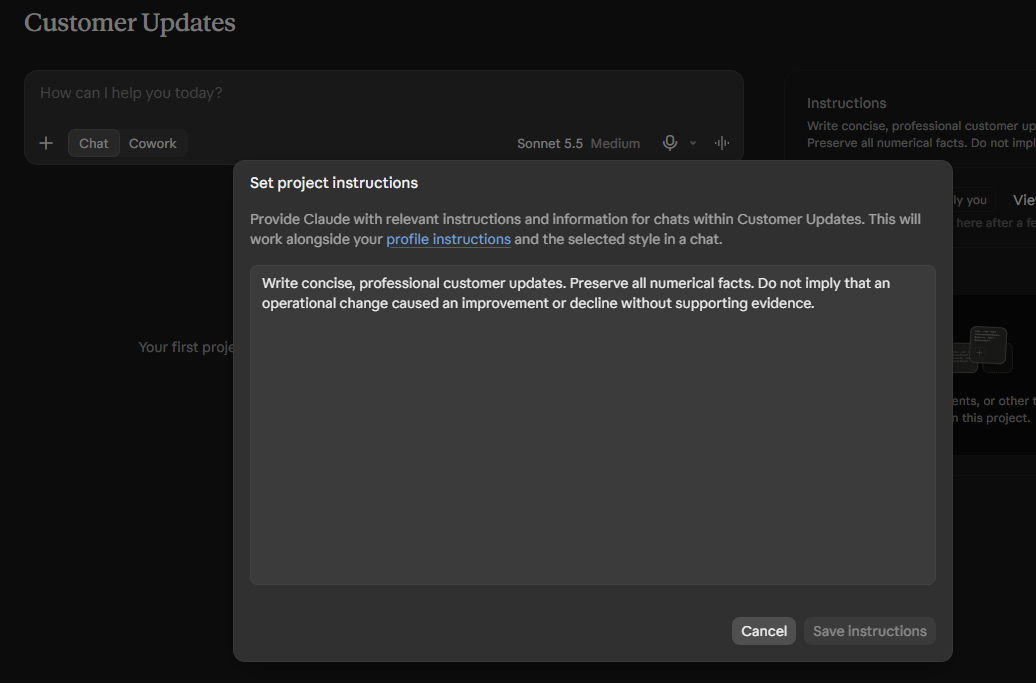
Claude Free gives you Sonnet and Haiku, web search, file creation, and up to five Projects. A Project can keep a brief, source documents, and instructions together across chats. If you write a weekly customer update, you can supply your style guide once and start a fresh conversation for each issue. How Claude Projects work · Claude plan comparison
When is Claude Pro worth $20 a month?
In the US, Claude Pro costs $20 when billed monthly or $200 paid up front for a year, before applicable tax. It adds Opus access, Claude Code, and higher usage allowances. Both Free and Pro have five-hour and weekly limits. If your free account handles your documents and you seldom hit a limit, you can keep the $20. If you regularly run out of messages halfway through a revision, the higher allowance is a reason to upgrade. US plans and usage limits
Claude Pro includes no monthly API credit. Eligible Max ($100/month) and Ultra ($200/month) subscribers can claim $100 and $200 in monthly Claude Platform credits, respectively, by linking a Console organization. New subscribers become eligible after seven days. Those credits expire each billing cycle and do not increase chat limits. Anthropic’s API credit terms
Is DeepSeek or Claude better for coding?
For a focused question like “Which setting controls this timeout?” DeepSeek Flash is a reasonable first choice. In Bito’s October 24 coding evaluation, DeepSeek V4.1 Flash-1017 earned 90% of the available points on one-shot questions, matching Claude Opus 5.5 running at medium effort. On longer sessions that involved tracing a defect, implementing a fix, and auditing it, Opus earned 87%. Flash earned 77%, as did Sonnet 5.5 running at medium effort. Bito’s results and grading method
Bito ran Flash through 16 one-shot questions and eight long sessions in Claude Code, then compared those scores with earlier Claude runs on the same tasks. Opus 5.5 used an answer key to grade every model’s responses, including its own. For a change that spans a database migration, a service, and its tests, those results give Opus an edge worth trying. For a small patch with a failing test that tells you exactly when it’s fixed, start with Flash.
Can DeepSeek replace Claude Code?
You can change the coding agent, the model, or both. Claude Code is Anthropic’s tool for reading a repository, editing files, and running commands. DeepSeek Harness is DeepSeek’s open-source agent, available in public preview, with repository navigation, file edits, and test execution. If you already like Claude Code, DeepSeek also documents how to point it at the DeepSeek endpoint with a DeepSeek API key. In that setup, Claude Code provides the interface and DeepSeek processes and bills the model requests. Claude Code · DeepSeek Harness · DeepSeek’s Claude Code integration
Which is better for writing, PDFs, and reasoning?
If natural-sounding prose is your priority, there’s evidence for trying Opus. On Artificial Analysis’s writing-style benchmark, Opus 5.5 scored above DeepSeek V4.1 Flash-1017 for natural phrasing and varied vocabulary. Both ran at maximum effort, with default fallback for Opus. A panel of AI models judged the writing traits. For a customer update, you’ll also want to see whether the draft preserves your facts. Side-by-side style scores · How the writing traits are judged
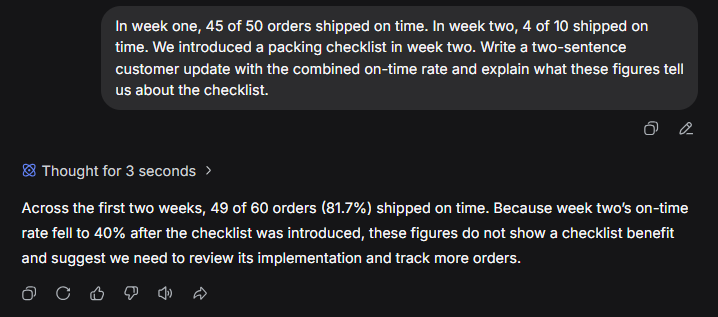
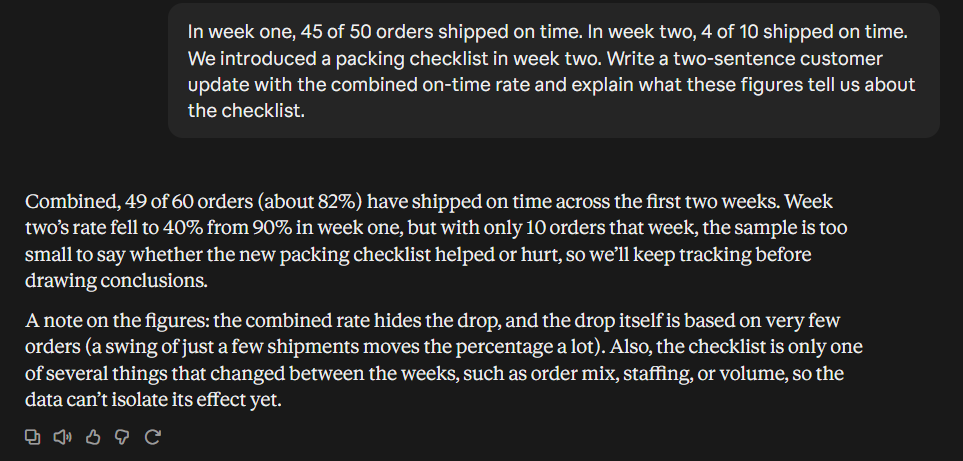
Try this in either chat. “In week one, 45 of 50 orders shipped on time. In week two, 4 of 10 shipped on time. We introduced a packing checklist in week two. Write a two-sentence customer update with the combined on-time rate and explain what these figures tell us about the checklist.”
An accurate draft reports 49 of 60 orders, or about 81.7%. Averaging the two weekly percentages gives 65% and assigns the ten-order week the same weight as the fifty-order week. The figures alone also can’t establish whether the checklist helped or hurt.
How the model tier changes reasoning performance
On ARC Prize’s semi-private ARC-AGI-2 grid puzzles, Claude Opus 5.5 scored 93.3%, DeepSeek V4.1 Flash-1017 scored 68.6%, and Claude Haiku 5.5 scored 30.7%, each at its provider’s high-effort setting. These puzzles measure the ability to infer a visual rule from examples. If you’re choosing between free chat apps for math homework, an Opus score tells you little about the Claude model you’ll actually use. Opus results · Flash results · Haiku results
When the answer is inside a chart
In Claude chat, a PDF of up to 100 pages can be analyzed as both text and visuals. From 101 through 1,000 pages, Claude processes the text only. If the answer depends on a graph on page 120, export that page as a short PDF or an image and ask for the axis labels, units, and values. A larger context window won’t recover a graph that the app only processed as text. Claude’s file-upload guide
For an app that takes screenshots or chart images directly, DeepSeek’s deepseek-flash accepts images. Its higher-priced deepseek-v4-pro accepts text and lacks native vision. Anthropic lists image input across Haiku 5.5, Sonnet 5.5, Opus 5.5, and Fable 5.1. All six models support a one-million-token context window through their providers’ APIs. For a long report, ask for the page and row behind an answer so you can check the figure in its original context. DeepSeek model specifications · Claude model specifications
Claude vs DeepSeek API pricing for the same workload
Suppose an application handles 1,000 requests, each with 2,000 uncached input tokens and 400 billed output tokens. That totals 2 million input and 400,000 output tokens. The table uses direct API rates in US dollars on November 6, 2026, with standard processing, no cache writes or hits, and no tool charges, taxes, or promotional credits. Each DeepSeek range runs from off-peak to peak. Totals are rounded to the nearest cent. DeepSeek API rates · Claude API rates
| Model and API ID | Input per 1M tokens | Output per 1M tokens | Cost for 1,000 requests |
|---|---|---|---|
Claude Haiku 5.5claude-haiku-5-5 | $0.10 | $0.50 | $0.40 |
DeepSeek V4.1 Flash-1017deepseek-flash | $0.15–$0.30 | $0.60–$1.20 | $0.54–$1.08 |
DeepSeek V4 Pro-0813deepseek-v4-pro | $0.66–$1.32 | $1.98–$3.96 | $2.11–$4.22 |
Claude Sonnet 5.5claude-sonnet-5-5 | $2.00 | $10.00 | $8.00 |
Claude Opus 5.5claude-opus-5-5 | $4.00 | $20.00 | $16.00 |
Claude Fable 5.1claude-fable-5-1 | $10.00 | $50.00 | $40.00 |
A long prompt reverses the low-cost result. Haiku’s lower rate applies to prompts up to 100,000 input tokens. Above that threshold, the rates for the request rise to $0.50 per million input and $2.50 per million output. One uncached request with 120,000 input and 2,000 billed output tokens costs 6.5 cents on Haiku, compared with 1.92 to 3.84 cents on Flash. For a transcription service, estimate cost using the distribution of transcript lengths before picking the cheaper model.
DeepSeek’s peak windows are 01:00–04:00 and 06:00–10:00 UTC on weekdays, excluding Chinese public holidays. Other hours are off-peak. Repeated input can change the bill again. Flash charges $0.003–$0.006 per million cache-hit input tokens, while short-prompt Haiku charges $0.01 per million cached input tokens and bills cache writes separately. For a production decision, divide the total bill, including retries and billed reasoning tokens, by the number of outputs that pass your checks. Different tokenizers can give the same text different token counts. DeepSeek peak hours and caching · Anthropic prompt-cache pricing
Which service can handle your private data?
For personal chats, DeepSeek says it processes and stores personal data in China. Its US terms describe a setting called Improve the model for everyone that lets you opt out of the model-improvement use described there. DeepSeek keeps personal data for as long as it considers necessary for the purposes in its policy. With consumer Claude, you can control model improvement in privacy settings, and Anthropic excludes Incognito chats from model improvement. DeepSeek privacy policy · DeepSeek US terms · Claude consumer data controls
For business use, Anthropic excludes Claude for Work and API inputs and outputs from model training by default. Its standard API policy deletes inputs and outputs within 30 days, subject to exceptions such as stored files, safety investigations, legal requirements, or different contractual terms. If customers use an app built on DeepSeek’s API, DeepSeek’s platform terms make the app developer responsible for explaining the app’s data practices to those users. Anthropic commercial training policy · API retention and exceptions · DeepSeek platform terms
The direct Claude API uses global routing by default. If a client requires US-only inference, Anthropic offers that setting for the listed Claude models at a 10% premium on token rates. Confirm storage and retention separately if the agreement covers those too. Claude API data residency pricing
Can you run either model locally?
DeepSeek publishes the V4.1 Flash-1017 weights under the MIT license. The official file repository totals about 510 GB before you budget for inference hardware, runtime memory, and operations. A team that must keep prompts on its own network can run a suitable DeepSeek deployment and control its logging and network access. With Claude, even a self-hosted Claude Code runner sends prompts and tool results to Anthropic for model inference. For a repository whose contents must stay on your network, a locally served DeepSeek model is the viable choice of these two. DeepSeek model card and license · Published model files · How self-hosted Claude Code runners work