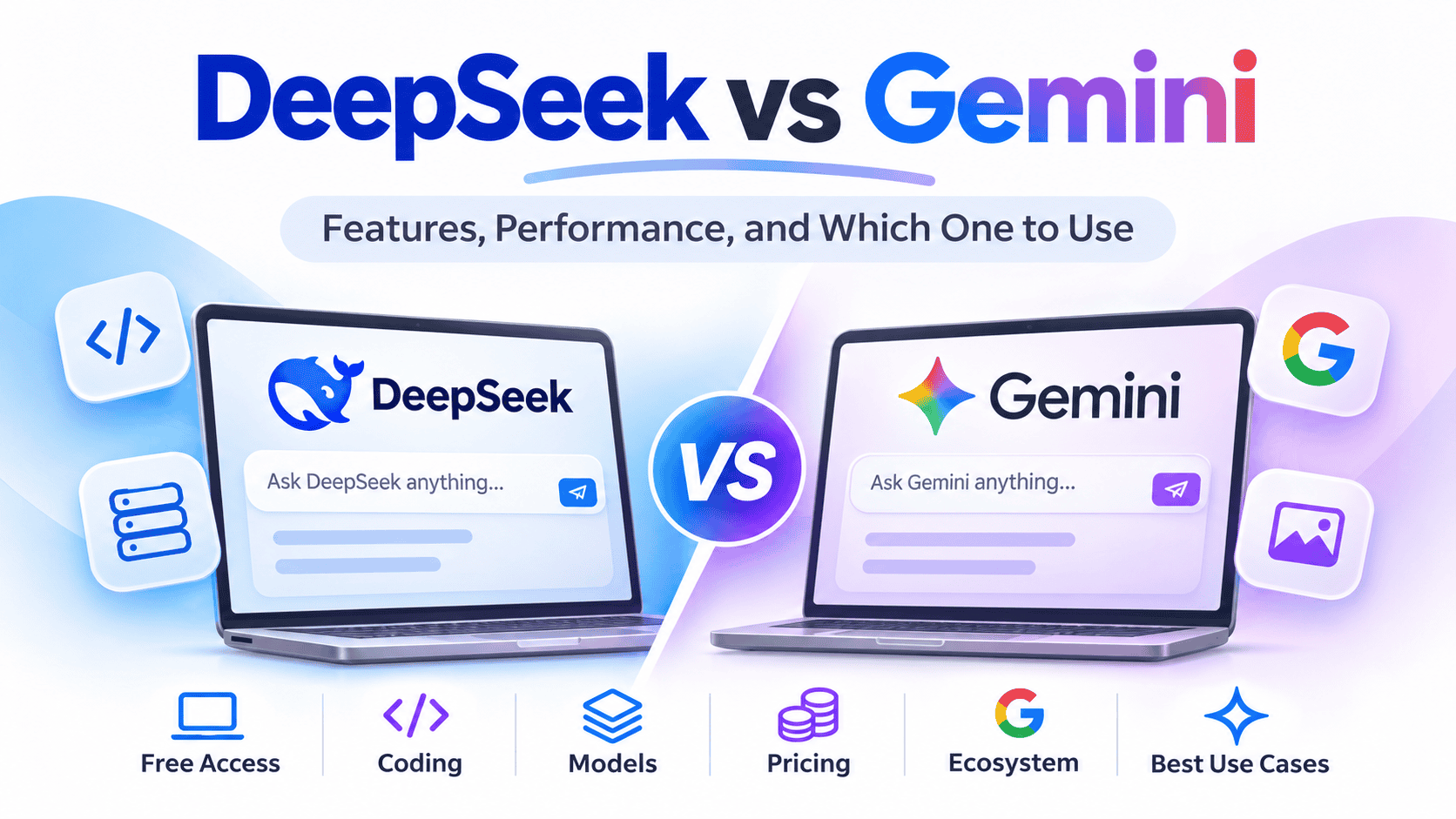

DeepSeek and Gemini overlap as AI assistants, but they are strongest in different situations. Gemini is the better all-around choice for most US users who want native support for audio, video, PDFs, Google Search, Google apps, and paid access to a frontier model. DeepSeek is the better value when the priorities are a free consumer chat, much lower API prices, open model weights, or the option to self-host. Coding is the closest contest: DeepSeek offers unusually strong price-to-performance, while Gemini gives paying users a broader agent and cloud ecosystem plus access to the more capable Gemini 4 Argon.
Published: November 5, 2026. Model availability, plan limits, and API prices can change quickly.
Quick recommendation: Choose DeepSeek for free general-purpose chat, low-cost text and image workloads, OpenAI- or Anthropic-compatible API access, and open-weight deployment. Choose Gemini for research, mixed-media files, voice and video, Google Workspace, Android assistance, and premium frontier reasoning.
DeepSeek vs Gemini at a glance
| Priority | Better fit | Why |
|---|---|---|
| Free consumer chat | DeepSeek | DeepSeek’s official web and mobile assistant is free, while Gemini’s free experience uses standard limits and reserves higher access for paid plans. |
| Google apps and Android | Gemini | Gemini connects with Google services and is built into a much wider Google productivity ecosystem. |
| Audio, video, PDFs, and mixed media | Gemini | Gemini 3.8 Flash documents native text, image, audio, video, and PDF input. DeepSeek V4.1 Flash documents text and image input. |
| Low-cost API | DeepSeek | DeepSeek V4.1 Flash’s published token prices are substantially below Gemini 3.8 Flash and Gemini 4 Argon. |
| Open weights or self-hosting | DeepSeek | DeepSeek V4.1 Flash weights are published under the MIT License. Gemini models are proprietary managed services. |
| Turnkey web research | Gemini | Gemini combines Google Search grounding, citations, and Deep Research. DeepSeek also offers web search, but its developer workflow is more modular. |
| Coding and reasoning | Depends | DeepSeek is compelling for price-sensitive development. Gemini 4 Argon is the stronger premium option, while the Flash-tier comparison is close and task-dependent. |
| Confidential or regulated work | Depends on deployment | Neither consumer chat should receive secrets by default. Compare paid API terms, enterprise controls, regional requirements, and self-hosting capabilities. |
What is actually being compared?
A brand-level comparison can be misleading because “DeepSeek” and “Gemini” each refer to consumer apps, APIs, several models, and different deployment methods.
DeepSeek’s October 17, 2026 changelog says its official web and app experience uses DeepSeek V4.1 Flash-1017. Developers call that model through the deepseek-flash API identifier. DeepSeek also continues to list V4 Pro as an API option, although V4.1 Flash is the current app model and the more relevant default for a present-day comparison.
Gemini’s consumer app is a product layer rather than one permanently fixed model. Paying Google AI Pro and Ultra subscribers can access Gemini 4 Argon, while the developer platform includes the stable Gemini 3.8 Flash and other specialized models. Google announced Gemini 4 Carbon on October 28, 2026, but stated that it was initially limited to selected cyber defenders and would come to developers, businesses, and consumers later. Carbon is therefore not treated as a generally available choice in this comparison.
The fairest comparison is consequently split into three decisions: DeepSeek versus Gemini as consumer assistants, DeepSeek V4.1 Flash versus Gemini 3.8 Flash for economical API workloads, and DeepSeek’s available models versus Gemini 4 Argon for demanding paid work.
Which is better for everyday users?
Free access and paid plans
DeepSeek has the simpler consumer offer. Its official download page describes the web and mobile assistant as free and powered by its latest flagship model. The API is separate and billed according to usage.
Gemini can also be used without a paid AI plan, but access is limited by product-level usage caps. In the United States, Google lists Google AI Pro at $19.99 per month with 5 TB of storage and expanded Gemini access. Google AI Ultra starts at $100 per month and provides higher limits and additional benefits. These are bundles rather than chatbot-only subscriptions, so their value depends partly on whether the storage, Google apps, media tools, and other benefits are useful to you.
Gemini also publishes different consumer context allowances by plan: 32,000 tokens without an AI plan, 128,000 with AI Plus, and 1 million with AI Pro or Ultra. DeepSeek publishes a 1-million-token context for its API model, but it does not publish an equivalent guaranteed context allowance for the free consumer app. Do not assume that an API limit automatically applies to a chat website.
Research, web search, and citations
Gemini is the stronger turnkey research product. Supported Gemini models can use Google Search grounding, and the consumer app offers Deep Research for multi-step reports that browse and synthesize many sources. This is more convenient for a student, analyst, or marketer who wants a cited report without building a retrieval system.
DeepSeek is no longer limited to static model knowledge. Its consumer app includes web search, and the DeepSeek Search and Fetch APIs let developers retrieve search results and page content as structured data. This is useful for agents and retrieval-augmented generation, but developers must decide how to rank sources, quote evidence, handle failures, and connect retrieved material to model responses.
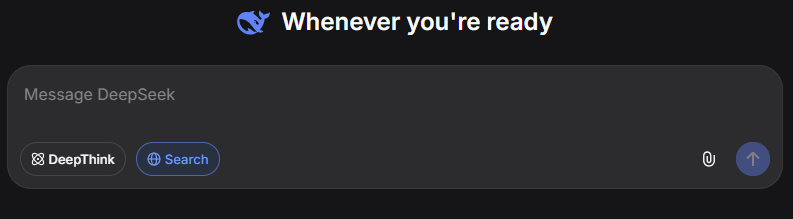
For a ready-made research assistant, Gemini has the advantage. For a lightweight custom search pipeline where cost and API simplicity matter, DeepSeek is highly competitive. In either product, open the cited pages and verify important facts; a citation proves that a source was retrieved, not that the model interpreted it correctly.
Files, images, audio, and video
Gemini wins the multimodal comparison. The Gemini 3.8 Flash model page lists text, images, video, audio, and PDFs as supported inputs, along with file search, code execution, Search grounding, structured output, and other tools.
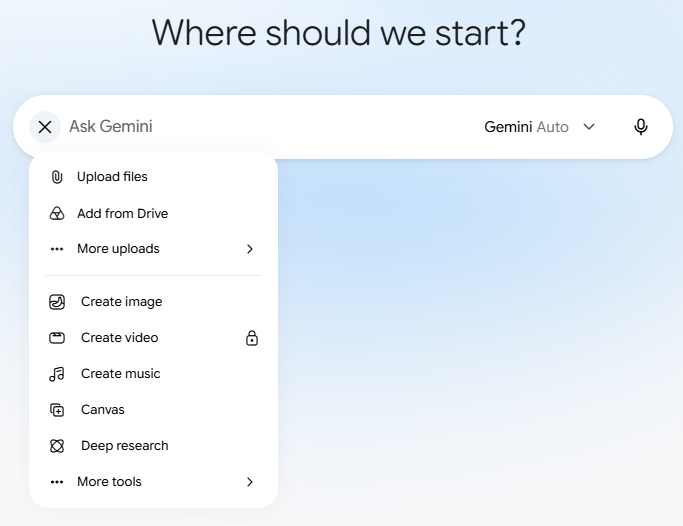
DeepSeek V4.1 Flash is genuinely multimodal, but its documented scope is narrower. The DeepSeek Vision guide covers image input for screenshots, charts, photographs, and optical text recognition. Its model listing identifies text and image input with text output; it does not document native audio or video input for V4.1 Flash.
Choose Gemini when your work routinely combines meeting audio, videos, screen sharing, large PDFs, photographs, and text. Choose DeepSeek when the workload is primarily text, code, screenshots, charts, or scanned images.
Google Workspace and connected apps
Gemini’s ecosystem is a decisive advantage for people already working in Gmail, Docs, Sheets, Drive, Chrome, Android, and other Google services. Depending on the account, region, and plan, Gemini can retrieve context from connected apps, help inside Google productivity tools, use personal information with permission, and complete multi-step tasks across supported services.
DeepSeek is more independent and more portable as a model and API, but its consumer app does not offer an equivalent first-party productivity suite. That makes DeepSeek attractive when you want a focused assistant without paying for a larger ecosystem, and Gemini attractive when reducing app switching is more valuable than obtaining the lowest model cost.
DeepSeek vs Gemini for coding and reasoning
There is no honest universal winner for coding. Results change with the exact model, reasoning setting, repository size, tool access, test harness, and whether success means producing a plausible answer or passing executable tests.
In a like-for-like Flash-tier comparison, Artificial Analysis scored DeepSeek V4.1 Flash-1017 at 33 and Gemini 3.8 Flash at 31 on its Intelligence Index when both used their highest listed reasoning setting. The subtests were mixed: DeepSeek led several automation and terminal-oriented evaluations, while Gemini led several knowledge-reliability and hard-reasoning evaluations. A two-point composite difference is not evidence that one model will be better on every codebase.
At the premium end, Gemini 4 Argon is a different class of product. The same independent index placed Argon well above the two Flash models, but Argon also costs much more and is unavailable on the free Gemini API tier. Comparing Argon directly with DeepSeek V4.1 Flash without acknowledging the price and access difference would be misleading.
- Choose DeepSeek for coding when API cost, open weights, long outputs, local control, or compatibility with OpenAI- and Anthropic-style clients is the priority.
- Choose Gemini for coding when you need the stronger paid frontier model, built-in code execution and Google tools, multimodal repository context, or an integrated agent environment.
- Benchmark both when the model will touch production code. Use 20 to 50 representative tasks, run unit and integration tests, measure retries and latency, and calculate the cost of successful tasks rather than the cost per token alone.
Which is better for writing, learning, and analysis?
For drafting, rewriting, summarizing, and explaining concepts, both tools are capable. The practical difference is usually the surrounding workflow rather than a permanent difference in prose quality.
- Writing and brainstorming: DeepSeek is attractive for unlimited-feeling free drafting and inexpensive API generation. Gemini is more useful when the draft needs information from Gmail, Docs, Drive, Search, or multimedia files.
- Learning: DeepSeek is a strong no-cost tutor for explanations and practice questions. Gemini has the advantage when lessons require diagrams, video, audio, cited web research, or a large collection of uploaded course materials.
- Business analysis: Gemini is generally the easier choice for mixed files and Google Workspace data. DeepSeek is compelling for repeatable text-heavy analysis where token cost dominates.
- High-stakes analysis: Neither model should be treated as the final authority for medical, legal, financial, safety, or security decisions. Require primary sources, calculations, and qualified human review.
For important writing, run a blind comparison using the same source material and rubric. Score factual accuracy, instruction following, tone, unsupported claims, editing effort, and total cost. Personal preference is useful, but it should not replace verification.
Developer comparison: current models and capabilities
| Model | Best role | Documented inputs | Context and output | Weights |
|---|---|---|---|---|
DeepSeek V4.1 Flash-1017deepseek-flash | Low-cost reasoning, coding, agents, and image understanding | Text and images | 1M context; up to 384K output | Open weights, MIT License |
Gemini 3.8 Flashgemini-3.8-flash | Production multimodal agents and high-volume work | Text, images, audio, video, and PDFs | 1,048,576 input tokens; 65,536 output tokens | Proprietary |
Gemini 4 Argongemini-4-argon | Frontier reasoning, complex coding, science, and long-horizon agents | Text, images, audio, and video | 1,048,576 unified input-and-output budget; long decode available | Proprietary, paid access |
DeepSeek V4 Pro remains listed by DeepSeek as an API model with a 1-million-token context and a 393,216-token maximum output, but it lacks V4.1 Flash’s vision support and costs more. New projects should compare it against V4.1 Flash on their own tasks rather than assuming “Pro” is automatically the better choice.
API pricing
The following first-party prices were checked on November 6, 2026. They exclude taxes, third-party hosting markups, storage, external tools, and any separate search charges.
| Model | Input per 1M tokens | Output per 1M tokens | Important condition |
|---|---|---|---|
| DeepSeek V4.1 Flash-1017 | $0.15 off-peak $0.30 peak | $0.60 off-peak $1.20 peak | Cache-hit input is $0.003 to $0.006. DeepSeek defines two weekday peak windows in UTC. |
| DeepSeek V4 Pro | $0.66 off-peak $1.32 peak | $1.98 off-peak $3.96 peak | Cache-hit input is $0.022 to $0.044. |
| Gemini 3.8 Flash | $0.75 | $3.75 | Introductory paid-tier pricing through December 31, 2026; output includes thinking tokens. |
| Gemini 4 Argon | $2 through November 30 $4 from December 1 | $10 through November 30 $20 from December 1 | No free API tier. Cached input is $0.10 during introductory pricing and $0.20 afterward. |
For a transparent example, consider one request batch containing 1 million uncached input tokens and 250,000 output tokens, with no search, tools, or storage charges. Published token rates produce an estimated cost of $0.30 to $0.60 with DeepSeek V4.1 Flash, $1.69 with Gemini 3.8 Flash, or $4.50 with Gemini 4 Argon during its introductory period. Actual cost can differ substantially because reasoning tokens, cache hits, retries, and output length vary by model.
Retrieval has separate economics. DeepSeek lists Search and Fetch at $0.75 per 1,000 successful requests each. Google’s Gemini 3-series pricing gives paid users a monthly Search-grounding allowance and then charges a higher per-1,000-query rate. A research agent can therefore reverse an apparently simple token-price comparison if it makes many searches, repeats long prompts, or produces excessive reasoning tokens.
Tools, compatibility, and deployment
DeepSeek emphasizes compatibility and straightforward deployment. Its first-party API supports JSON output, tool calls, the Responses API, an Anthropic-compatible endpoint, prefix completion, fill-in-the-middle completion in non-thinking mode, vision, and separate Search and Fetch endpoints. This can make migration easier when an application already uses OpenAI- or Anthropic-style clients.
Gemini offers the broader built-in toolset. Gemini 3.8 Flash documents structured output, function calling, code execution, file search, URL context, Google Search and Maps grounding, caching, and preview computer use. Google also provides AI Studio, Vertex AI, Google Cloud governance controls, and specialized models for live audio, image generation, video generation, transcription, embeddings, and research agents.
DeepSeek has the decisive advantage for organizations that require downloadable weights. The official V4.1 Flash-1017 model card publishes the weights under the MIT License. However, “open weights” does not mean “easy to run on a laptop.” The official repository is roughly 510 GB, and the model has hundreds of billions of total parameters. Serious serving requires high-end accelerator infrastructure, quantization decisions, monitoring, security controls, and experienced operations.
Gemini cannot be self-hosted from downloadable Gemini weights. Its tradeoff is a managed platform with less infrastructure work and tighter integration with Google Cloud. DeepSeek gives more deployment freedom; Gemini gives a more complete managed ecosystem.
Privacy and data handling
Privacy must be compared by product and plan, not by brand slogans. Consumer chat, a free API tier, a paid API, an enterprise cloud service, and a self-hosted model can have very different data practices.
DeepSeek consumer services
DeepSeek’s privacy policy says it may collect prompts, uploaded files, photos, chat history, device information, logs, and approximate location. It says personal data can be used to develop and improve services and train or improve its technology. The policy also lists a right to opt out of using personal data for model training or technology optimization.
The same policy says DeepSeek directly collects, processes, and stores personal data in the People’s Republic of China. It generally retains account, input, and payment data while an account is active and may keep data longer for legal, security, or legitimate business purposes. That can be unacceptable for some employers, government users, regulated organizations, and contracts even when the model’s technical performance is suitable.
Gemini consumer services
Google’s Gemini Apps Privacy Hub says Gemini can collect prompts, files, videos, screens, photos, connected-app information, generated content, usage data, and location information. Google says some collected data can be reviewed by human reviewers and used to improve its services and machine-learning technologies.
For adults, Gemini’s Keep Activity setting is on by default. When it is on, saved activity can be used to improve Google services, including generative AI models. Users can turn it off; Google says future chats are then not used to train its AI models unless the user submits feedback, although chats are still retained for up to 72 hours to provide and protect the service. Temporary chats offer similar training controls but are not a substitute for an approved confidential-data system.
APIs and enterprise use
Google’s Gemini API pricing documentation marks free-tier data as usable to improve Google products and paid-tier data as not used for that purpose. Google Cloud separately states that prompts and responses submitted to Gemini for Google Cloud are not used to train its models. DeepSeek’s public privacy policy permits use of user input to improve its technology, while its open-platform terms place responsibility on developers to publish privacy rules for their own end users. Organizations should obtain contractual answers about retention, training, subprocessors, incident response, and data location before sending confidential material.
- Do not paste passwords, private keys, unreleased source code, health records, legal files, customer databases, or regulated personal data into a consumer chat.
- Use a paid API or enterprise service with terms approved by legal and security teams when confidential data is necessary.
- Self-hosting DeepSeek can increase control, but only when logging, access control, backups, telemetry, model servers, and network boundaries are configured correctly.
- Review settings again after product updates. Privacy controls and defaults can change.
Is DeepSeek banned in the United States?
No nationwide consumer ban is established by the federal order reviewed for this article. However, the distinction matters.
On October 20, 2026, the US Department of Homeland Security published a Federal Register notice ordering the exclusion of DeepSeek products from federal civilian agency procurements and the removal of DeepSeek, affiliated products, and third-party products or services developed using DeepSeek implementations from federal civilian agency IT systems, subject to an exception process.
That is a significant restriction for federal civilian agencies, government contractors, and vendors serving those systems. It is not the same as a general prohibition on private consumers or ordinary US businesses. State agencies, schools, employers, and regulated organizations may impose separate policies, so users should check the rules that apply to their device and workplace.
Who should choose DeepSeek?
- You want a capable consumer assistant without a monthly AI subscription.
- Your application is sensitive to token cost, especially for long text, code, or agent loops.
- You need open weights, an MIT-licensed model, or a path to self-hosting.
- You prefer OpenAI- or Anthropic-compatible API formats.
- Your inputs are mainly text, code, screenshots, charts, and images rather than native audio and video.
- You can manage privacy, deployment, and organizational-policy requirements independently.
Who should choose Gemini?
- You rely on Gmail, Docs, Sheets, Drive, Chrome, Android, Google Search, or Google Cloud.
- You need native audio, video, PDF, image, and text understanding in one workflow.
- You want Deep Research, Search grounding, connected apps, or agentic task features without building the orchestration layer yourself.
- You are willing to pay for access to Gemini 4 Argon and higher consumer limits.
- Your developers need a broad set of managed tools, specialized media models, and enterprise cloud controls.
- Your organization cannot use DeepSeek because of federal, state, contractual, or internal policy.
When using both is the better answer
The choice does not need to be permanent. A practical split is to use Gemini for web research, Google files, audio, video, and source-backed reports, then use DeepSeek for inexpensive drafting, code iteration, structured transformation, or workloads that benefit from open deployment. Developers can route tasks by modality, sensitivity, latency, and budget instead of forcing one model to handle everything.
Using two models also creates a useful verification loop: ask one model to produce an answer and the other to identify unsupported claims, missing edge cases, or failing tests. This reduces dependence on one provider, but it does not replace primary sources or human review.
Final verdict: DeepSeek or Gemini?
Gemini is the better general-purpose choice for most US users because it combines strong models with native multimodal input, Google Search, Deep Research, connected apps, voice and video features, and a mature cloud platform. It is especially compelling for people already paying for or working inside Google’s ecosystem.
DeepSeek is the better value and deployment choice when a free chat, low API cost, open weights, long text output, or self-hosting matters more than native audio, video, and Google integration. Its V4.1 Flash-1017 model makes it a serious option for coding and agent workloads rather than merely a budget alternative.
For coding, there is no brand-level winner. Use DeepSeek when cost and control dominate; use Gemini 4 Argon when the hardest task quality and managed agent ecosystem justify the premium; and test both against executable work before committing.
Frequently asked questions
Is DeepSeek better than Gemini?
DeepSeek is better for low-cost API use, free chat, open weights, and self-hosting. Gemini is better for multimodal work, Google integrations, web research, connected apps, and access to a stronger paid frontier model. The better choice depends on the workload and plan.
Which is better for coding, DeepSeek or Gemini?
DeepSeek offers excellent coding value and can be self-hosted, while Gemini offers the stronger premium model and a broader managed tool ecosystem. For production use, test both on your repositories and score passing tests, retries, latency, and total cost.
Is DeepSeek completely free?
The official DeepSeek consumer web and mobile assistant is free. The DeepSeek API is not free; it uses prepaid, usage-based billing for model tokens and separate Search and Fetch requests.
Which is more private, DeepSeek or Gemini?
Neither brand has one privacy answer across every product. Gemini provides detailed consumer activity controls and distinguishes free from paid API data use. DeepSeek offers an opt-out right and open weights that can be self-hosted, but its consumer policy says personal data is processed and stored in China. Sensitive use should be evaluated by deployment, contract, settings, and organizational rules.
Is DeepSeek banned in the US?
DeepSeek is subject to a federal order affecting federal civilian executive branch IT systems and procurements. The order is not a nationwide ban on ordinary private consumer use, although other employers, states, schools, and organizations may have their own restrictions.
Can DeepSeek replace Gemini?
DeepSeek can replace Gemini for many text, code, reasoning, image-analysis, and API workloads. It is not a complete substitute when the workflow depends on native audio or video, Google Workspace integration, Deep Research, Gemini Live, or Google-specific agent tools.
Sources checked
- DeepSeek API changelog
- DeepSeek models and API pricing
- DeepSeek Vision documentation
- DeepSeek Search and Fetch documentation
- DeepSeek Privacy Policy
- DeepSeek V4.1 Flash-1017 model card
- Gemini API model directory
- Gemini Developer API pricing
- Gemini Apps limits and feature availability
- Gemini Apps Privacy Hub
- Google AI plans for the United States
- Gemini 4 Argon availability announcement
- Gemini 4 Carbon announcement and rollout status
- Federal Register notice concerning DeepSeek in federal civilian systems
- Artificial Analysis Flash-model comparison
- Artificial Analysis Gemini 4 Argon profile