

Published: November 7, 2026.
DeepSeek V4.1 Flash is a multimodal Mixture-of-Experts model designed for long-context reasoning, coding, visual understanding, and tool-using agents. The API alias deepseek-flash currently serves the DeepSeek-V4.1-Flash-1017 checkpoint, which also powers DeepSeek’s official web and mobile assistant.
The model accepts text and images but generates text rather than image files. It supports a one-million-token context window, thinking and non-thinking modes, tool calls, structured JSON, and several API formats. Its main qualification is scale: “Flash” refers to serving efficiency and cost, not to a small model that is easy to run on an ordinary laptop.
DeepSeek V4.1 Flash at a glance
| Specification | Current information |
|---|---|
| Current API version | DeepSeek-V4.1-Flash-1017 |
| API model name | deepseek-flash |
| Original release | September 10, 2026 |
| 1017 update | October 17, 2026 |
| Model type | Multimodal Mixture-of-Experts model |
| Context window | 1,048,576 tokens |
| Maximum output | 393,216 tokens, commonly shown as 384K |
| Input modalities | Text and images |
| Output modality | Text |
| Thinking mode | Supported and enabled by default |
| Reasoning-effort levels | Low, high, and max; high is the default |
| API formats | OpenAI-compatible Chat Completions, Responses API, and Anthropic-compatible Messages API |
| Other features | JSON Output, tool calls, streaming, context caching, Prefix Completion, and FIM Completion in non-thinking mode |
| Account concurrency limit | 2,500 concurrent model requests |
| Checkpoint license | MIT on the official Hugging Face repository |
These specifications were checked against the current DeepSeek models and pricing page and the live model metadata documentation. The API alias is a floating name, so DeepSeek can update the checkpoint behind deepseek-flash without requiring applications to change their model string.
What is DeepSeek V4.1 Flash-1017?
DeepSeek released the original V4.1 Flash model on September 10, 2026. On October 17, it updated the model to DeepSeek-V4.1-Flash-1017 and moved the official website, mobile app, and deepseek-flash API alias to the new checkpoint.
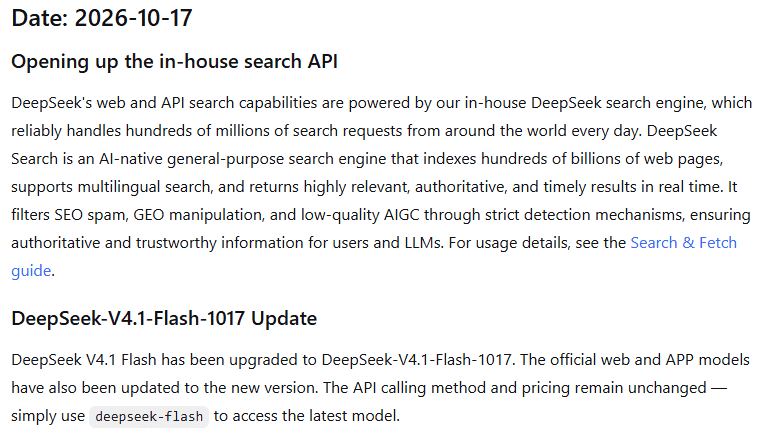
The official 1017 model card describes it as a minor update rather than a new architecture. Its configuration, tokenizer, API name, and pricing remain aligned with the original V4.1 Flash release; the primary change is the updated model weights and post-training behavior.
| Name | What it means | Current status |
|---|---|---|
| DeepSeek-V4.1-Flash | The model family and original September checkpoint | Superseded in the hosted API by the 1017 update |
| DeepSeek-V4.1-Flash-1017 | The versioned October 17 weight update | Current checkpoint served by the Flash API alias |
deepseek-flash | The recommended floating API alias | Currently routes to V4.1-Flash-1017 |
deepseek-v4-flash | A legacy API name | Still accepted but routes to V4.1-Flash-1017 |
deepseek-v4-flash-vision-exp | A legacy experimental vision-model name | Retired; requests route to the current Flash model |
deepseek-v4-pro | A separate API model | Still available as DeepSeek-V4-Pro-0813 |
The distinction matters in production. An application using deepseek-flash receives DeepSeek’s current hosted Flash version, while a self-hosted deployment can pin the exact DeepSeek-V4.1-Flash-1017 checkpoint for reproducibility.
What changed in the 1017 update?
DeepSeek says the 1017 update improves reasoning, coding, visual tasks, and longer agent workflows. The company also reports shorter outputs and faster task completion, which can reduce per-task cost even though the underlying per-token API prices did not change.
The update places particular emphasis on end-to-end project development. DeepSeek says it used reinforcement learning with self-feedback to improve tasks such as repository work, game creation, and multi-step application development.
- Same API model name: Applications continue to use
deepseek-flash. - Same API prices: The October update did not introduce another price change.
- Same architecture: DeepSeek describes 1017 as a minor weight update, not a replacement architecture.
- Updated web and app model: DeepSeek Web and the official mobile app moved to 1017.
- Agent optimization: The release was tuned for DeepSeek Harness and other coding-agent environments.
- Shorter task outputs: DeepSeek reports that the updated checkpoint often completes work with fewer generated tokens.
At launch, DeepSeek recommended DeepSeek Harness 0.2.1-rc.1 or later for the best experience with the 1017 checkpoint. That was a minimum recommendation for the release, not a claim that 0.2.1-rc.1 remains the newest Harness version.
How many parameters does DeepSeek V4.1 Flash have?
Different pages show different parameter counts because they are not necessarily counting the same parts of the model. The safest approach is to keep each number attached to the component it describes.
| Parameter figure | What it describes |
|---|---|
| 552 billion | The language-model backbone reported in the technical report |
| 196 billion | Engram conditional-memory parameters, accessed sparsely through token-based lookup |
| 8 billion active | Approximate active parameters per token during prefill or input processing |
| 16 billion active | Approximate active parameters per token during decode or output generation |
| 763 billion | The parameter count displayed in the Hugging Face repository metadata for the full checkpoint |
These figures are not interchangeable. The 552B figure refers to the backbone, while the repository-level count includes a broader set of model components. The active counts describe how much of the sparse architecture participates in processing each token; they do not describe the downloaded checkpoint’s storage size.
The practical point is that V4.1 Flash uses a very large sparse model while activating a smaller subset for each token. That can lower inference computation, but it does not turn the full checkpoint into a small or laptop-friendly model.
How the architecture works in plain English
Mixture of Experts
A Mixture-of-Experts model contains many specialized expert networks but routes each token through only a subset of them. DeepSeek’s model card describes one shared expert and 384 routed experts in each MoE layer, with six routed experts activated per token.
This allows the model to have a large overall capacity without using every parameter for every word. It can improve serving efficiency, although sparse activation alone does not guarantee accuracy or speed for every workload.
Causal Encoder–Decoder
V4.1 Flash uses a 40-layer Causal Encoder–Decoder architecture, split into a 20-layer causal encoder and a 20-layer decoder. During prefill, when the model processes the prompt, it can perform most of the input work through the encoder half. During decode, when it generates the answer, both sides of the architecture contribute to output production.
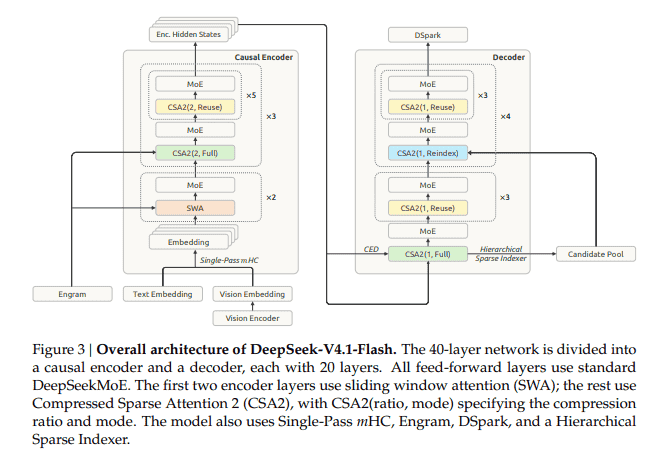
This asymmetric design helps explain the difference between approximately 8B active parameters during prefill and 16B during decode. It is particularly relevant to coding agents and document workflows, where prompts, files, logs, and tool outputs can be much longer than the final answer.
Compressed Sparse Attention 2 and FP4 KV caching
A model’s key-value cache stores information needed to continue generating text without recalculating the entire prompt for every output token. Long conversations and million-token contexts can make this cache extremely expensive in accelerator memory, host memory, and storage.
The V4.1 Flash technical report describes two important techniques: cross-layer cache reuse through Compressed Sparse Attention 2 and lower-precision FP4 cache storage. DeepSeek reports a global KV-cache footprint of about 890 bytes per token, approximately one-quarter of the corresponding V4 Flash footprint.
SWA Bounded Replay
Sliding-window attention lets a layer focus on a limited recent range instead of repeatedly processing all previous tokens. DeepSeek’s SWA Bounded Replay deployment method replays only a bounded suffix of the sequence when reconstructing certain cache states.
DeepSeek reports that this reduces the persistent KV cache stored in host memory or on SSD to roughly one-eighth of the previous V4 Flash requirement. This is a serving optimization, not a promise that long-context requests become free or that every third-party runtime will reproduce the same result.
Engram and DSpark
Engram is a sparsely accessed conditional-memory component that stores token-pattern information outside the normal expert layers. The model card assigns 196B parameters to this memory system. Because it is accessed through token-based lookup, not all Engram parameters participate in every request.
DSpark is DeepSeek’s speculative-decoding system. It drafts multiple possible output tokens and verifies them using confidence-aware scheduling. The purpose is to accelerate generation without changing the requested model behavior, although observed speed still depends on hardware, batching, runtime, and workload.
Vision support: what the model can and cannot do
DeepSeek V4.1 Flash accepts interleaved text and image input. Through the official API, images can be supplied as base64 data, an external URL, or a file uploaded through the Files API.
The official Vision guide lists JPEG, PNG, GIF, and WebP as supported formats. The model can describe images, read screenshots, interpret charts, inspect user interfaces, and analyze visual output returned by an external tool.
| Visual task | Supported? | What the model returns |
|---|---|---|
| Describe a photograph | Yes | Text |
| Read a screenshot | Yes | Extracted or interpreted text |
| Analyze a chart | Yes | Textual analysis |
| Inspect a generated interface | Yes | Feedback or instructions in text |
| Accept images returned by a tool | Yes, in supported API formats | Textual interpretation |
| Generate a PNG, JPG, or WebP image | No | Text only |
| Native inpainting or background removal | Not documented | Requires a separate image-generation or editing tool |
Vision support is not image generation. The current model metadata lists text as the output modality, so V4.1 Flash does not natively return newly rendered image files.
Thinking mode and reasoning effort
Thinking mode is enabled by default for deepseek-flash. The current API exposes three reasoning-effort levels: low, high, and max. If no effort is specified, the server uses high.
| Setting | Good starting point for | Tradeoff |
|---|---|---|
none | Rewriting, classification, extraction, short summaries, and simple tool routing | Lower reasoning cost but less analysis on difficult tasks |
low | Moderate questions where speed and cost matter | May miss steps that a higher effort catches |
high | Coding, planning, document analysis, mathematics, and normal complex tasks | Uses more output tokens and usually takes longer |
max | Hard problems that justify maximum reasoning effort | Can substantially increase output length, latency, and cost |
The API also accepts compatibility labels from some clients. For example, minimal maps to low, medium and xhigh map to high, and ultra maps to max. Applications should still prefer the model’s documented values when they control the request directly.
In thinking mode, DeepSeek returns internal reasoning through reasoning_content and the final answer through content. When a request uses tools, previous reasoning content must be preserved correctly across the tool loop so the model can continue its existing reasoning process.
The official Thinking Mode guide also notes that temperature, presence_penalty, and frequency_penalty have no effect in thinking mode. For Flash, top_p only operates within a narrow effective range in thinking mode and is fixed in non-thinking mode.
How to call DeepSeek V4.1 Flash through the API
DeepSeek provides an OpenAI-compatible API at https://api.deepseek.com. The following example uses the recommended deepseek-flash alias and reads the credential from an environment variable.
Install the current OpenAI Python SDK:
python -m pip install openaiStore the key in your shell rather than inside the source file:
export DEEPSEEK_API_KEY="your_api_key_here"On Windows PowerShell, use:
$env:DEEPSEEK_API_KEY = "your_api_key_here"Then make a request:
import os

from openai import OpenAI, OpenAIError

api_key = os.environ.get("DEEPSEEK_API_KEY")
if not api_key:
    raise RuntimeError("DEEPSEEK_API_KEY is not set.")

client = OpenAI(
    api_key=api_key,
    base_url="https://api.deepseek.com",
)

try:
    response = client.chat.completions.create(
        model="deepseek-flash",
        messages=[
            {
                "role": "system",
                "content": "You are a precise software architecture assistant.",
            },
            {
                "role": "user",
                "content": (
                    "Compare event-driven and request-response architectures "
                    "for a payment-notification service. Use a decision table "
                    "and identify the main failure modes."
                ),
            },
        ],
        reasoning_effort="high",
        extra_body={
            "thinking": {
                "type": "enabled"
            }
        },
        stream=False,
    )

    message = response.choices[0].message
    print(message.content)
except OpenAIError as exc:
    print(f"DeepSeek API request failed: {exc}")
The official first-call guide also documents the Anthropic-compatible base URL as https://api.deepseek.com/anthropic. Use the API format that matches your framework rather than assuming that every parameter from another provider is implemented identically.
API features and important compatibility limits
| Feature | Current support | Important qualification |
|---|---|---|
| Chat Completions | Supported | OpenAI-compatible format |
| Responses API | Supported | Several OpenAI Responses features remain unsupported or are ignored |
| Anthropic Messages API | Supported | Some message and system-prompt behavior differs by model |
| Function tools | Supported | The application executes the function; the model only requests it |
| Parallel tool calls | Supported | The Responses API treats parallel tool calling as always enabled |
| JSON Output | Supported | The prompt should explicitly request JSON and the application should handle blank or invalid results |
Custom apply_patch tool | Supported in Responses API | Other custom-tool names are not generally supported |
| Chat Prefix Completion | Beta | Check current documentation before production use |
| FIM Completion | Beta | Available only in non-thinking mode |
| Context caching | Automatic | Only eligible repeated prefixes receive the lower cache-hit price |
Server-side web_search | Not supported by Flash | Currently supported with deepseek-v4-pro and ignored with deepseek-flash |
The Responses API is currently stateless. Features such as previous_response_id, server-side conversation storage, background responses, and several other OpenAI-specific controls are not supported. Some unsupported parameters are silently ignored, so applications should inspect the actual response rather than assuming a request feature was applied.
How to add web search to V4.1 Flash
V4.1 Flash does not currently use DeepSeek’s built-in server-side web_search tool in the Responses API. A developer can still give it current web information through:
- A custom search function exposed through tool calling.
- The standalone DeepSeek Search API.
- The DeepSeek Fetch API for reading a selected URL.
- A retrieval-augmented generation pipeline.
- A client-managed browser, crawler, or enterprise search system.
The distinction is important: support for function calling does not mean the model automatically owns or executes a search engine. The application must run the external tool and return its result to the model.
DeepSeek V4.1 Flash API pricing
DeepSeek bills model usage per one million tokens. Prices depend on whether input tokens hit the context cache and whether the request occurs during a published peak window.
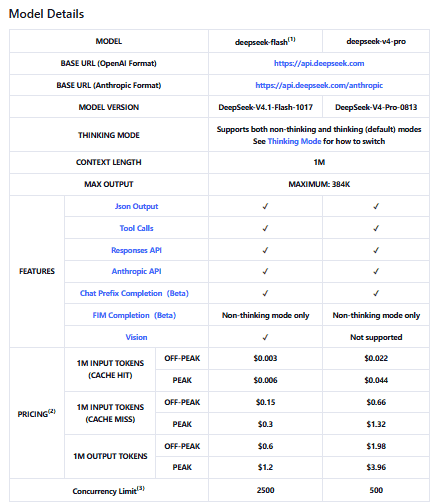
The following rates were verified on November 6, 2026:
| Token category | Off-peak price per 1M tokens | Peak price per 1M tokens |
|---|---|---|
| Input: cache hit | $0.003 | $0.006 |
| Input: cache miss | $0.15 | $0.30 |
| Output | $0.60 | $1.20 |
Peak hours are currently 01:00–04:00 UTC and 06:00–10:00 UTC, Monday through Friday, excluding Chinese public holidays. Weekends, Chinese public holidays, and all other hours use off-peak rates.
DeepSeek also lists a concurrency limit of 2,500 simultaneous model requests per account. The limit is calculated at the account level rather than separately for each API key.
Example request cost
Assume an off-peak request contains 100,000 uncached input tokens and generates 20,000 output tokens:
Input:
100,000 ÷ 1,000,000 × $0.15 = $0.015

Output:
20,000 ÷ 1,000,000 × $0.60 = $0.012

Estimated model cost:
$0.015 + $0.012 = $0.027
The same request at peak rates would cost approximately $0.054. This example excludes standalone Search or Fetch calls, third-party tools, storage, hosting, and any infrastructure operated by the application developer.
Search and Fetch currently cost $0.75 per 1,000 successful requests each. Those charges are separate from the model tokens used to analyze or summarize the returned material.
How the one-million-token context works
The one-million-token context window is the total capacity available to a request. It can include system instructions, conversation history, text, image tokens, tool calls, tool results, retrieved documents, reasoning content, and generated output.
The 384K output limit is a maximum inside that overall request budget. It does not mean an application can submit a full one-million-token input and then generate another 384K tokens on top of it.
- Large context does not guarantee perfect recall. Important details can still be missed or misinterpreted.
- Unnecessary context increases cost. Sending entire repositories or document collections without filtering can waste tokens and reduce focus.
- Output tokens are usually more expensive. Max reasoning effort and verbose answers can materially affect cost.
- Caching can lower repeated-input cost. DeepSeek manages context caching automatically, but only qualifying repeated prefixes receive cache-hit pricing.
- Compression benefits the provider’s infrastructure. Efficient KV storage does not make million-token requests free.
DeepSeek V4.1 Flash vs. V4 Pro
DeepSeek initially announced plans to phase out V4 Pro after the original V4.1 Flash launch. It later reversed that plan in response to user demand, and deepseek-v4-pro remains a separately priced API model.
| Area | V4.1 Flash-1017 | V4 Pro-0813 |
|---|---|---|
| API alias | deepseek-flash | deepseek-v4-pro |
| Context window | 1M tokens | 1M tokens |
| Maximum output | 384K tokens | 384K tokens |
| Image input | Supported | Not supported |
| Thinking and non-thinking | Supported | Supported |
| JSON Output and function tools | Supported | Supported |
| Responses and Anthropic APIs | Supported | Supported |
| Built-in Responses API web search | Ignored | Supported |
| Off-peak uncached input | $0.15 per 1M tokens | $0.66 per 1M tokens |
| Off-peak output | $0.60 per 1M tokens | $1.98 per 1M tokens |
| Concurrency per account | 2,500 | 500 |
| Current hosted version | V4.1-Flash-1017 | V4-Pro-0813 |
V4.1 Flash is the more practical starting point for vision, cost-sensitive high-volume processing, and multimodal agents. V4 Pro remains relevant when an application has already validated it for a particular workload or needs DeepSeek’s built-in server-side web-search tool.
Do not select a model only from a vendor benchmark table. Test both models on representative inputs, expected output formats, tool loops, latency targets, and failure cases before changing a production system.
What the benchmark results do and do not show
The current 1017 model card reports improvements over the original V4.1 Flash checkpoint across reasoning, coding, agentic, and visual benchmarks. Examples include higher reported scores on Terminal-Bench 4.0, DeepSWE v1.1, ProgramBench, Automation-Bench, and Humanity’s Last Exam.
| Benchmark | Original V4.1 Flash | V4.1 Flash-1017 |
|---|---|---|
| Humanity’s Last Exam without tools | 36.8 | 42.6 |
| Terminal-Bench 4.0 | 31.2 | 42.3 |
| DeepSWE v1.1 | 74.2 | 77.0 |
| ProgramBench | 20.3 | 29.1 |
| Automation-Bench | 54.8 | 60.5 |
These are vendor-published results, not proof that every real application will improve by the same amount. Scores can change with the harness, reasoning effort, tool access, prompt, token budget, pass-rate method, and benchmark version.
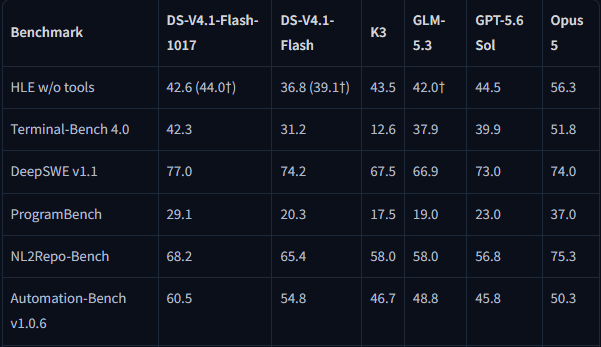
The 1017 model card identifies specific scaffolds for important agent tests, including Claude Code for Terminal-Bench 4.0 and Mini-SWE-V2 for DeepSWE v1.1. A result obtained through one scaffold should not be treated as a pure measurement of the base model or compared casually with a score produced under different conditions.
Open weights and local deployment
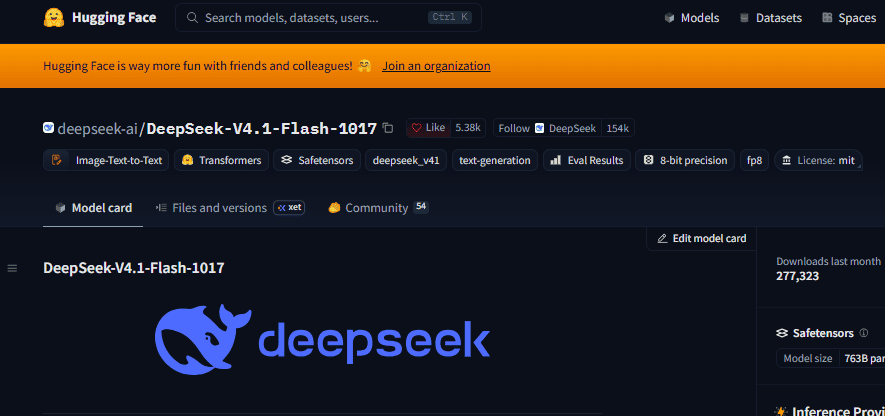
DeepSeek publishes the V4.1 Flash-1017 checkpoint on Hugging Face under the MIT License. The repository provides model files and links to compatible inference options.
DeepSeek also released DeepInfer, an Apache-2.0-licensed inference framework that supports V4.1 Flash and provides optimized kernels, distributed parallelism, DSpark decoding, bounded replay, structured output, and offline inference.
This makes the model open weight and provides important open-source inference components. It does not mean that the complete training dataset, every training tool, or every part of DeepSeek’s production serving infrastructure is publicly available.
Can it run on a normal laptop?
The full checkpoint should not be treated as a typical laptop model. Hugging Face reports a repository-level parameter count of approximately 763B, and the official deployment material focuses on distributed accelerator configurations, expert parallelism, host-memory offloading, and large-scale serving.
DeepSeek does not publish one universal minimum RAM, VRAM, GPU-count, or storage requirement that applies to every runtime and quantization. Requirements vary according to precision, quantization, sequence length, batch size, multimodal use, parallelism, and the inference framework.
Community quantizations may reduce memory requirements, but they are separate artifacts and may change accuracy, throughput, context support, or compatibility. Evaluate their maintainers, licenses, and validation results independently.
Best use cases for V4.1 Flash
| Use case | Why the model may fit | What to test |
|---|---|---|
| Coding assistants | Long context, tool calls, FIM, reasoning controls, and lower API pricing | Patch correctness, dependency assumptions, test quality, and tool-loop stability |
| Repository-level debugging | Large context and agent-oriented post-training | Retrieval accuracy, unnecessary edits, and performance on your languages and frameworks |
| Visual software agents | Can inspect screenshots and images returned by tools | Small text, ambiguous interfaces, spatial accuracy, and error recovery |
| Document analysis | One-million-token context and multimodal input | Citation accuracy, recall across distant sections, and extraction consistency |
| Structured extraction | JSON Output and strict function schemas | Blank responses, truncation, malformed fields, and retry behavior |
| RAG applications | Large context, automatic caching, and tool integration | Retrieval quality, context selection, source attribution, and total token cost |
| Tool-using agents | Thinking-mode tool calls and support for major agent API formats | Argument validation, repeated calls, cost limits, and permission boundaries |
| High-volume API workloads | Lower token prices and higher published concurrency than V4 Pro | Latency, output quality, cache-hit rates, and behavior during peak demand |
Limitations and production considerations
- It can hallucinate. Long reasoning, visual input, and tool use do not guarantee factual or logical correctness.
- Vision can fail. Small text, crowded interfaces, charts, and spatial relationships can be misread.
- Large context is not perfect memory. The model may overlook details or give excess weight to irrelevant sections.
- The API alias can change. Pin and test a versioned checkpoint when deterministic version control is required.
- Responses API compatibility is partial. Unsupported parameters may be silently ignored.
- Built-in web search is unavailable on Flash. Use a separate retrieval tool or choose V4 Pro when server-side search is required.
- Reasoning effort changes cost. Max effort can produce much longer outputs than the task needs.
- Vendor benchmarks require context. Harnesses, tool access, reasoning budgets, and evaluation versions can change the result.
- Self-hosting is operationally demanding. Open weights do not remove hardware, monitoring, scaling, or security costs.
Controls for agent applications
- Grant tools the minimum permissions required for the task.
- Use explicit tool allowlists and validate every argument.
- Limit the number of turns, tool calls, tokens, and total cost.
- Run generated code and commands in an isolated environment.
- Require human approval for destructive, financial, publishing, or security-sensitive actions.
- Record prompts, tool requests, results, errors, and model versions for debugging.
- Maintain backups and version control before allowing file modifications.
- Test failure cases, prompt injection, malformed tool output, and partial responses.
DeepSeek V4.1 Flash is a model component, not a complete security boundary. Application developers remain responsible for authentication, data handling, permissions, validation, logging, monitoring, and recovery.
Frequently asked questions
Is DeepSeek V4.1 Flash-1017 a new architecture?
No. The official model card describes 1017 as a minor update to V4.1 Flash. It retains the same model family and API calling method while updating the weights and post-training behavior.
What does deepseek-flash currently point to?
As of November 6, 2026, the alias routes to DeepSeek-V4.1-Flash-1017. Because it is a floating alias, DeepSeek may update the backend in the future.
Is V4.1 Flash used in the DeepSeek app?
Yes. DeepSeek’s October 17 changelog says its official web and mobile assistant were updated to DeepSeek-V4.1-Flash-1017.
Can DeepSeek V4.1 Flash generate images?
No. It accepts images for visual understanding but its current API metadata lists text as the output modality. Image generation requires a separate model or external tool.
Does V4.1 Flash support built-in web search?
Not through the current server-side web_search tool in the Responses API. That tool is supported by deepseek-v4-pro and ignored with deepseek-flash. Flash can still use custom search functions, the standalone Search and Fetch APIs, or another retrieval system.
Is DeepSeek V4 Pro still available?
Yes. DeepSeek initially planned to phase it out but later continued the service in response to user demand. The current model catalog lists DeepSeek-V4-Pro-0813 under the deepseek-v4-pro alias.
Is DeepSeek V4.1 Flash free?
The official consumer assistant currently uses the model without a separately listed consumer subscription, but API access is usage-based and paid. The downloadable checkpoint is MIT-licensed, while self-hosting still requires computing infrastructure and engineering work.
Can the checkpoint be used commercially?
The official Hugging Face repository labels the checkpoint with the MIT License, which generally permits commercial use, modification, and distribution under its conditions. Review the exact license, dependencies, third-party components, and trademark rules for the planned deployment. This is not legal advice.
The bottom line
DeepSeek V4.1 Flash-1017 is the current multimodal Flash checkpoint used by the official DeepSeek web assistant, mobile app, and deepseek-flash API alias. Its main strengths are a one-million-token context, native vision input, selectable reasoning effort, broad agent API support, automatic caching, and lower hosted pricing than V4 Pro.
Its architecture is designed to reduce the compute and KV-cache burden of input-heavy agent workloads, but the full checkpoint remains extremely large. Use the hosted API when you need straightforward access, pin the versioned checkpoint when reproducibility matters, and validate the model on representative tasks before using it in a production agent.
Official sources checked
Information verified on November 6, 2026. DeepSeek can update the checkpoint behind its API alias, pricing, compatibility, limits, and documentation. Recheck the official sources before publishing technical instructions or changing a production integration.
- Official DeepSeek V4.1 Flash launch announcement
- Official DeepSeek-V4.1-Flash-1017 release announcement and current API changelog
- Current DeepSeek models and pricing and model metadata documentation
- DeepSeek V4.1 Flash technical report
- Official versioned Hugging Face checkpoint and model card
- Official Thinking Mode guide and Vision guide
- Official Responses API compatibility guide and Tool Calls guide
- Official DeepInfer inference framework