
Published: November 7, 2026.
DeepSeek is open in several important ways, but “DeepSeek is fully open source” is too broad to be accurate without qualification. Many current DeepSeek models have publicly downloadable weights, public inference code, technical reports, and permissive MIT licenses. Developers can run, modify, fine-tune, redistribute, and commercially use many of those releases under the applicable license terms.
However, the complete answer depends on which model or product you mean and which definition of open source you apply. DeepSeek’s hosted chat service and API are services governed by separate terms, and the public materials checked do not establish that the complete end-to-end training code, full data-processing pipeline, or complete training corpus for its latest models has been released.
For a developer asking, “Can I download and commercially deploy a current DeepSeek model?” the answer is often yes. For a researcher asking, “Can I rebuild the same model from the released code and data information?” the answer is not clearly established.
Under DeepSeek’s own terminology, major releases such as DeepSeek-R1 and DeepSeek-V4 have been described as open source. Under the stricter Open Source AI Definition from the Open Source Initiative, public weights and inference code alone are not enough. The assessment must also consider training code, data information, parameters, and whether users have the practical ability to study, modify, use, and share the system.
The practical answer depends on what you mean by DeepSeek
The word “DeepSeek” may refer to several different things:
- A specific model checkpoint, such as DeepSeek-R1 or DeepSeek-V4.1-Flash-1017.
- The files and inference code published through DeepSeek’s official GitHub and Hugging Face accounts.
- The official DeepSeek Chat website or mobile app.
- The hosted DeepSeek API.
- DeepSeek Harness, a separately released open-source agent application.
- A third-party application, quantization, API provider, or local runtime that uses a DeepSeek model.
These components do not automatically have the same source availability, license, privacy terms, or commercial-use rules. A downloadable model can be openly licensed even when the hosted product built around it is not published as a complete open-source codebase.
| What the reader means | Practical answer |
|---|---|
| Current DeepSeek model weights | Many major releases are publicly downloadable and use permissive licenses such as MIT. |
| Inference and deployment code | DeepSeek publishes model-specific inference resources and open-source tools, although availability differs by release. |
| Complete training pipeline | Technical details are published, but complete end-to-end training code was not established in the official materials checked. |
| Complete training dataset | DeepSeek publishes training-data summaries, but the complete corpus is not publicly provided in the materials checked. |
| Official DeepSeek Chat product | It is a hosted service. The complete product source code was not established as publicly available. |
| Official DeepSeek API | It is a hosted developer service governed by platform terms, not an open-source API backend release. |
| DeepSeek Harness | This separate agent application is publicly available under the MIT License. |
Open source, open weights, and public access are not the same
Much of the disagreement over whether DeepSeek is open source comes from using several different terms as though they mean the same thing.
| Term | Plain-English meaning | How it applies to DeepSeek |
|---|---|---|
| Open-source software | Human-readable source code is provided under a license that permits use, modification, and redistribution. | Some DeepSeek repositories, libraries, inference tools, and applications are open-source software. |
| Open weights | The learned parameters of a trained model are downloadable. | Many official DeepSeek checkpoints provide downloadable model weights. |
| Permissively licensed weights | The provider applies a broad license, such as MIT, to the model weights. | Current releases including DeepSeek-V4.1-Flash-1017 state that the repository and weights use MIT. |
| Source available | Code or files can be inspected, but the license may restrict use or redistribution. | Availability alone does not prove that an artifact is open source. |
| Open Source AI | Under the OSI definition, users need the freedoms to use, study, modify, and share, plus access to the preferred form for modification. | This requires examining weights, training and inference code, data information, and license terms for the exact release. |
| Hosted service | A provider runs the software and model on its own infrastructure. | DeepSeek Chat and the DeepSeek API are services even when the underlying model has public weights. |
A model can therefore be highly useful and permissively licensed while still being more accurately described as an open-weight model under a stricter openness framework.
What DeepSeek currently publishes
DeepSeek’s official Transparency Center provides model cards, technical reports, and information about major model releases. Its official model mechanism and training-method disclosure states that DeepSeek releases model weights, parameters, and inference tool code on open-source platforms under the MIT License.
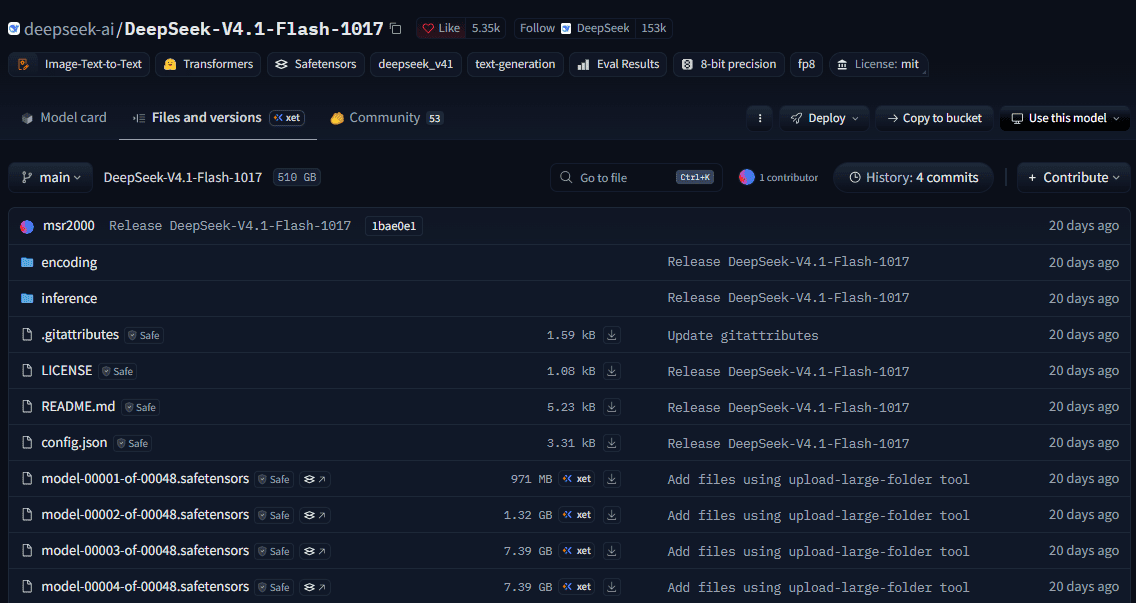
The latest public V4.1 checkpoint checked for this article is DeepSeek-V4.1-Flash-1017. Its official Hugging Face model page includes downloadable weights, configuration files, an encoding reference implementation, minimal inference resources, a technical report, and an MIT license file.
DeepSeek also publishes supporting open-source infrastructure. Examples include:
- DeepInfer, an inference framework for DeepSeek models.
- deepseek-recipe, which handles prompt encoding, protocol conversion, image preprocessing, and response parsing for V4 and V4.1.
- DeepSeek Harness, an open-source agent application released under MIT.
- Model-specific repositories containing inference demonstrations, evaluation resources, configuration files, or deployment guidance.
DeepSeek now publishes training-data summaries
It would be inaccurate to say that DeepSeek publishes no information about its training data. The company provides public summaries for recent model families, including a DeepSeek-V4.1 training-content summary.
The V4.1 summary describes more than 10 trillion text tokens and more than 1 billion images, and identifies categories such as publicly available internet content, licensed datasets, code, scientific material, OCR data, image-text documents, user interaction data, and synthetic data. It names Common Crawl and Stack Exchange among the public sources and describes general filtering, deduplication, language identification, safety screening, and crawler behavior.
That is meaningful transparency, but it is not the same as publishing the complete training corpus or everything required to reproduce the model. The summary does not provide a complete itemized list of all public, licensed, private, user-derived, and synthetic training samples, and it does not provide the full implementation of every collection, filtering, labeling, and training stage.
DeepSeek model licenses must be checked version by version
It is unsafe to assume that every DeepSeek model ever released uses the same license. DeepSeek’s licensing approach has changed over time, and code, weights, distilled checkpoints, and hosted services can be governed by different documents.
| Model or component | Publicly available assets | License position | Important caveat |
|---|---|---|---|
| DeepSeek-V4.1-Flash-1017 | Weights, configuration, encoding and inference resources, technical report | The official model card says the repository and weights are under MIT | Complete end-to-end training code and the full corpus were not established as public |
| DeepSeek-V3.2 | Official weights and model repository | The official model page lists MIT for the repository and weights | Do not apply this license retroactively to the original V3 release |
| DeepSeek-R1 and R1-Zero | Official weights, repository, technical report, deployment information | Repository and weights are under MIT | Distilled checkpoints require additional base-model review |
| R1-Distill-Qwen models | Official DeepSeek-released distilled weights | DeepSeek states that R1 code and weights are MIT; the base Qwen 2.5 models were Apache 2.0 | Retain applicable notices and review both sources |
| R1-Distill-Llama models | Official DeepSeek-released distilled weights | DeepSeek identifies Llama 3.1 or Llama 3.3 as the base model | The relevant Llama license must also be reviewed |
| Original DeepSeek-V3 Base and Chat | Weights, inference code, technical report | Code is MIT; model weights use the separate DeepSeek Model License | The custom model license contains use-based restrictions |
| DeepSeek Harness | Application source code and documentation | MIT License | This is not the same product as the standard DeepSeek Chat service |
| DeepSeek Chat and mobile app | Hosted user-facing service | Governed by DeepSeek service terms | The full official product source was not established as public |
| DeepSeek Open Platform API | Hosted API access and public documentation | Governed by the Open Platform Terms of Service | API compatibility and public documentation do not make the backend open source |
The original DeepSeek-V3 release is an important exception
The original DeepSeek-V3 repository separates its licenses. Its code uses MIT, while the Base and Chat model weights are governed by a custom DeepSeek Model License.

That custom license permits commercial use, modification, derivatives, redistribution, and hosted access, but it also contains use-based restrictions that must be passed to downstream users. Because it restricts certain fields of use, it should not be treated as equivalent to the unrestricted MIT License.
Later releases may use MIT, but that does not retroactively change the license attached to an older checkpoint. A company using the original V3 weights must review the original V3 license rather than relying on the license shown for V3.2 or V4.1.
Is DeepSeek-R1 open source?
DeepSeek describes R1 as a fully open-source model, and the official DeepSeek-R1 repository states that its code and model weights are licensed under MIT. It explicitly permits commercial use, modifications, derivative works, and distillation for training other language models.
From a practical developer perspective, R1 is therefore a highly permissive open-weight release. A developer can download the weights, deploy them, fine-tune them, create derivatives, and use them commercially while complying with the MIT notice requirement and any applicable third-party obligations.
Under the stricter OSI framework, the licensing of the final weights is only one part of the assessment. The public R1 repository contains model details, evaluation information, inference guidance, and a technical report, but the materials checked do not provide the complete original pretraining corpus and complete code for every data-processing, pretraining, reinforcement-learning, and post-training stage required to rebuild an equivalent R1 model.
Does DeepSeek meet the Open Source AI Definition?
The Open Source AI Definition 1.0 requires the freedoms to use, study, modify, and share an AI system. It also requires access to what it calls the preferred form for making modifications.
For machine-learning systems, that preferred form includes:
- Data information: details sufficient for a skilled person to understand the sources, scope, provenance, collection, labeling, processing, and filtering well enough to build a substantially equivalent system.
- Code: the complete source code used to process data, train, validate, test, and run the system, including relevant settings and supporting tools.
- Parameters: the trained weights and configuration information.
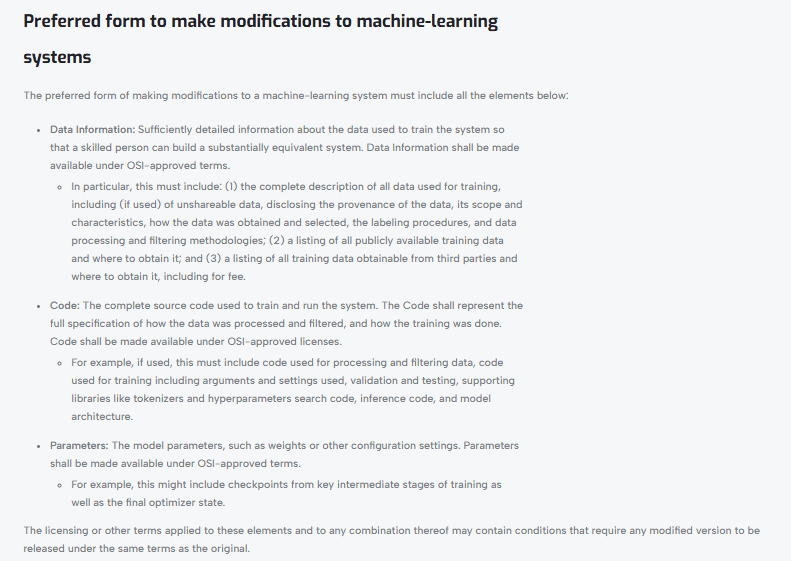
The definition does not necessarily require providers to redistribute every legally restricted training file. It does, however, require sufficiently detailed information about unavailable data and a listing of public and third-party datasets so that meaningful study and modification are possible.
| OSI-related requirement | What DeepSeek provides for recent releases | Assessment based on public materials |
|---|---|---|
| Model parameters | Official downloadable weights and configurations | Publicly available for major releases |
| Inference code | Reference inference files and open-source inference tools | Publicly available in meaningful form |
| Technical architecture | Model cards and detailed technical reports | Publicly documented |
| Training-data information | Training summaries and technical descriptions | Partially documented, with significantly more detail for recent releases |
| Complete dataset inventory | Categories and selected sources are identified | A complete source inventory was not found in the materials checked |
| Complete data-processing code | General filtering and processing methods are described | Complete implementation was not established as public |
| Complete training and post-training code | Algorithms and training recipes are described in reports | Complete end-to-end code was not established as public |
| Ability to rebuild a substantially equivalent model | Weights can be modified and inference can be reproduced | Rebuilding the original model from raw data is not clearly reproducible from the released materials alone |
For that reason, the most defensible conclusion is that many current DeepSeek releases are permissively licensed open-weight models with substantial public code and documentation. The available evidence does not clearly establish that the complete system behind the latest checkpoint satisfies every requirement of the OSI Open Source AI Definition.
This conclusion does not diminish the practical value of DeepSeek’s releases. Public weights under MIT, inference code, architecture reports, evaluation resources, and training summaries provide substantially more freedom than a model available only through a closed hosted API.
Is the DeepSeek app open source?
The standard DeepSeek website and mobile app are hosted products. Public model weights do not mean that the complete frontend, backend, authentication system, search tools, moderation layers, account infrastructure, or production serving stack for those products is open source.
The complete official source code for the standard DeepSeek Chat website and mobile app was not identified in the official repositories checked. The products are governed by the DeepSeek Terms of Use and related privacy and product policies.
Third-party GitHub projects that wrap the DeepSeek website or connect to its API should not be mistaken for the official app’s source code.
DeepSeek Harness is a separate open-source application
DeepSeek Harness is an official, open-source agent application released under the MIT License. It provides a desktop and web interface with a plugin-based architecture.
Its source availability does not establish that the standard DeepSeek Chat product uses the same codebase or that every DeepSeek consumer application is open source. Treat Harness as a separate product with its own repository, license, documentation, and development status.
Is the DeepSeek API open source?
The official DeepSeek API is a hosted developer service. It lets applications send requests to DeepSeek’s infrastructure, but it does not provide the source code for DeepSeek’s production API backend, account system, billing system, routing infrastructure, safety layers, or full serving environment.
Use of the service is governed by the DeepSeek Open Platform Terms of Service. Those terms are separate from the MIT license attached to a downloadable model checkpoint.
An API can also be OpenAI-compatible without being open source. Compatibility describes how requests and responses are formatted; it says nothing about whether the provider has published the backend source code.
Self-hosting a DeepSeek checkpoint behind vLLM, SGLang, DeepInfer, or another server creates an API that you operate. That self-hosted endpoint is different from the official DeepSeek Open Platform service, even when both accept similar request formats.
Can DeepSeek models be used commercially?
Many current DeepSeek releases can be used commercially. For example, the official R1 documentation explicitly permits commercial use, modifications, derivative works, and distillation, while DeepSeek-V4.1-Flash-1017 applies the MIT License to its repository and weights.
The MIT License generally allows a recipient to use, copy, modify, merge, publish, distribute, sublicense, and sell copies. It requires the copyright notice and permission notice to be included in copies or substantial portions, and it provides the material without warranty.
Commercial use still requires checking several layers:
- The exact checkpoint and revision.
- The license file attached to the model weights.
- The license attached to repository code.
- The original base-model license for a distilled checkpoint.
- Third-party library and runtime licenses.
- Trademark restrictions and attribution notices.
- The terms of any hosted provider used to serve the model.
- Applicable privacy, intellectual-property, export-control, and industry-specific laws.
“Commercial use permitted” does not mean that no obligations, risks, or third-party rights apply. Organizations planning consequential deployments should have the exact model and dependency licenses reviewed by qualified legal counsel.
Hosted API output rights come from separate terms
The current DeepSeek Open Platform terms state that users retain any rights they have in their inputs and that DeepSeek assigns any rights it may have in service outputs to the user. The terms also permit uses such as derivative product development and training other models, subject to applicable law and the platform terms.
Those contractual permissions apply to the hosted service. They should not be confused with the MIT license governing a downloadable model or with the license attached to an older checkpoint.
Distilled DeepSeek models require an extra license check
A distilled DeepSeek model is not simply the full R1 model compressed into a smaller file. It may use a separate base architecture that was post-trained with examples or reasoning traces derived from a larger DeepSeek model.
The official R1 repository identifies four distilled Qwen 2.5 models and two distilled Llama models:
- R1-Distill-Qwen-1.5B, 7B, 14B, and 32B are derived from Qwen 2.5 models originally released under Apache 2.0.
- R1-Distill-Llama-8B is derived from Llama 3.1 8B Base.
- R1-Distill-Llama-70B is derived from Llama 3.3 70B Instruct.
DeepSeek states that the R1 repository and model weights are under MIT, but it also directs users to the original base-model licenses. Before redistribution or commercial deployment, review DeepSeek’s license statement, the specific model card, the base-model license, and any required notices.
Can DeepSeek be downloaded, modified, and run locally?
Yes. Public weights allow developers to download and self-host many DeepSeek models, modify supported checkpoints, create fine-tunes, produce quantized versions, and run inference without sending prompts to the official DeepSeek API.
That does not mean every model is practical on a personal computer. Recent flagship checkpoints can require specialized multi-GPU or distributed infrastructure. Smaller R1 distilled models and third-party quantizations are more realistic for consumer hardware, but third-party conversions have their own publisher, packaging, and license-verification requirements.
Local deployment can improve control over prompts and stored documents, but open source does not automatically guarantee privacy. Privacy still depends on the runtime, logs, plugins, network bindings, optional cloud features, connected applications, and the security of the device or server.
How to verify whether a DeepSeek release is open
Do not rely on a search-result snippet, a model-directory badge, or a third-party article. Use this process for the exact DeepSeek release you plan to deploy:
- Record the complete model name, repository ID, and revision.
- Open the model through DeepSeek’s verified GitHub or Hugging Face organization.
- Read the actual license file rather than relying only on a license badge.
- Check whether the repository code and model weights use separate licenses.
- Read the model card for additional permissions, restrictions, and deployment notes.
- Identify whether the checkpoint is a full model, fine-tune, distillation, merge, or quantization.
- For a distilled model, identify the base model and read its original license.
- Check whether the required tokenizer, configuration, inference code, and model architecture are available.
- Check separately for training code, data-processing code, evaluation code, and training-data information.
- Separate downloadable model rights from hosted API or app terms.
- Retain all required copyright, permission, attribution, and modification notices.
- Save the relevant license files and commit or revision identifiers used in production.
- Record the date of the review because model cards and provider terms can change.
- Obtain legal review before a high-risk commercial, regulated, or redistribution project.
Common misconceptions about DeepSeek and open source
| Claim | More accurate explanation |
|---|---|
| Every DeepSeek model is MIT licensed | Many current releases are MIT, but the original V3 weights use a separate custom model license. |
| Public weights make the whole company open source | Model releases, hosted products, internal systems, and corporate operations are separate. |
| The full DeepSeek app is open source | The standard chat product is a hosted service; DeepSeek Harness is a separate open-source application. |
| The DeepSeek API is open source | The API is a hosted service. OpenAI-compatible request formatting is not an open-source classification. |
| Open weights include the training dataset | Weights are the trained parameters. They do not automatically include the source corpus or training pipeline. |
| A technical report is the same as training code | A report can explain algorithms without providing the complete executable implementation. |
| MIT means no obligations | MIT requires preservation of its copyright and permission notice and provides no warranty. |
| Open source means outputs are accurate | Licensing does not guarantee factual reliability, security, fairness, or suitability for a task. |
| Open source means all prompts remain private | Privacy depends on whether the model is local, which runtime is used, and what networked tools are enabled. |
| A Hugging Face model is automatically official | Verify that the publisher is DeepSeek’s official account and inspect the exact model card and files. |
So, is DeepSeek really open source?
The most accurate answer is:
- Yes, in DeepSeek’s own release terminology: major models such as R1 and V4 are described as open source, with public weights, reports, and code resources.
- Yes, for many practical development rights: current checkpoints such as DeepSeek-V4.1-Flash-1017 and DeepSeek-R1 use permissive MIT licensing for the repository and weights.
- More cautiously under strict AI-openness definitions: these models are safely described as open-weight releases with substantial open-source components, because complete training code and sufficiently comprehensive reproducibility materials have not been established for every model.
- No, not for every DeepSeek product: the hosted chat application and official API do not become open source merely because some underlying models are downloadable.
- No, not under one universal license: older models and distilled checkpoints may involve custom or base-model licenses that require separate review.
For most developers, the useful conclusion is that DeepSeek provides unusually broad access to major model weights and deployment resources. For researchers, compliance teams, and companies redistributing models, “open source” should be replaced with a precise statement identifying the exact checkpoint, publicly released artifacts, applicable licenses, and remaining reproducibility gaps.
Official sources checked
- DeepSeek Transparency Center
- DeepSeek model mechanism and training-method disclosure
- DeepSeek-V4.1-Flash-1017 official model page
- DeepSeek-V4.1 public training-content summary
- DeepSeek-R1 official repository and license notes
- Original DeepSeek-V3 repository
- Original DeepSeek-V3 model license
- DeepSeek Harness official repository
- DeepSeek Open Platform Terms of Service
- Open Source AI Definition 1.0
Model availability, licenses, service terms, and official documentation checked on November 6, 2026. This article provides general information and is not legal advice.