
Published: November 5, 2026
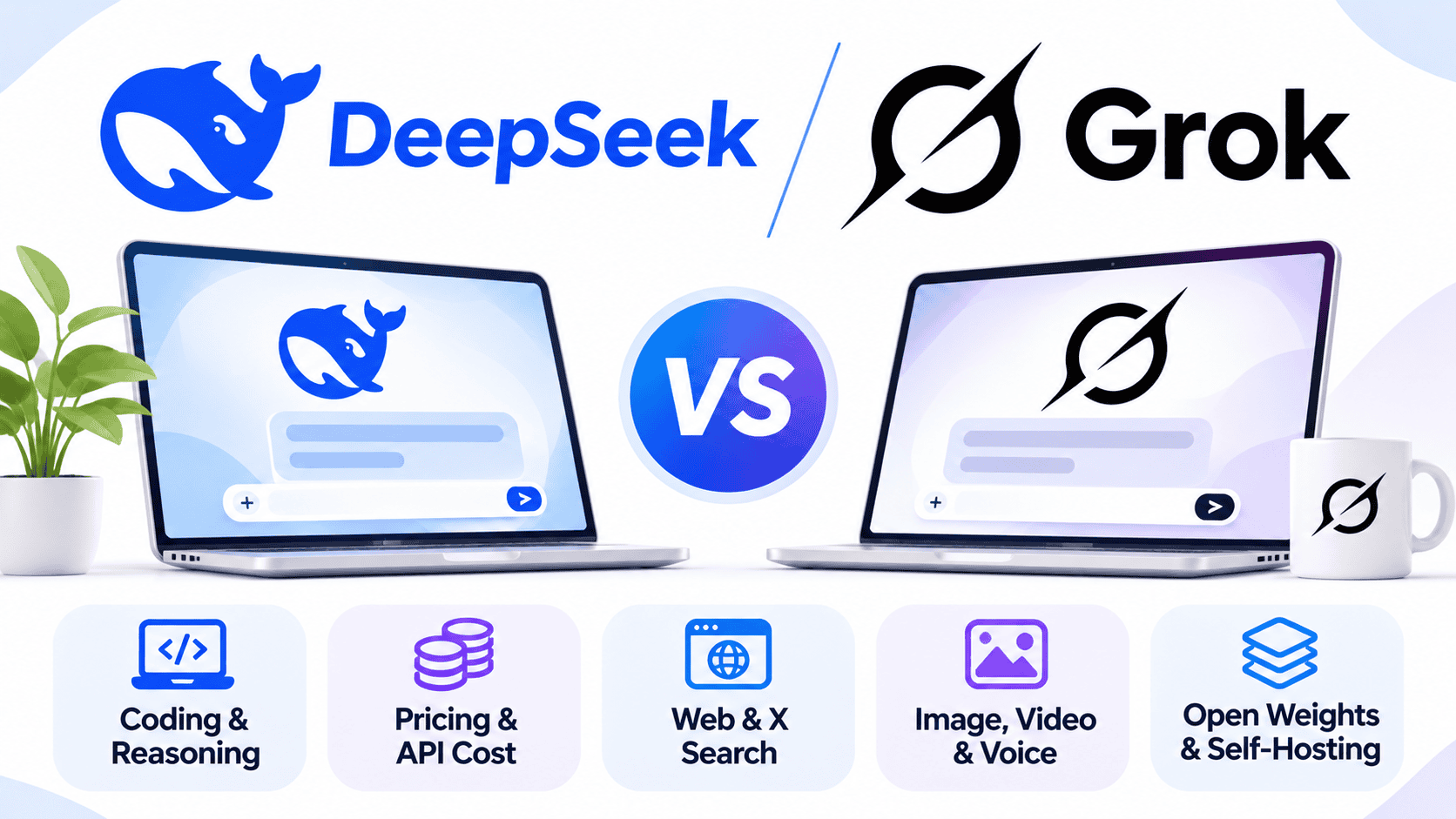
DeepSeek vs Grok does not have one universal winner. DeepSeek is the better default when your priorities are free access, low API costs, a larger documented context window, current open weights, or self-hosting. Grok is the better fit when you need first-party Web and X search, built-in image, video, and voice features, connectors, or a broader managed agent stack.
For coding and difficult reasoning, neither brand deserves an automatic win. Current independent comparisons use different models, prompts, tools, and scoring methods, and they do not produce one consistent verdict. The practical choice depends on the exact product layer you are comparing: the consumer assistant, the hosted API, or a model you can run yourself.
DeepSeek vs Grok at a glance
| Decision | Better fit | Why |
|---|---|---|
| Free everyday chat | DeepSeek | The official DeepSeek app is free, while Grok’s free plan has limited usage. |
| Live web and X research | Grok | Grok combines managed Web Search with a first-party X Search tool. |
| Lowest published text API cost | DeepSeek | DeepSeek Flash token rates are substantially lower in a like-for-like text workload. |
| Coding and difficult reasoning | Workload dependent | Both current model families are competitive, and independent evaluations do not establish a universal winner. |
| Largest documented API context in the main comparison | DeepSeek | deepseek-flash lists 1 million tokens; grok-4.7 lists 500,000. |
| Image, video, and voice creation | Grok | Grok offers dedicated Imagine and Voice products and APIs. |
| Current open weights and self-hosting | DeepSeek | DeepSeek-V4.1-Flash-1017 has a current MIT-licensed weight release. |
| Managed agent tools and connected apps | Grok | Grok provides managed web, X, code, file, RAG, and connector workflows. |
| Highly sensitive business use | Evaluate contracts, not brands | Retention, training, region, tools, and enterprise terms matter more than the chatbot name. |
First, compare the right products
A large share of misleading Grok vs DeepSeek comparisons mix a free chatbot, a paid subscription, an API model, and a downloadable checkpoint in the same table. Those are different products with different prices, capabilities, and data terms.
| Layer | DeepSeek | Grok |
|---|---|---|
| Consumer assistant | DeepSeek web and mobile apps. The official change log says the web and app were updated to DeepSeek-V4.1-Flash-1017 on October 17, 2026. | Grok.com, mobile apps, and Grok on X. The October 3 release notes say Grok 4.7 powers Expert mode and Fast mode for paid subscribers. That does not prove every free request uses the same model or settings. |
| Hosted text API | deepseek-flash and deepseek-v4-pro | grok-4.7, with separate models and APIs for image, video, and voice work |
| Local or self-hosted model | Current DeepSeek-V4.1-Flash-1017 weights are available under the MIT License. | xAI publishes historical Grok-1 and Grok-2 weights under different licenses; these do not reproduce the current hosted Grok 4.7 model. |
The rest of this comparison keeps these layers separate. Consumer features are compared as consumer features; API prices are compared per token under stated conditions; and local deployment is evaluated from the actual released weights and licenses.
Which is better for everyday users?
Free access and paid plans
DeepSeek describes its official app as free and powered by its latest flagship model. “Free” should not be read as “unlimited,” because service capacity and usage controls can still change, but there is no monthly consumer subscription required on the official download page.
Grok has a limited free tier plus paid plans. As checked on November 6, 2026, the official pricing page lists Plus at $8 per month, Premium at $30, Super at $100, and Ultra at $200 before applicable taxes and fees. Paid usage is drawn from a shared weekly pool, and different activities consume that pool at different rates.
This is not a pure chatbot-price comparison. Grok’s subscriptions can bundle access across Chat, Voice, Imagine, Build, Cursor, and X features. DeepSeek’s free app is simpler, while its API and self-hosting options are billed or operated separately.
Current information and research
Grok has the clearest advantage for research that depends on X. Its API offers separate Web Search and X Search tools, including keyword, semantic, user, and thread search on X. That makes Grok a natural choice for tracking posts, reactions, breaking discussions, and first-party social activity.
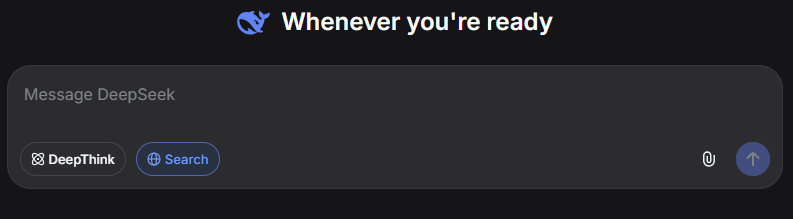
DeepSeek is no longer limited to static model knowledge. Its consumer app has web search, and DeepSeek opened its own Search and Fetch APIs in October 2026. Search returns structured results, while Fetch retrieves a page as Markdown. The main difference is product design: Grok offers a more integrated managed research stack, while DeepSeek exposes lower-level search services that developers can orchestrate themselves.
Search access does not guarantee a correct answer. Either system can select weak sources, miss context, or summarize a page incorrectly. For consequential research, open the cited pages, check publication dates, and confirm the claim with a primary source.
Coding, math, and reasoning
Both companies position their current models for coding and agentic work. DeepSeek reports strong coding, tool-use, and reasoning results for V4.1-Flash-1017, while Grok presents Grok 4.7 as its leading model for coding and knowledge work. Vendor benchmarks are useful for understanding intended strengths, but they should not be treated as a neutral head-to-head test.
Independent evidence is mixed. A current Respan model-family comparison gives DeepSeek’s best listed models an edge in coding and reasoning while giving Grok an edge in knowledge and language. A separate llmwise comparison using 50 prompts across 10 job categories found that the two families shared the best result in nine categories, with DeepSeek alone leading its writing category. Each methodology has limits, and neither proves that one model will be better on your repository, language, framework, or error pattern.
For practical selection, DeepSeek is attractive when you want low inference cost, a larger context window, or local control. Grok is attractive when the coding task benefits from managed web search, code execution, connectors, or the wider Grok Build ecosystem. For production work, test both on a private evaluation set that includes real bugs, repository-scale tasks, unit tests, and failure cases.
Files, vision, image generation, video, and voice
DeepSeek-V4.1-Flash supports native visual understanding, and the DeepSeek app supports file-based work. DeepSeek also offers DeepSeek Harness, an open-source desktop agent in public preview that can work with local files, code, documents, spreadsheets, research tasks, and plugins.
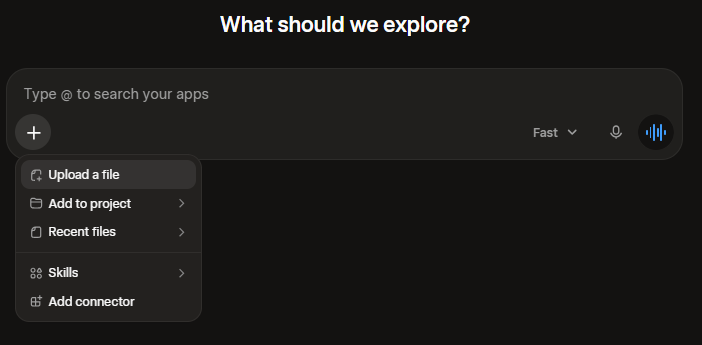
Grok has the broader consumer media suite. Its consumer documentation lists file uploads, voice conversations, image and video creation through Grok Imagine, and connectors for email, cloud files, calendars, and other services. Its developer platform also has separate Imagine and Voice APIs.
Do not confuse image understanding with image generation. DeepSeek Flash can analyze visual input, but that does not make it an image or video generator. Grok is the stronger choice when the workflow itself requires generating or editing media or holding a real-time voice conversation.
DeepSeek vs Grok API comparison
The most useful current API baseline is DeepSeek’s deepseek-flash against Grok’s grok-4.7. DeepSeek also keeps deepseek-v4-pro available as a separate option. The specifications below were checked against the official model pages on November 6, 2026.
| API model | Documented context | Documented output | Input and core capabilities |
|---|---|---|---|
deepseek-flashDeepSeek-V4.1-Flash-1017 | 1 million tokens | Maximum 393,216 tokens | Text and image input; thinking and non-thinking modes; JSON output; tool calls; Responses API; OpenAI- and Anthropic-format endpoints |
deepseek-v4-proDeepSeek-V4-Pro-0813 | 1 million tokens | Maximum 393,216 tokens | Text input; no vision in the current pricing table; thinking and non-thinking modes; JSON output; tool calls; Responses API; OpenAI- and Anthropic-format endpoints |
grok-4.7 | 500,000 tokens | The guide lists no separate text-output limit; practical request and product constraints still apply. | Text and image input; configurable reasoning; structured outputs; function calling; Responses API; managed web, X, and code tools |
Context size is not the same as reliable document capacity. A model can accept a long prompt yet still miss a detail, over-compress a document, or spend more than expected on repeated context. Test retrieval accuracy, citation quality, latency, and total cost with representative files before choosing a model only because its context number is larger.
API pricing: DeepSeek is much cheaper for text
The following prices are in US dollars per 1 million tokens and were checked on November 6, 2026. DeepSeek uses peak and off-peak rates. Grok applies higher long-context rates when a request’s prompt reaches 200,000 tokens.
| Model and condition | Cached input | Uncached input | Output |
|---|---|---|---|
deepseek-flash off-peak | $0.003 | $0.15 | $0.60 |
deepseek-flash peak | $0.006 | $0.30 | $1.20 |
deepseek-v4-pro off-peak | $0.022 | $0.66 | $1.98 |
deepseek-v4-pro peak | $0.044 | $1.32 | $3.96 |
grok-4.7, prompt below 200K | $0.50 | $2.00 | $6.00 |
grok-4.7, prompt at or above 200K | $1.00 | $4.00 | $12.00 |
DeepSeek’s official pricing page defines peak hours as 01:00–04:00 and 06:00–10:00 UTC, Monday through Friday, excluding Chinese public holidays. All other times are off-peak. Grok’s official API pricing page says that once the prompt reaches its long-context threshold, the higher rates apply to all tokens in that request.
A transparent cost example
Assume a monthly workload uses 10 million uncached input tokens and 2 million output tokens. Each Grok request stays below the 200,000-token threshold, and the calculation excludes caching, tools, retries, media, taxes, and third-party infrastructure.
- DeepSeek Flash, off-peak: (10 × $0.15) + (2 × $0.60) = $2.70
- DeepSeek Flash, peak: (10 × $0.30) + (2 × $1.20) = $5.40
- Grok 4.7, short-context rates: (10 × $2.00) + (2 × $6.00) = $32.00
In this specific example, Grok costs about 5.9 times the DeepSeek peak total and about 11.9 times the DeepSeek off-peak total. Real workloads can narrow or widen that gap because the providers tokenize differently, cache behavior varies, agent loops make additional calls, and a cheaper model may require more retries to reach an acceptable result.
Tools and integrations
DeepSeek supports JSON output, function calling, the OpenAI Responses format, an Anthropic-compatible endpoint, and separate Search and Fetch APIs. This is attractive when you already operate your own agent framework and want inexpensive model calls with familiar API formats.
Grok provides a more extensive managed tool layer. Its current developer documentation includes Web Search, X Search, code execution, file attachments, collections search for RAG, image generation, and remote MCP tools. Structured outputs can be combined with server-side tools or developer-defined functions.
Tool prices are not directly comparable because the billing units and product behavior differ. DeepSeek lists Search and Fetch at $0.75 per 1,000 successful requests for each endpoint. Grok lists Web Search and code execution at $5 per 1,000 calls, while X Search is billed by posts and profiles fetched. Evaluate the total cost of a successful researched answer, not only the base model’s token rate.
Open weights and local deployment
DeepSeek has the stronger current local-deployment story. The DeepSeek-V4.1-Flash-1017 repository includes model weights, local inference guidance, and an MIT License. That gives organizations more control over hosting, fine-tuning, access policies, and data flow.
That does not mean the full current model is practical on an ordinary laptop. It is a very large model that requires substantial memory, storage, and inference infrastructure. Smaller community quantizations or distillations may be easier to run, but they are not identical to the official hosted model.
xAI has published historical weights for both Grok-1 and Grok-2. Grok-1 is a 314-billion-parameter raw base checkpoint released under Apache 2.0. Grok-2 is a post-trained model used at xAI in 2024 and released under the xAI Community License, which has additional use and redistribution conditions. These are different releases with different licenses; neither should be presented as reproducing the current hosted Grok 4.7 assistant.
Privacy, training, and business use
Neither product should receive confidential, regulated, or personally sensitive data through a personal account without a documented legal and security review. Consumer policies, API policies, and enterprise contracts are different, and using a stateless endpoint does not automatically mean zero retention.
Consumer accounts
DeepSeek’s consumer privacy policy says it may collect prompts, files, photos, chat history, and other inputs, and may use personal data to train and improve its technology. The policy says personal data is directly collected, processed, and stored in the People’s Republic of China. It also gives account data and inputs kept while an account remains active as an example of retention.
Grok’s consumer FAQ says content may be used for model training, but signed-in users can turn off “Improve the Model,” and Private Chat conversations are not used for training. The FAQ says Private Chat or deleted conversations are removed from systems within 30 days, subject to stated safety, legal, de-identification, and related exceptions. Grok used inside X is governed by X’s policies rather than the standalone Grok policy.
API and enterprise controls
DeepSeek documents its Responses API as stateless: the server does not preserve conversation state, so the client must resend the required history. That is an architectural statement, not a complete promise about logs, abuse monitoring, billing records, or retention. Teams should review the current Open Platform terms and privacy documents before sending business data.
Grok’s API security FAQ says API inputs and outputs are not used for training without explicit permission. By default, requests and responses are retained for 30 days for abuse auditing, and eligible teams can enable Zero Data Retention, although doing so disables features that depend on stored data.
Grok also offers a US regional endpoint for Grok 4.7 and 4.6 at a 10% token-price premium. The guarantee covers request handling, inference, moderation, and retained request data in the United States, but it does not cover files, collections, server-side tools, or the network path. That distinction matters for formal data-residency requirements.
For regulated or high-risk use, compare the actual contract, data-processing agreement, retention setting, regional scope, subprocessors, incident terms, audit controls, and tool configuration. A consumer privacy toggle is not a substitute for an enterprise control framework.
Which one should you choose?
| User or workload | Recommended starting point | Reason |
|---|---|---|
| Casual user who wants a capable free text assistant | DeepSeek | The official app is free and uses the current V4.1 Flash model. |
| Researcher following current web events and X discussions | Grok | Its managed Web Search and first-party X Search are the clearest differentiators. |
| Developer optimizing text-inference cost | DeepSeek | Published Flash token rates are far lower under the conditions compared above. |
| Team building a managed agent with search, code, files, and connectors | Grok | The managed tool and connector surface is broader. |
| Organization that needs current open weights or self-hosting | DeepSeek | Its current Flash checkpoint is available under the MIT License. |
| Creator who needs images, video, or voice | Grok | Imagine and Voice are first-party product lines rather than external add-ons. |
| Coding team choosing a production model | Pilot both | Evaluate repository-level success, test pass rate, latency, retries, tool reliability, and total cost. |
| Regulated enterprise workload | Run a formal vendor review | Contractual retention, regional processing, ZDR, tools, and compliance requirements determine suitability. |
Using both can also be rational. A team might use DeepSeek for low-cost batch analysis, coding, or long-context processing, then use Grok for live web and X research, source discovery, voice, or media generation. The additional operational complexity is worthwhile only when the two systems have clearly separated jobs and outputs are independently verified.
Final verdict
Choose DeepSeek when economics, long context, open weights, API compatibility, or deployment control are the deciding factors. Its current Flash model combines a free consumer experience with exceptionally low published API prices and a current self-hostable release.
Choose Grok when your workflow depends on real-time web and X research, connected services, managed agent tools, or native image, video, and voice features. You pay more for text inference, but you receive a broader integrated product ecosystem.
For coding and hard reasoning, the honest answer is to test the current models on your own work. A benchmark or generic chatbot trial cannot reveal how reliably a model will understand your repository, follow your policies, call your tools, or produce an answer that passes your acceptance criteria.
Frequently asked questions
Is DeepSeek better than Grok?
DeepSeek is generally the better fit for low-cost API use, large-context work, current open weights, and self-hosting. Grok is generally better for live web and X research, media generation, voice, connectors, and managed agent tools. There is no universal winner for every task.
Which is better for coding, DeepSeek or Grok?
Both are strong coding options. DeepSeek has major cost and deployment advantages, while Grok has a broader managed tool ecosystem. Test the exact current models on repository-level tasks and score test pass rates, regressions, latency, retries, and total cost.
Is DeepSeek or Grok free?
The official DeepSeek consumer app is free. Grok has a limited free tier and several paid plans. Neither “free” label guarantees unlimited requests, identical model access, or free API usage.
Which API is cheaper?
DeepSeek Flash has substantially lower published text-token prices than Grok 4.7 under the current rate cards. The final cost can still depend on caching, long-context thresholds, tools, retries, response length, and the number of successful outputs.
Can DeepSeek or Grok run locally?
DeepSeek offers current V4.1-Flash-1017 weights under the MIT License, although the full model requires substantial infrastructure. xAI publishes historical Grok-1 and Grok-2 weights under different licenses. Neither release reproduces the current hosted Grok 4.7 assistant.
Does Grok always have current information?
No. Grok 4.7’s official model page lists a May 2026 knowledge cutoff. Current information requires Web Search or X Search, and retrieved claims still need source verification.
Which is more private?
Neither is automatically the private choice for every scenario. Grok documents consumer training controls, Private Chat, 30-day default API retention, ZDR, and a limited US regional endpoint. DeepSeek offers current self-hostable weights, but its consumer policy describes training uses and processing in China. Match the deployment and contract to your data requirements.
Sources checked
- DeepSeek API change log
- DeepSeek models and API pricing
- DeepSeek Search and Fetch documentation
- DeepSeek-V4.1-Flash-1017 model card and license
- DeepSeek privacy policy
- Grok 4.7 developer guide
- Grok API pricing and tool pricing
- Grok consumer plans
- Grok consumer FAQ and data controls
- Grok API security and retention FAQ