

Published: November 5, 2026
DeepSeek is the better value choice for most people who prioritize free chat access, low API costs, faster generation, optional reasoning, and straightforward self-hosting rights. Kimi is the stronger capability-first choice for demanding coding, agentic workflows, research, and knowledge work built around an integrated suite of tools.
There is no universal winner in the DeepSeek vs Kimi comparison. Current independent evaluations favor Kimi K3.1 Pro on several broad intelligence and agent benchmarks, but DeepSeek-V4.1-Flash-1017 is considerably less expensive, faster in the same independent test set, and competitive enough to be the more practical production option for many workloads.
This comparison separates three products that are often mixed together: the consumer assistants, the official hosted APIs, and the downloadable model weights. Features available in Kimi Work or DeepSeek Harness do not automatically belong to every API request, and a consumer subscription should not be compared directly with a per-token API rate.
DeepSeek vs Kimi at a glance
| Decision | Better starting point | Why |
|---|---|---|
| Free everyday chat | DeepSeek | The official DeepSeek assistant is advertised as free, while Kimi reserves higher allowances and several advanced features for paid memberships. |
| Complex coding and agentic tasks | Kimi | Kimi K3.1 Pro currently leads several independent agent and coding evaluations, although results vary by benchmark. |
| API price and output speed | DeepSeek | DeepSeek Flash costs substantially less per token and was much faster in the independent comparison reviewed for this article. |
| Integrated research and office workflows | Kimi | Kimi combines Agent, Deep Research, Docs, Sheets, Slides, Work, Code, Claw, and Swarm products. |
| Long context | Tie on specifications | Both current flagship API models support approximately one million tokens, but practical retrieval quality and plan access still differ. |
| Optional reasoning for simple tasks | DeepSeek | DeepSeek Flash supports thinking and non-thinking modes; Kimi K3.1 Pro always reasons. |
| Managed developer tools | Kimi | Kimi provides a broad managed tool catalog that includes search, fetch, code execution, spreadsheets, JavaScript, and memory. |
| Open-weight licensing | DeepSeek | DeepSeek’s current weights use the MIT License. Kimi uses a custom license with conditions for certain large commercial deployments. |
| Documented API privacy controls | Kimi | Kimi explicitly states that API data is not used for training and advertises Zero Data Retention availability. |
What products and models are being compared?
As of November 6, 2026, the most relevant model comparison is DeepSeek-V4.1-Flash-1017 against Kimi K3.1 Pro. Older pages comparing DeepSeek V3, DeepSeek R1, Kimi K2, or Kimi K3 may still be useful historically, but they do not represent the current flagship comparison.
| Product layer | DeepSeek | Kimi |
|---|---|---|
| Consumer assistant | DeepSeek web and mobile apps currently use DeepSeek-V4.1-Flash-1017, according to the official change log. | Kimi K3.1 Pro is available on Kimi web and mobile apps, Kimi Work, and other Kimi products, with access and allowances depending on the plan. |
| Primary hosted API model | deepseek-flash, currently serving DeepSeek-V4.1-Flash-1017 | kimi-k3.1-pro, with kimi-k3.1-pro-highspeed available for faster output |
| Coding product | DeepSeek can be used through compatible coding agents, while DeepSeek Harness provides an official desktop agent. | Kimi Code provides dedicated desktop, CLI, VS Code, and third-party coding integrations. |
| Open-weight release | DeepSeek-V4.1-Flash-1017 under the MIT License | Kimi K3.1 Pro under the custom Kimi K3.1 Pro License |
Kimi K3.1 Pro was introduced in October 2026 as Moonshot AI’s most capable K3.1-series model, with native visual understanding and a one-million-token context window. Its official launch post confirms availability through Kimi’s consumer products, Kimi Work, Kimi Code, and the Kimi API.
DeepSeek released the current 1017 update in October 2026. The official release announcement describes improvements in coding, reasoning, visual tasks, and end-to-end project development, while keeping the existing deepseek-flash API identifier.
Which is better for everyday use?
DeepSeek offers the simpler free experience
The official DeepSeek download page describes its web and mobile assistant as free and powered by its latest flagship model. The app supports ordinary chat, web-assisted answers, file-based tasks, and visual understanding through the current Flash model.
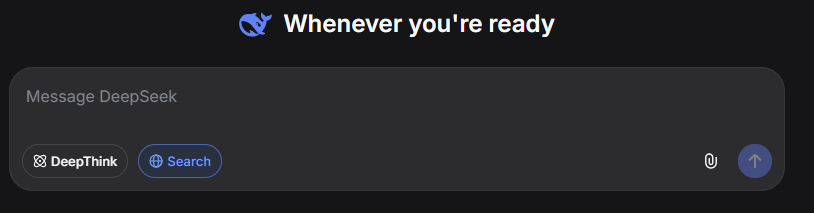
Free access does not necessarily mean unlimited access. Capacity controls, request limits, and temporary availability can still change. However, a user who primarily wants a capable chatbot without selecting a paid membership has a clearer starting point with DeepSeek.
Kimi provides a broader productivity workspace
Kimi also offers a free tier, but its main advantage is the breadth of its product ecosystem. The Kimi product overview describes an assistant with web search, multimodal reasoning, file processing, memory, Deep Research, autonomous agents, coding tools, and office-document workflows.
Separate Kimi products include Kimi Work for local knowledge work, Kimi Code for software development, Kimi Claw for persistent cloud automation, and Agent Swarm for tasks that benefit from parallel subagents. Kimi can also create websites, presentations, documents, and spreadsheets through its managed Agent environment.
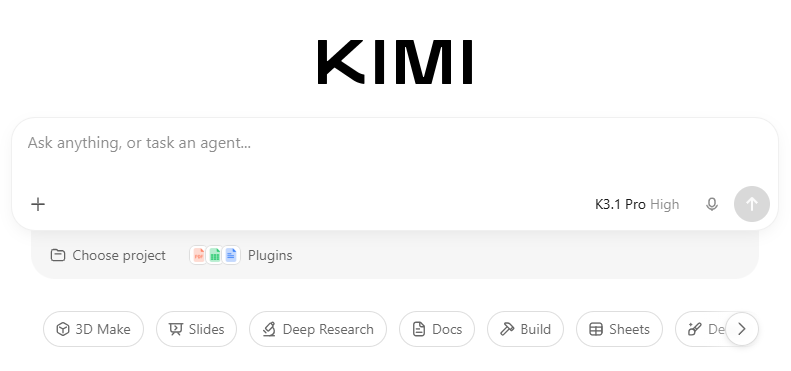
Kimi’s current international membership lineup includes Free, Plus, Pro, Max, and Ultra. The official K3.1 Pro pricing guide says Plus includes Kimi Code, Pro adds K3.1 Pro Highspeed, and Max and Ultra add higher allowances and extra-long chat capacity. Membership credits are shared across supported Kimi features, so a long research or coding task may consume more of the allowance than a short conversation.
Consumer verdict: Choose DeepSeek for straightforward free chat and general assistance. Choose Kimi when you want a more complete workspace for research, coding, files, presentations, spreadsheets, scheduled tasks, and autonomous agents—and are willing to manage plan limits or pay for higher usage.
Which is better for coding and complex reasoning?
Kimi has the stronger current case for maximum capability, but the result is not absolute. This article does not claim an original hands-on test. The comparison below uses the independent Artificial Analysis comparison available on November 6, 2026.
| Independent metric | Kimi K3.1 Pro | DeepSeek V4.1 Flash 1017 | Result |
|---|---|---|---|
| Artificial Analysis Intelligence Index | 46 | 33 | Kimi led the combined evaluation. |
| Terminal-Bench 4.0 | 67% | 34% | Kimi had the larger lead on this agentic terminal benchmark. |
| FrontierCode 2.0 | 25% | 28% | DeepSeek led this coding evaluation. |
| Average output speed | 34 tokens per second | 172 tokens per second | DeepSeek generated output much faster in this test. |
| Mean time per evaluation task | 35.9 minutes | 13.5 minutes | DeepSeek completed the measured workloads faster. |
The figures support a nuanced conclusion. Kimi performed better across the overall evaluation set and several difficult agentic tasks, while DeepSeek remained competitive, won at least one important coding subtest, and completed the measured workloads much faster.
No public benchmark can tell you which model will understand your repository, follow your coding standards, avoid regressions, or use your tools more reliably. Different evaluations use different harnesses, reasoning settings, time budgets, judge models, and tool configurations. Vendor-published scores can also use settings that do not match ordinary API use.
For a production coding decision, test both models on a private evaluation set containing real issues from your codebase. Measure:
- Unit and integration test pass rates
- Successful repository navigation
- Correctness of multi-file changes
- Regressions introduced
- Tool-call failures
- Human review time
- Total tokens and retries per accepted result
- End-to-end completion time and cost
Coding verdict: Begin with Kimi K3.1 Pro when maximum agentic capability is the priority. Begin with DeepSeek Flash when cost, responsiveness, and the number of tasks completed per dollar matter more. Run a controlled pilot before standardizing on either one.
Long context, documents, and research
Both models advertise a one-million-token context window
DeepSeek Flash and Kimi K3.1 Pro both support approximately one million tokens through their official APIs. DeepSeek’s model documentation lists a 1M-token context and a maximum output of 393,216 tokens. Kimi’s official model card lists a context length of 1,048,576 tokens.
A matching context specification does not mean the models retrieve every detail equally well. Long-context quality depends on where the relevant information appears, how much unrelated material surrounds it, the prompt structure, tool use, and whether the task requires exact retrieval or broad synthesis.
Kimi also gates context access differently across products. A model may support one million tokens through the Open Platform while a particular Kimi Code or consumer membership tier provides a lower limit. Always verify the context available through the exact plan and endpoint you intend to use.
Kimi has the broader integrated research workflow
Kimi combines web-connected search, Deep Research, document processing, professional databases, parallel agents, and office-output tools inside its consumer ecosystem. This makes it well suited to projects that begin with source discovery and end with a report, spreadsheet, slide deck, or website.
DeepSeek also supports current-information workflows. Its consumer assistant offers web search, while developers can use the official Search and Fetch APIs. DeepSeek Harness can research, verify facts, cite sources, work with local files, execute scripts, and use plugins.
The difference is mainly product integration. Kimi provides more managed research and office capabilities in one environment. DeepSeek offers a lower-cost model plus separate search, fetch, and harness components that developers can assemble around their own workflow.
Neither system should be trusted merely because it displays citations. Open the cited source, verify that it supports the statement, check its publication date, and prefer primary sources for consequential claims.
DeepSeek vs Kimi API comparison
| API feature | DeepSeek Flash | Kimi K3.1 Pro |
|---|---|---|
| Current model ID | deepseek-flash | kimi-k3.1-pro |
| Current underlying model | DeepSeek-V4.1-Flash-1017 | Kimi K3.1 Pro |
| Context window | 1 million tokens | 1,048,576 tokens |
| Input modalities | Text and images | Text, images, and video |
| Reasoning behavior | Thinking and non-thinking modes | Thinking is required; effort supports low, high, and max |
| OpenAI-compatible API | Yes, including Chat Completions and Responses | Yes, including Chat Completions and Responses |
| Anthropic-compatible API | Yes | Yes |
| Structured output | JSON output and structured text formats | JSON Mode |
| Developer-defined tools | Function and tool calling | Function and tool calling |
| Managed tools and search | Standalone Search and Fetch APIs; support varies by model and API format | Web search, fetch, code runner, Excel, JavaScript, memory, and other official tools |
| Open weights | Yes | Yes |
DeepSeek’s optional thinking mode is useful when one application handles both simple and difficult requests. A routine extraction or classification job can use non-thinking mode to reduce latency and output usage, while a difficult coding or reasoning task can enable thinking.
Kimi K3.1 Pro always reasons. Developers can choose low, high, or max reasoning effort, but requests that try to disable reasoning are rejected. This design favors difficult tasks but can be inefficient for simple, high-volume work.
Kimi’s managed tool catalog is broader. Its API documentation distinguishes the model from external resources: the model does not access the web or databases automatically, and developers must enable official or custom tools. DeepSeek’s search services are also separate from ordinary model inference unless explicitly integrated.
API pricing: DeepSeek has a major cost advantage
The prices below were checked on November 6, 2026. They are in US dollars per one million tokens and exclude taxes, tool charges, storage, infrastructure, and third-party services.
| Model and billing condition | Cached input | Regular or uncached input | Output |
|---|---|---|---|
| DeepSeek Flash, off-peak | $0.003 | $0.15 | $0.60 |
| DeepSeek Flash, peak | $0.006 | $0.30 | $1.20 |
| Kimi K3.1 Pro | $0.20 | $2.00 | $10.00 |
| Kimi K3.1 Pro Highspeed | $0.20 | $4.00 | $20.00 |
DeepSeek’s official pricing page defines peak hours as 01:00–04:00 and 06:00–10:00 UTC, Monday through Friday, excluding Chinese public holidays. All other periods use the lower off-peak rates.
Kimi’s official API platform lists K3.1 Pro at $2 per million input tokens, $10 per million output tokens, $0.20 per million cache-hit tokens, and $2 per million five-minute cache-write tokens. A one-hour cache write costs more. Highspeed doubles the standard input, output, and cache-write rates while retaining the same cache-hit rate.
The cache systems are not billed identically. DeepSeek’s table distinguishes cache hits from cache misses. Kimi separately accounts for regular input, cache hits, and new cache writes. A workload with a frequently reused prefix needs a provider-specific calculation rather than a simple cached-input comparison.
Worked cost example
Assume a monthly workload uses 10 million uncached input tokens and 2 million output tokens. It uses standard Kimi K3.1 Pro, involves no cache writes or hits, and excludes tools, retries, taxes, and third-party infrastructure.
- DeepSeek Flash during off-peak hours: (10 × $0.15) + (2 × $0.60) = $2.70
- DeepSeek Flash during peak hours: (10 × $0.30) + (2 × $1.20) = $5.40
- Kimi K3.1 Pro: (10 × $2.00) + (2 × $10.00) = $40.00
Under these assumptions, Kimi costs about 7.4 times the DeepSeek peak total and about 14.8 times the DeepSeek off-peak total. That does not prove DeepSeek is always more economical. A stronger model may solve a task in fewer attempts or require less human correction. The meaningful metric is the cost per accepted result, not the token rate alone.
API pricing verdict: DeepSeek is the clear first choice for high-volume inference, cost-sensitive applications, and workloads where Flash produces acceptable results. Kimi becomes easier to justify when its higher success rate on difficult agentic tasks saves enough engineering or review time to offset the price difference.
Open weights, licensing, and self-hosting
Both companies publish current model weights, but “open weight” does not mean that the entire consumer product is open source. Downloading a checkpoint does not include the hosted search system, user interface, agent tools, databases, cloud infrastructure, or operational safety services.
DeepSeek has the simpler license
The DeepSeek-V4.1-Flash-1017 repository publishes the model weights under the MIT License. The license permits use, modification, distribution, sublicensing, and commercial use while requiring preservation of the copyright and permission notice.
This makes DeepSeek easier to evaluate for internal deployment, derivative development, and commercial products without a provider-specific revenue threshold.
Kimi’s license is permissive but includes conditions
The Kimi K3.1 Pro repository allows use, modification, fine-tuning, distribution, sublicensing, and commercial deployment under a custom license.
The Kimi K3.1 Pro License requires a separate agreement for certain model-as-a-service businesses whose aggregate revenue exceeds $20 million over a consecutive 12-month period. It also introduces attribution requirements for commercial products above specified monthly-user or revenue thresholds. Organizations near those thresholds should obtain legal review before deployment.
Neither full model is a casual laptop installation
The official releases are infrastructure-scale models. Self-hosting requires substantial storage, accelerator memory, an appropriate inference engine, networking, monitoring, security controls, and experienced operators. Quantized community releases may reduce hardware requirements, but they can differ from the official hosted models in speed, accuracy, context length, and tool behavior.
Self-hosting verdict: DeepSeek is the more practical starting point because of its MIT license and lower operational burden relative to Kimi’s much larger K3.1 Pro release. Kimi may still be attractive to organizations that prioritize maximum open-weight capability and can support the infrastructure and license review.
Privacy and business use
Do not upload confidential, regulated, or personally sensitive information to either consumer chatbot based only on a brand-level privacy claim. Consumer chat, API use, enterprise accounts, and self-hosted deployment have different data rules.
DeepSeek data considerations
DeepSeek’s consumer privacy policy says the service may collect prompts, uploaded files, photos, feedback, and chat history. It also describes using personal data to improve and train its technology, while providing a right to opt out of model-training use. The policy states that personal data is directly collected, processed, and stored in the People’s Republic of China.
DeepSeek’s Responses API is documented as stateless, with conversation state not stored by the endpoint and store fixed to false. Stateless request handling is useful, but it should not be interpreted as a complete contractual guarantee of zero logging, zero retention, or no training. Businesses should review the current Open Platform terms and obtain written commitments appropriate to their data.
Kimi data considerations
Kimi’s API data-security documentation states that API inputs and outputs are not used to train or improve Kimi models. The K3.1 Pro launch announcement also says Zero Data Retention is available to API customers.
Kimi Business separately advertises isolated enterprise workspaces and says enterprise data is not used for training. These controls should not be assumed to apply automatically to ordinary consumer chat or third-party plugins. Verify the exact product, contract, region, retention setting, and connected tools.
Business privacy verdict: Kimi currently publishes clearer developer-facing statements about no-training API use and Zero Data Retention. DeepSeek’s open weights can provide greater control when self-hosted, but the organization then becomes responsible for access control, encryption, logging, patching, backups, and incident response.
Which should you choose?
| User or workload | Recommended starting point | Reason |
|---|---|---|
| Casual user who wants a free assistant | DeepSeek | It provides a capable current model without requiring a consumer membership. |
| Researcher creating reports, slides, and spreadsheets | Kimi | Its integrated Agent and office-product ecosystem reduces the number of separate tools required. |
| Developer seeking maximum current coding capability | Kimi, followed by a private evaluation | K3.1 Pro leads several current independent agentic evaluations, but repository-specific testing remains necessary. |
| Developer running large volumes of routine requests | DeepSeek | Its token prices and measured output speed are substantially more favorable. |
| Application mixing simple and difficult tasks | DeepSeek | Optional thinking mode makes it easier to control latency and cost by request type. |
| Long-context knowledge or codebase analysis | Test both | Both support about one million tokens; retrieval accuracy and total cost matter more than the headline number. |
| Team that wants managed agents and developer tools | Kimi | Kimi offers a wider first-party tool and agent ecosystem. |
| Organization planning self-hosting | DeepSeek | The MIT License is simpler, and the release is more approachable than Kimi K3.1 Pro’s full-scale deployment. |
| Enterprise prioritizing documented API data controls | Kimi, subject to contract review | Kimi publicly documents no-training API use and ZDR availability. |
| Team optimizing both capability and cost | Use both selectively | Route difficult agentic tasks to Kimi and high-volume or latency-sensitive work to DeepSeek. |
Final verdict
Choose DeepSeek when value, speed, optional reasoning, free consumer access, or straightforward open-weight licensing is the priority. It is particularly compelling for high-volume API use, cost-sensitive startups, and teams that want to run or customize an MIT-licensed model.
Choose Kimi when your priority is maximum current capability on complex coding and agent workflows, or when you want research, office creation, coding, automation, and parallel agents inside one product ecosystem. Its higher API price can be worthwhile when it completes difficult tasks that cheaper models cannot finish reliably.
For many organizations, the strongest answer is not an exclusive choice. Use a small evaluation router: send routine classification, extraction, and high-volume work to DeepSeek, while reserving Kimi for the most difficult repository, research, and multi-step agent tasks. Keep the route only when measured improvements justify its additional cost.
Frequently asked questions
Is DeepSeek better than Kimi?
DeepSeek is better for API value, speed, free everyday chat, optional reasoning, and straightforward self-hosting rights. Kimi is better for current high-end agentic capability and an integrated ecosystem of research, coding, office, and automation tools.
Is Kimi better than DeepSeek for coding?
Kimi K3.1 Pro leads several current independent coding and agent benchmarks, including Terminal-Bench 4.0, but DeepSeek wins some coding evaluations and responds much faster. Test both on real issues from your repository before choosing.
Which API is cheaper, DeepSeek or Kimi?
DeepSeek Flash is substantially cheaper under the official rate cards checked on November 6, 2026. Kimi may still deliver a lower total cost on a difficult task when its higher capability reduces retries, failures, and human correction.
Are DeepSeek and Kimi free?
DeepSeek advertises its official consumer assistant as free. Kimi has a free tier plus paid memberships for higher allowances and features such as Kimi Code, Highspeed models, expanded agent credits, and extra-long conversations. API use is billed separately for both providers.
Do DeepSeek and Kimi both support one million tokens?
The current DeepSeek Flash and Kimi K3.1 Pro APIs both support approximately one million tokens. Access through consumer products or coding subscriptions can have plan-specific limits, and practical long-context recall still requires testing.
Can DeepSeek and Kimi run locally?
Both publish current model weights, but the full models require server-grade infrastructure. DeepSeek uses the MIT License, while Kimi K3.1 Pro uses a custom license with additional conditions for certain large commercial deployments.
Which is more private for business data?
Kimi publishes clearer API statements about no-training use and Zero Data Retention availability. DeepSeek offers additional control through self-hosting, but its consumer privacy policy permits training-related uses subject to an opt-out. Confidential workloads still require a contract, security review, and correct product configuration.
Sources checked
- DeepSeek change log and current model routing
- DeepSeek API models and pricing
- DeepSeek Harness product page
- DeepSeek-V4.1-Flash-1017 model card
- DeepSeek privacy policy
- Kimi K3.1 Pro launch and availability
- Kimi memberships and K3.1 Pro API pricing
- Kimi K3.1 Pro model card
- Kimi image and video input documentation
- Kimi API data processing and security
- Independent Kimi K3.1 Pro and DeepSeek V4.1 Flash 1017 comparison