
Published: November 5, 2026
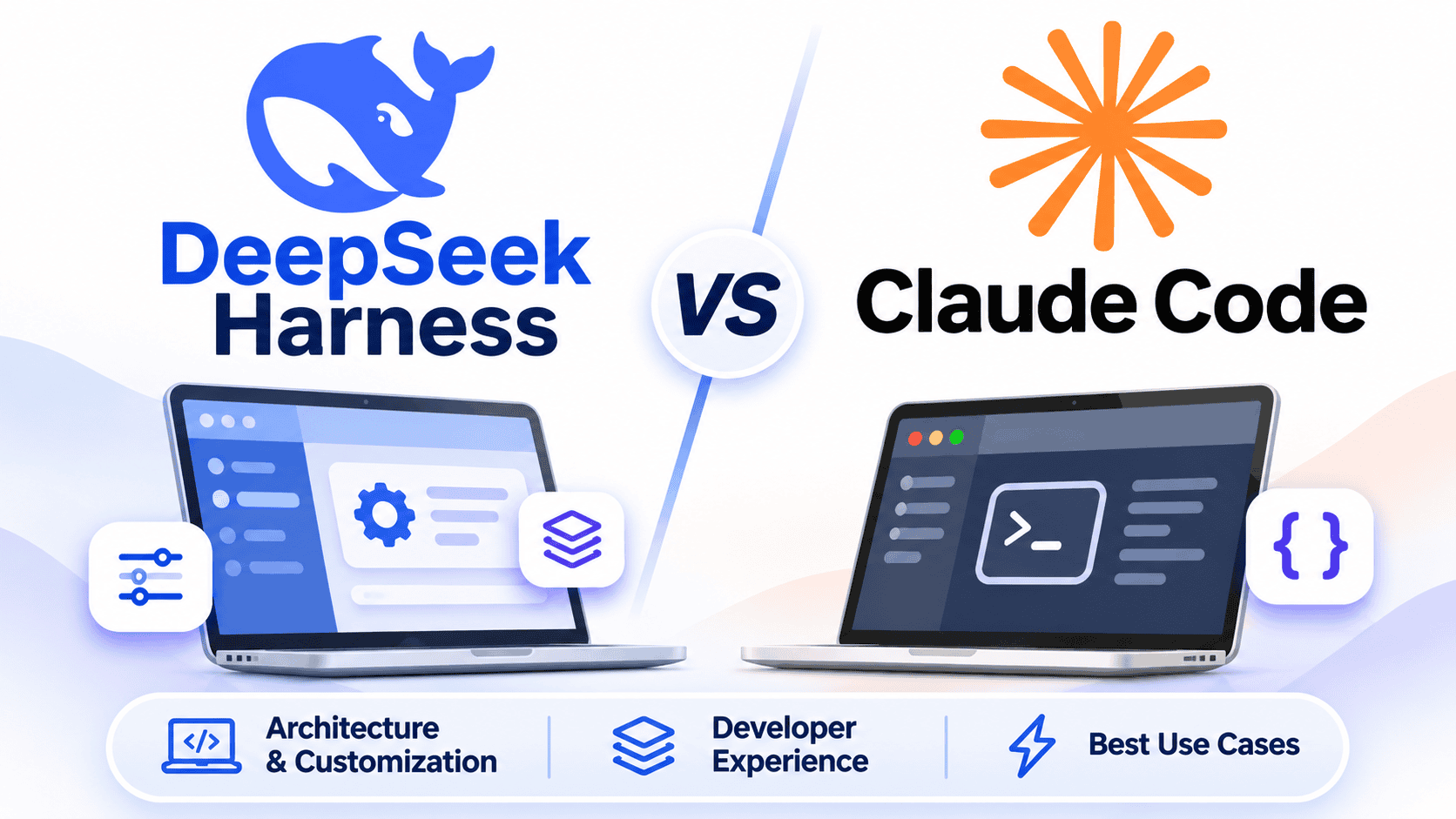
Claude Code is the stronger default for most developers who want a polished coding agent they can install, open inside a repository, and use across the terminal, IDE, desktop, browser, mobile devices, and CI workflows. DeepSeek Harness is the better choice for engineers who want to inspect, replace, or build the agent runtime itself, including its model adapters, tools, storage, sandbox, session log, and agent loop.
That distinction matters more than a simple DeepSeek-versus-Claude model comparison. A coding agent’s behavior comes from the combination of its model, system instructions, context management, tools, permissions, retries, subagents, and execution environment. Changing the harness can change the result even when the underlying model remains the same.
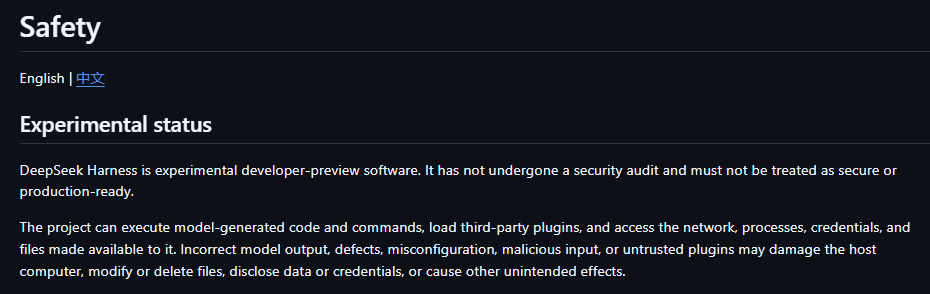
DeepSeek Harness also carries more operational risk today. DeepSeek describes it as a public preview, while its repository and safety notice call it experimental developer-preview software that has not undergone a security audit and should not be treated as production-ready. Claude Code is proprietary and less deeply replaceable, but it offers a more mature product surface, centralized configuration, broader official integrations, and a lower-friction path for day-to-day software development.
DeepSeek Harness vs Claude Code at a glance
| Decision factor | DeepSeek Harness | Claude Code |
|---|---|---|
| Core design | Composable agent runtime with deeply replaceable components | Packaged coding agent with a built-in loop and extensive workflow extensions |
| Best fit | Agent platform engineers, researchers, framework builders, and teams requiring provider flexibility | Application developers, product teams, and organizations standardizing AI-assisted development |
| Current status | Public and developer preview; current release is a pre-release candidate | Actively maintained product with broad official deployment and integration documentation |
| License | MIT License | Proprietary; use is governed by Anthropic’s applicable terms |
| Model choice | Built-in and custom providers using OpenAI Chat Completions, OpenAI Responses, or Anthropic Messages formats | Designed around Claude models, with supported cloud providers, gateways, and limited compatible-endpoint flexibility |
| Runtime customization | Model adapter, tool registry, storage, session log, sandbox, and agent loop can be replaced | Customize around the core loop with CLAUDE.md, Skills, Hooks, Subagents, MCP, plugins, settings, and the Agent SDK |
| Everyday coding experience | More setup and configuration; strongest when runtime control is part of the project | Faster path from installation to repository work |
| Official surfaces | Local Web UI, desktop packages, headless profiles, automation profiles, and Python SDK | Terminal, VS Code, JetBrains, desktop, browser, mobile, Slack, GitHub, and CI/CD integrations |
| Security posture | Explicitly experimental and not security-audited; strong isolation is the user’s responsibility | More developed permission, sandbox, managed-policy, and enterprise controls, but still requires careful configuration |
| Software cost | No license fee, but model, infrastructure, tools, and maintenance still cost money | Available through eligible Claude subscriptions, API billing, or supported cloud providers |
| Recommended default | Choose when you need to build or modify the agent platform | Choose when you primarily need the agent to build or modify application code |
What are you actually comparing?
DeepSeek Harness and Claude Code overlap, but they start from different product philosophies.
DeepSeek Harness is an extensible agent runtime
DeepSeek Harness is a local-first coding agent and agent-development runtime. It can read and modify files, run commands, maintain plans, delegate work, and connect to model providers, but its defining characteristic is not any one coding feature. Its defining characteristic is that the runtime itself is configurable.
The official architecture documentation describes a Cordis-based plugin tree in which the model adapter, tool registry, session log, storage, sandbox, and agent loop are replaceable through configuration. Shipped profiles include Web, headless, SDK, minimal SDK, and automation-oriented configurations.
This makes DeepSeek Harness attractive when the agent architecture is part of the engineering problem. A team can replace the model route, customize tool behavior, add a storage implementation, change the approval layer, create a specialized loop, or build a controlled runtime for internal agents.
Claude Code is a packaged coding agent
Claude Code is an agentic coding product that reads repositories, edits files, executes commands, runs tests, navigates code, and coordinates development tasks. Anthropic supplies the core agent engine and exposes it through multiple interfaces rather than asking the user to assemble the runtime.
Claude Code is highly extensible, but most extensions sit around the supplied agent loop. Teams can provide project instructions through CLAUDE.md, package reusable workflows as Skills, execute deterministic automation with Hooks, add specialized Subagents, connect external systems through MCP, and distribute the configuration as plugins.
The Claude Agent SDK also exposes the same tools, agent loop, permissions, sessions, hooks, and context-management behavior to Python and TypeScript applications. It makes Claude Code programmable, but it does not turn the proprietary binary into an open-source runtime with every internal component replaceable as a plugin.
Product maturity and release status
The maturity gap should influence any production decision.
As checked on November 6, 2026, the latest listed DeepSeek Harness release is v0.2.2-rc.1, published as a pre-release on November 4. The product page calls Harness a public preview, while the repository warns that it is in developer preview and that compatibility-breaking changes should be expected.
Its official safety notice is more explicit: DeepSeek Harness is experimental, has not undergone a security audit, and must not be treated as secure or production-ready. Teams adopting it should pin versions, test upgrades, preserve configuration history, and expect profiles or plugins to require changes as the project evolves.
As checked on November 8, 2026, the Claude Code changelog lists version 2.1.319. Claude Code also has established documentation for local and cloud sessions, IDE integrations, managed organizational settings, permissions, sandboxing, data controls, CI, observability, and deployment through supported cloud providers.
This does not mean Claude Code is risk-free or suitable for every regulated environment. It means that a team seeking a supported daily coding product faces less platform-building work than a team adopting a rapidly changing runtime preview.
Architecture and customization: where the biggest difference appears
Both products can be customized, but they expose different depths of control.
| Customization need | DeepSeek Harness approach | Claude Code approach |
|---|---|---|
| Persistent repository instructions | Prompt and profile configuration through the runtime’s plugin tree | CLAUDE.md, rules, memory, and managed settings |
| Reusable workflows | Skills, tools, plugins, profiles, and custom agent components | Skills, commands, plugins, and project configuration |
| Deterministic automation | Plugins and event-driven runtime services | Hooks triggered by lifecycle events |
| External systems | MCP, custom tools, Web providers, and provider plugins | MCP servers, plugins, built-in tools, and supported connectors |
| Specialized workers | Local agents and external subagent providers | Subagents, dynamic workflows, and agent teams |
| Replace model adapter | Yes | Provider and model routing can be configured, but the product remains designed around Claude-compatible behavior |
| Replace storage or session-log implementation | Yes, through the plugin architecture | Session behavior and external persistence can be controlled through documented product and SDK interfaces, but not by replacing every internal component |
| Replace the core agent loop | Yes | No comparable user-replaceable core-loop plugin documented in Claude Code |
| Maintenance burden | Higher because the team owns more architectural choices | Lower because Anthropic supplies and updates more of the runtime |
When DeepSeek Harness’s deeper control matters
Deep runtime control is useful when you are building an internal agent platform rather than adopting a finished coding assistant. Examples include:
- Testing several models behind one agent interface
- Replacing the default planning or execution loop
- Building a provider-independent evaluation harness
- Capturing custom session events for replay or auditing
- Implementing organization-specific storage and approval services
- Developing a specialized sandbox or execution environment
- Embedding the runtime inside another application through the SDK
The tradeoff is ownership. Every replaceable component becomes another component the team must configure, test, secure, document, and maintain.
When Claude Code’s extension layer is enough
Most application teams do not need to replace the agent loop. They need the agent to follow coding conventions, connect to internal systems, run standard checks, delegate bounded investigations, and apply organization-wide policies.
Claude Code’s extension system is designed for those needs:
CLAUDE.mdsupplies persistent project instructions.- Skills store reusable knowledge and repeatable workflows.
- Hooks run scripts, HTTP requests, MCP calls, prompts, or subagents at defined lifecycle events.
- Subagents isolate specialized tasks in separate contexts.
- MCP connects databases, browsers, issue trackers, and other external services.
- Plugins package Skills, Hooks, Subagents, and MCP servers for reuse.
- Shared and managed settings help teams standardize models, permissions, plugins, and policies.
Claude Code offers less freedom to redesign the core engine, but its constraints reduce the amount of platform work required before developers can become productive.
Which provides the better everyday coding workflow?
Claude Code is the better default for daily application development.
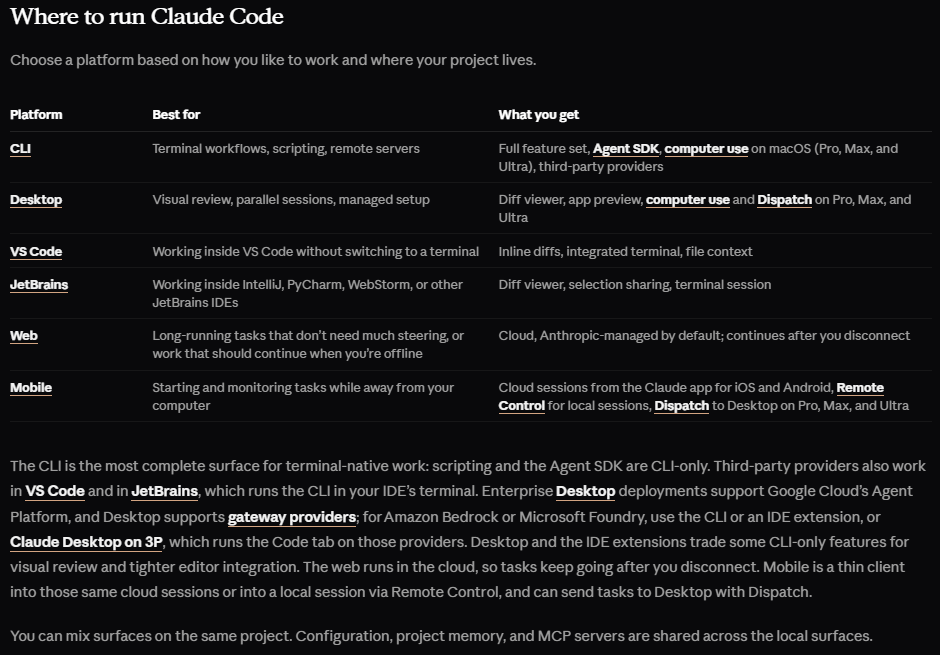
Its official platform documentation covers the terminal, VS Code, JetBrains, the desktop application, browser sessions, mobile access, Slack, GitHub workflows, and CI/CD. The same underlying engine is presented through interfaces optimized for interactive coding, visual review, remote work, and automation.
A developer can install Claude Code, authenticate with an eligible Claude plan, API key, or supported cloud provider, open a repository, and begin asking it to investigate bugs, implement features, run tests, explain architecture, review changes, or prepare pull requests. Project-specific behavior can be added incrementally instead of requiring a runtime architecture to be designed first.
DeepSeek Harness can perform similar repository work. Its Web UI guide shows that an agent can read and edit workspace files, run commands, delegate work, and maintain a plan. It also offers headless and SDK profiles for automation.
The difference is the starting point. A new Harness user must select or configure a provider, understand the workspace and permission model, and potentially work with profiles, bundles, or patches. That additional setup is reasonable when customization is the goal, but it is overhead when the goal is simply to fix a bug or build a feature.
Operating-system and interface considerations
Both products support Windows, macOS, and Linux in documented configurations. DeepSeek’s Python SDK currently lists Linux on x64 and ARM64, macOS 14 or newer on Apple silicon, and Windows x64 among its supported environments. Claude Code provides official local and remote experiences across the terminal, desktop, VS Code, JetBrains, browser, and mobile devices.
Do not assume that every interface is equivalent. A cloud session, desktop session, IDE session, and local CLI session may read different settings, run on different machines, or have different data and security boundaries. Evaluate the exact surface your team plans to deploy.
Model choice and provider flexibility
DeepSeek Harness offers broader provider control
DeepSeek Harness has the clearer advantage when model portability is a requirement. Its provider configuration includes installed routes for providers such as DeepSeek, Anthropic, OpenAI, and Moonshot AI, while custom providers can use:
- OpenAI Chat Completions
- OpenAI Responses
- Anthropic Messages
A custom route can point to a relay, company gateway, third-party service, or self-hosted inference server. Compatibility options can adjust request fields when an endpoint does not implement a protocol exactly as expected.
This flexibility does not guarantee portability without engineering work. Different providers handle system roles, output limits, reasoning controls, images, tool calls, caching, and errors differently. An endpoint that accepts an OpenAI- or Anthropic-shaped request may still reject fields or behave differently from the original service.
Claude Code is flexible within a more opinionated model system
Claude Code is designed around Claude models. Its official deployment options include direct Anthropic access and supported routes through Amazon Bedrock, Google Cloud’s Agent Platform, Microsoft Foundry, Claude Platform on AWS, and organizational gateways.
Organizations can configure model aliases, pin provider-specific model IDs, restrict available models, and route requests through compatible gateways. However, Claude Code should not be described as fully model-agnostic. Some features, model assumptions, tool behavior, remote services, authentication flows, and compatibility logic remain tied to Claude Code’s product design.
Can Claude Code use DeepSeek?
Yes. DeepSeek provides an official Claude Code integration guide that points Claude Code to DeepSeek’s Anthropic-compatible endpoint through environment variables. DeepSeek maps Claude model-family names to its own current models.
This gives developers the Claude Code interface with DeepSeek model billing, but it should not be treated as perfect feature parity. DeepSeek’s Anthropic-compatible API documents fields that are ignored, translated, or handled differently. A successful connection proves protocol compatibility, not identical reasoning controls, caching, tool execution, streaming, context handling, or error behavior.
Can DeepSeek Harness use Claude?
Yes. Anthropic is one of the provider routes documented by DeepSeek Harness. Harness also includes an official Claude Code subagent provider that can launch Claude Code non-interactively as an external worker.
This creates useful hybrid patterns. A team can use DeepSeek Harness as an orchestration layer while assigning selected tasks to Claude Code, or use Claude Code as the daily interface while routing some sessions to DeepSeek. Hybrid use can reduce migration pressure, but it adds more credentials, billing systems, data processors, and failure modes.
What do current benchmarks actually show?
No current benchmark establishes that one harness is universally better. Results depend on whether the test compares native product stacks or holds the model constant.
Default-stack results favor Claude Code for capability and DeepSeek Harness for cost
The current Artificial Analysis comparison pairs Claude Code with Claude Opus 5.5 at maximum effort and DeepSeek Harness with DeepSeek V4.1 Flash 1017 at maximum effort.
| Metric | Claude Code with Claude Opus 5.5 | DeepSeek Harness with DeepSeek V4.1 Flash 1017 |
|---|---|---|
| Coding Agent Index v2.0 | 62 | 46 |
| FrontierCode v1.1 | 56 | 47 |
| Terminal-Bench 4.0 | 63 | 31 |
| SWE-Atlas-QnA-AA | 66 | 62 |
| Average API cost per task | $11.42 | $0.30 |
| Average wall time per task | 1 hour | 21.4 minutes |
| Average token usage per task | 14.5 million | 16.7 million |
The Coding Agent Index v2.0 methodology covers 290 tasks across FrontierCode v1.1, Terminal-Bench 4.0, and SWE-Atlas-QnA-AA, with three attempts per task. That provides broader evidence than a single demo.
It is still not a harness-isolation test. The agents used different models with very different prices and capabilities. The result supports two conclusions about the tested stacks: Claude Code with Opus achieved higher aggregate performance, while DeepSeek Harness with DeepSeek Flash was far cheaper and faster. It does not prove that Claude Code’s loop is inherently better or that DeepSeek Harness itself creates the cost advantage.
Same-model testing does not produce a clear winner
A November 5, 2026 Product Compass evaluation used DeepSeek V4.1 Flash 1017 through DeepSeek’s API across several harnesses. Its Bug Hunt Bench placed 105 bugs into two codebases and measured how many each agent fixed.
| Effort level | DeepSeek Harness average | Claude Code average | Runs per harness |
|---|---|---|---|
| Maximum | 42.7 of 105 bugs | 39.1 of 105 bugs | 7 |
| High | 39.2 | 36.4 | 5 |
| Low | 34.8 | 34.4 | 5 |
At maximum effort, the DeepSeek Harness runs averaged 62 minutes and $1.84, while Claude Code averaged 58 minutes and $1.01. The score ranges overlapped, and the reported permutation test produced p=0.14, which did not support declaring a reliable winner from that sample.
The evaluation is useful because it keeps the model, provider, repositories, and main task more consistent. It still has important limits:
- It covers one model and one benchmark design.
- The tested versions were DeepSeek Harness
0.2.1-rc.2and Claude Code2.1.302, not the newest releases available at the review date. - DeepSeek Harness used subagents, while Claude Code’s subagent tool was disabled by the benchmark.
- Run-to-run variation was large enough to overlap substantially.
- Cost differences came partly from how each harness consumed tokens and delegated work.
The result is evidence that harness behavior can affect performance and cost. It is not evidence that DeepSeek Harness will outperform Claude Code on every repository.
A one-task case study shows how permissions can dominate timing
A DataCamp case study gave both tools the same small TypeScript repository, prompt, and Claude Sonnet 5 model. Both produced a byte-identical patch and passed all 10 tests.
Claude Code reported 55 seconds, while DeepSeek Harness took 125.4 seconds. The Harness run encountered a Windows sandbox problem, requested three wider-permission approvals, and repeated installation work. The author conducted one timed run per configuration, so the timing difference should not be generalized.
This narrow test demonstrates a practical lesson: setup, permissions, sandbox behavior, and tool strategy can matter as much as the model on a small coding task.
Pricing and total cost
DeepSeek Harness is open-source software under the MIT License. There is no license fee for the runtime itself. That does not make the complete workflow free.
A Harness deployment may still incur costs for:
- Hosted model input, output, reasoning, and cached tokens
- Search, fetch, code execution, or other paid tools
- Cloud GPUs or local inference hardware
- Plugin and MCP infrastructure
- Logging, storage, monitoring, and sandbox environments
- Engineering time spent configuring and maintaining the runtime
- Human review and retries after unsuccessful agent runs
Claude Code is available through eligible paid Claude plans, API billing, Team or Enterprise access, and supported cloud providers. As checked on November 6, 2026, Anthropic’s US pricing page lists Pro at $20 per month or $17 per month with annual billing, Max at $100 per month, Ultra at $200 per month, and a Team standard seat at $20 per month with annual billing or $25 monthly. Usage limits and additional usage charges apply.
These subscriptions are not directly comparable with a DeepSeek API token rate. A subscription provides an included usage pool shared across supported Claude experiences. A pay-as-you-go model provider charges for actual API consumption. Claude Code can also be used with API credentials, at which point model and cache rates become more directly measurable.
| Cost category | DeepSeek Harness | Claude Code |
|---|---|---|
| Software license | No license fee under MIT | Proprietary product governed by Anthropic’s terms |
| Typical individual access | Bring a model provider, gateway, or self-hosted endpoint | Eligible paid subscription or API credentials |
| Variable model cost | Depends on the configured provider and model | Included-plan limits or API/cloud-provider rates |
| Infrastructure cost | Potentially higher when the team owns runtime, storage, execution, and observability | Varies by local, cloud, API, or enterprise deployment |
| Maintenance cost | Higher when using custom plugins or replacing runtime components | Lower for standard product use; increases with extensive hooks, MCP, plugins, and Agent SDK applications |
The best financial metric is cost per accepted result, not software price or cost per run. Measure how much each system spends before it produces a correct change that passes tests and requires an acceptable amount of human review.
The same-model Product Compass results illustrate why this matters. DeepSeek Harness had a slightly higher average score at maximum effort, but it cost about 1.8 times as much per run as Claude Code with the same model. A free runtime license did not automatically produce the cheaper execution path.
Permissions, sandboxing, and security
Both agents can execute commands and change files. Neither should be given unrestricted access to an untrusted repository, production system, broad credential store, or sensitive network merely because it provides approval prompts.
DeepSeek Harness security
DeepSeek Harness separates sandbox mode from approval policy. Its documented permission presets include a workspace-write configuration that asks for approval and a danger-full-access configuration that does not request approvals. The approval service fails closed when a valid approval is unavailable.
Those controls reduce risk, but DeepSeek’s own safety notice says they do not guarantee isolation. Harness can execute model-generated commands, load third-party plugins, use the network, and access any credentials, processes, or files made available to it.
DeepSeek recommends least privilege, backups, careful plugin review, and a disposable virtual machine, container, or dedicated environment for risky workloads. That warning should be treated as a deployment requirement rather than a footnote.
Claude Code security
Claude Code provides multiple permission modes plus allow, ask, and deny rules for tools and paths. Settings can be scoped to an individual user, a shared project, a local project override, or an organization’s managed policy.
Claude Code also provides a sandboxed Bash tool with filesystem and network controls. The sandbox is off by default and must be enabled or enforced through settings. It wraps shell commands, but some tools and processes run outside that shell boundary. Commands may also be configured to retry outside the sandbox unless stricter settings prevent it.
Anthropic recommends using a container, virtual machine, or sandboxing the entire Claude Code process when one boundary must cover every tool and subprocess. Its security documentation also advises reviewing commands, verifying changes to critical files, and using virtual machines for untrusted content.
Practical safety checklist
- Run the agent in a disposable branch, worktree, container, or virtual machine.
- Expose only the repository and directories needed for the task.
- Remove unnecessary cloud, production, and package-registry credentials.
- Use explicit allowlists and deny access to secrets such as
.envfiles. - Review plugins, MCP servers, hooks, and provider endpoints before enabling them.
- Keep the network disabled unless the task genuinely requires it.
- Review proposed commands and diffs before merging or deploying.
- Run automated tests, static analysis, secret scanning, and dependency checks.
- Pin agent, plugin, and runtime versions in reproducible environments.
- Maintain backups for every file or resource the agent can modify.
Data flow, privacy, and retention
A local interface is not the same as local model inference.
DeepSeek Harness’s current Privacy Policy distinguishes official model services from custom model services. For official services, it describes collecting account details, session logs with inputs, outputs and tool activity, and device and network information. Stated uses include operating the service and training or improving its technology. The policy describes processing and storage in China, with retention based on the data and purpose rather than a single fixed period.
For custom model services, the policy says no Harness registration or login is needed: inputs go directly to the configured model provider and outputs return directly from it. Harness does not store or process those inputs and outputs on its servers in that scenario; the model provider’s policies govern its processing. A custom provider can still be a remote service, so this does not mean that all processing stays on your computer.
Search tools, MCP servers, plugins, and other connected services can also receive relevant data. Review their policies separately; the client interface does not override the terms of the services connected to it.
Local Claude Code sessions run tools on the user’s machine, but prompts and selected code context are sent to the configured model endpoint for inference. Cloud sessions execute in a different environment, and routing through Bedrock, Google Cloud, Microsoft Foundry, or a gateway changes which providers process the data.
According to Claude Code’s data-usage documentation, consumer users can choose whether their data is used to improve future models. Consumer data has a stated 30-day retention period when model improvement is disabled and a five-year retention period when it is enabled. Under commercial terms, Anthropic does not train its generative models on Team, Enterprise, API, third-party platform, or Claude Gov content unless the customer opts into a qualifying program.
Standard commercial retention is documented as 30 days. Zero Data Retention for Claude Code is available only to qualified Claude for Enterprise accounts and requires separate enablement. It is not automatically included in every Enterprise plan or available for every surface and third-party route.
For confidential code, compare the exact combination of client, model provider, account type, retention setting, plugins, tools, and deployment environment. A brand-level statement that one product is “private” is not specific enough for a security review.
Which one should you choose?
| User or workload | Recommended starting point | Why |
|---|---|---|
| Individual application developer | Claude Code | Faster setup, broader interfaces, and less runtime maintenance |
| Team standardizing AI-assisted development | Claude Code | Shared settings, managed policies, IDE support, administration, and documented team deployment |
| Agent framework researcher | DeepSeek Harness | The core loop, adapters, storage, and tools can be inspected and replaced |
| AI platform team supporting several providers | DeepSeek Harness | Broader native and custom provider routing |
| Developer who wants Claude Code with a DeepSeek model | Claude Code with DeepSeek’s compatible endpoint | Retains the familiar interface while changing the inference provider, subject to compatibility limits |
| Team prioritizing maximum current benchmark performance | Claude Code with a capable current Claude model, followed by a private pilot | Representative default-stack results currently favor Claude Code, but the model drives much of the difference |
| High-volume, cost-sensitive coding automation | Test DeepSeek Harness and Claude Code with the same economical model | Token use and task success can reverse the expected price advantage |
| Production team with low tolerance for breaking changes | Claude Code | DeepSeek Harness remains a preview project with compatibility risk |
| Organization needing a custom agent runtime embedded in its own product | DeepSeek Harness or a carefully evaluated SDK architecture | Harness exposes deeper internal replacement points under the MIT License |
| Highly sensitive or untrusted workload | Neither without dedicated isolation and a formal review | Both can execute code and access resources; permissions alone are not a complete security boundary |
How to benchmark both tools on your own repository
A useful evaluation requires two separate experiments.
Test 1: Compare the native product experiences
Use each tool with its normal recommended model, interface, permissions, and workflow. This answers the purchasing question: which complete product helps your team finish work more effectively?
Test 2: Hold the model constant
Run the same model through both harnesses to reduce model quality as a confounding variable. Keep the following consistent:
- Model ID, provider, endpoint, and reasoning effort
- Repository commit and installed dependencies
- Prompt and acceptance criteria
- Network and web-search access
- Available tools and MCP servers
- Permission and sandbox policy
- Subagent availability and concurrency
- Timeout, turn limit, and budget
- Context and compaction settings
- Clean repository state before every run
Run each task several times because coding agents are nondeterministic. Include successful, failed, timed-out, and invalid runs rather than reporting only the best attempt.
Measure outcomes that matter
- Acceptance-test pass rate
- Regressions introduced
- Correctness of multi-file changes
- Human intervention and review time
- Wall-clock completion time
- Input, output, and cached tokens
- Tool, search, and subagent calls
- Retries and recoverable failures
- API and infrastructure cost
- Cost per accepted result
- Security or policy violations
- Ease of reproducing the result across developers
A small but realistic internal benchmark is more useful than a public leaderboard when it reflects your languages, repository size, build system, tests, security restrictions, and definition of an acceptable change.
Final verdict
Choose Claude Code when your main objective is to improve everyday software development. It offers the stronger out-of-the-box experience, broader official interfaces, mature team configuration, extensive workflow extensions, and less responsibility for maintaining the agent runtime.
Choose DeepSeek Harness when controlling or changing the runtime is part of your engineering objective. Its MIT license, provider flexibility, replaceable agent loop, plugin architecture, headless profiles, and SDK make it a compelling foundation for experimentation and internal agent-platform development.
DeepSeek Harness is not currently a drop-in production replacement for Claude Code. Its own documentation identifies it as experimental preview software without a completed security audit. A team can still adopt it for controlled research, evaluations, internal prototypes, and isolated automation, but it should budget for compatibility changes, security engineering, and platform maintenance.
The benchmark evidence also does not support declaring one harness universally superior. Claude Code paired with a leading Claude model currently achieves stronger representative benchmark results, while DeepSeek Harness paired with DeepSeek Flash can be dramatically cheaper. When the same model is used, observed differences are smaller, variable, and sometimes more expensive for Harness.
A hybrid strategy can be stronger than a forced migration. Developers can use Claude Code as their daily interface with a DeepSeek-compatible endpoint, or use DeepSeek Harness as an orchestration runtime that delegates selected work to Claude Code. Keep the combination only when measured improvements justify the additional configuration, billing, security, and debugging complexity.
Frequently asked questions
Is DeepSeek Harness a free alternative to Claude Code?
DeepSeek Harness has no software license fee under the MIT License, but it is not cost-free to operate. You still need a model endpoint or local inference infrastructure and may pay for tokens, search, tools, storage, monitoring, execution environments, and engineering maintenance.
Is DeepSeek Harness better than Claude Code?
DeepSeek Harness is better for deep runtime customization, model-provider flexibility, and agent-platform development. Claude Code is better for most developers who want a mature coding agent with lower setup friction, broader official interfaces, and stronger team-management features.
Can Claude Code use DeepSeek models?
Yes. DeepSeek publishes an official integration that points Claude Code to its Anthropic-compatible API endpoint. Compatibility is not identical to native Claude access, so test model mapping, tools, reasoning controls, caching, context, and error behavior before production use.
Can DeepSeek Harness use Claude models?
Yes. DeepSeek Harness includes an Anthropic provider route and supports the Anthropic Messages protocol for compatible custom endpoints. It also has an official provider that can run Claude Code as a noninteractive subagent.
Does DeepSeek Harness run locally?
The Harness application and its default session storage run locally, but the model may still run on an external API. Local UI and local data storage do not mean local inference. A fully local workflow requires a compatible self-hosted model endpoint and locally controlled tools.
Which tool is safer for untrusted repositories?
Neither should process an untrusted repository with unrestricted host access. Claude Code has more developed permission, sandbox, and managed-policy controls, while DeepSeek Harness explicitly says it is not security-audited or production-ready. Use a disposable container or virtual machine, remove credentials, restrict the network, and review every change.
Which is cheaper?
The answer depends on the model, provider, token use, caching, tools, retries, and success rate. DeepSeek Harness has no license fee and can use inexpensive models, but same-model testing has shown it can consume more money per run than Claude Code. Compare cost per accepted result rather than license price alone.
Is DeepSeek Harness ready for production?
DeepSeek’s current repository and safety notice describe it as experimental developer-preview software, warn of compatibility-breaking changes, and say it should not be treated as secure or production-ready. Production use requires independent testing, isolation, version pinning, upgrade controls, and a formal security review.
Sources checked
- DeepSeek Harness official product page
- DeepSeek Harness official repository
- DeepSeek Harness release history
- DeepSeek Harness safety notice
- DeepSeek Harness architecture reference
- DeepSeek Harness model-provider guide
- DeepSeek Harness Privacy Policy
- Claude Code overview
- Claude Code extension architecture
- Claude Code permissions documentation
- Claude Code sandbox documentation
- Claude Code data-usage documentation
- Artificial Analysis Coding Agent Index methodology
- Product Compass same-model comparison
- DataCamp same-model case study