
DeepSeek is worth using for non-sensitive chat, coding, technical problem-solving, and cost-conscious API workloads. Its official consumer assistant is free, its current model performs competitively on coding and reasoning evaluations, and its developer API combines low token prices with a 1-million-token context window, image understanding, tool calling, and unusually long output limits.
The trade-offs are equally important. DeepSeek’s consumer privacy policy says prompts, uploaded files, photos, chat history, device information, and approximate location may be collected; personal data is directly processed and stored in the People’s Republic of China; and user data may be used to improve or train its technology unless the user opts out. Its consumer ecosystem is also narrower than assistants that combine native audio, video, media generation, productivity-suite integrations, and mature business administration.
Published: November 5, 2026. Models, app features, prices, policies, and legal restrictions can change.
Quick verdict: DeepSeek is an excellent free assistant for public or low-sensitivity work and one of the most attractive APIs for developers who prioritize price, coding, reasoning, long context, and open weights. It should not be the default destination for confidential business files, regulated personal data, or covered US federal systems. Users who need native audio, video, connected workplace apps, or formal enterprise data controls may be better served by another platform.
DeepSeek at a glance
| Category | Review finding | What it means |
|---|---|---|
| Overall value | Excellent for the right workload | The free app and low-cost API deliver unusually strong capability for the price. |
| Current app model | DeepSeek-V4.1-Flash-1017 | DeepSeek says its official website and app were updated to this model on October 17, 2026. |
| Best uses | Coding, reasoning, technical analysis, text work, web-assisted research, and image understanding | It is strongest when the work is verifiable and does not contain sensitive data. |
| Consumer price | Free | DeepSeek advertises free access, but it does not publish a stable consumer usage-limit schedule. |
| Developer API | Strong value | It offers low token rates, long context, long output, tools, JSON output, and OpenAI- and Anthropic-style endpoints. |
| Multimodality | Text and images | The current Flash model supports image understanding but does not document native audio or video input. |
| Privacy | Unsuitable for many confidential workloads by default | The official consumer service processes and stores personal data in China and may use data for model improvement. |
| Open weights | Yes | The current V4.1 Flash checkpoint is available under the MIT License, but full deployment requires substantial infrastructure. |
| US availability | Available to ordinary consumers, with important government restrictions | A federal order covers federal civilian systems and procurements; it is not a nationwide consumer ban. |
What this review covers
DeepSeek is no longer a single chatbot or model. It now includes several distinct products:
- The official DeepSeek web and mobile assistant
- DeepSeek Harness, a desktop agent for files, research, coding, plugins, and background tasks
- The first-party DeepSeek API
- Standalone Search and Fetch APIs
- Downloadable open-weight models
- Third-party services that host DeepSeek models
This is an evidence-based editorial review of the current first-party consumer product, API, and open-weight release. It uses DeepSeek’s official documentation, app-store information, current independent model evaluations, published safety research, and government records.
The logged-in consumer app was not directly tested for this review, so no firsthand test results or numerical rating are claimed. App-specific observations are limited to currently documented features and clearly attributed independent evidence.
What is the current version of DeepSeek?
DeepSeek’s official changelog says the company updated its web assistant, mobile app, and API to DeepSeek-V4.1-Flash-1017 on October 17, 2026. Developers access the same version through the deepseek-flash model ID.
This distinction matters because many DeepSeek reviews still focus on R1, V3, V3.1, or the original V4 Flash. Those models explain DeepSeek’s history, but they should not be used as the sole basis for judging the current product.
The first-party API also continues to list deepseek-v4-pro, which currently maps to DeepSeek-V4-Pro-0813. V4 Pro costs more, lacks the Flash model’s image support, and should not automatically be assumed to outperform the newer Flash model on every task.
Is the DeepSeek app really free?
Yes. DeepSeek’s official download page describes its web and mobile assistant as free and powered by its latest flagship model. The app is available for iOS and Android, while the browser version is available through DeepSeek’s official website.
No paid consumer subscription is prominently listed on the official pages reviewed. That makes DeepSeek particularly attractive to students, hobbyists, developers, and anyone who does not want another $20-per-month AI subscription.
“Free” should not be interpreted as a contractual promise of unlimited use. DeepSeek does not publish a stable consumer limit table showing daily messages, reasoning requests, file uploads, or capacity-based restrictions. Limits can still appear during heavy demand or as product policies change.
The consumer experience is simple but less expansive than its rivals
DeepSeek’s main assistant focuses on chat, reasoning, web search, uploaded files, images, and synchronized conversation history. Its US App Store version history shows that photo and file uploads were improved during 2026 and that separate Instant, Expert, and Vision modes were later unified.
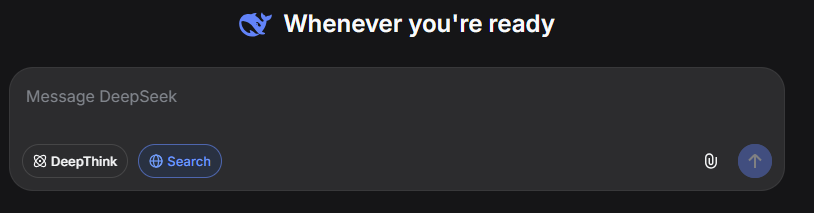
This streamlined approach is a benefit when the goal is to ask questions, write code, analyze a screenshot, summarize a file, or work through a technical problem without navigating a large product suite.
It is less compelling when the workflow depends on features such as native audio and video analysis, image or video generation, connected email and calendar data, persistent personal memory, custom assistants, shared team workspaces, or deep integration with a productivity suite. DeepSeek’s public consumer pages emphasize its core model and chat experience rather than those broader ecosystem features.
DeepSeek Harness expands the product beyond chat
DeepSeek Harness is a separate desktop product in public preview for macOS and Windows. It can work with local files, analyze documents and spreadsheets, edit code, run tests, perform research, execute background tasks, and install plugins.
Harness makes DeepSeek more competitive with coding agents and AI workspaces, but it should not be confused with the basic consumer chatbot. Several Harness features are experimental, and its plugin-based architecture creates additional security and permission questions that do not apply to a normal text conversation.
How good is DeepSeek for coding, reasoning, and everyday work?
| Workload | Evidence-based assessment | Main qualification |
|---|---|---|
| Coding | Very strong value | Real repository work still depends on the agent, tools, tests, permissions, and exact reasoning setting. |
| Math and technical reasoning | Strong | Correct-looking reasoning can still contain errors; verify the final result. |
| General writing | Capable but not always the most polished | Reasoning mode can produce more detail and verbosity than a simple writing task needs. |
| Current web research | Useful with search enabled | Links and citations must be opened and checked; retrieval does not guarantee correct interpretation. |
| Images and screenshots | Good documented support | The current model understands images but produces text rather than generated images. |
| Audio and video | Limited compared with broader multimodal platforms | Native audio and video input are not listed for the current first-party model. |
| Long inputs | Potentially excellent through the API | The 1-million-token API context should not be assumed to apply unchanged to the free app. |
| Confidential business work | Poor default fit through the consumer app | Data-processing location, retention, training use, and organizational policy must be addressed first. |
Coding and agentic work are DeepSeek’s clearest strengths
DeepSeek’s current model card and release notes emphasize coding, repository-level work, terminal tasks, tools, automation, and end-to-end project development. These are vendor-reported results and should not be treated as neutral proof, but they show where the model was deliberately optimized.
Independent testing points in the same general direction. Artificial Analysis places the reasoning version of V4.1 Flash-1017 among the stronger open-weight models it has evaluated. Its profile also characterizes the model as fast and relatively verbose.
That makes DeepSeek a credible option for:
- Explaining compiler and runtime errors
- Generating functions and tests
- Refactoring code
- Working through algorithmic problems
- Producing structured data
- Powering coding agents and terminal workflows
- Handling long code and document contexts
It does not remove the need to run the code. Security flaws, nonexistent libraries, incomplete error handling, and subtly incorrect tests can appear in output from any coding model. Production teams should evaluate DeepSeek against real repositories and count passing tests, retries, human corrections, latency, and total cost per accepted result.
Reasoning mode is useful but can be excessive
The API supports thinking and non-thinking modes, with thinking enabled by default. Reasoning mode is valuable for mathematics, planning, complex debugging, and tasks where intermediate analysis improves the chance of a correct final answer.
For extraction, classification, rewriting, short answers, and predictable JSON, non-thinking mode can be faster and less expensive. Developers should not leave maximum reasoning enabled for every request simply because it is available.
Writing quality is competent, but technical depth is the bigger attraction
DeepSeek can draft articles, emails, summaries, explanations, outlines, and translations. Its stronger differentiation is not polished lifestyle writing or a highly personalized assistant experience; it is the combination of technical competence, detailed reasoning, low cost, and open deployment options.
For important writing, provide source material, define the audience and tone, request a fact-check pass, and review every claim. A confident, fluent paragraph is not evidence that the information is correct.
Web search and citations are helpful, not self-validating
DeepSeek’s official app supports web search, and the company opened its own Search and Fetch APIs in October 2026. The Search API returns structured search results, while the Fetch API retrieves a page as Markdown for an agent or retrieval system.
This is useful for current events, product research, documentation lookup, and source-backed reports. The practical weakness is the same one found in every AI research tool: retrieving a source does not guarantee that the model understood it correctly.
- Open the cited page rather than trusting the link label.
- Check that the source actually supports the nearby claim.
- Compare publication date with the date the event occurred.
- Prefer primary sources for prices, laws, policies, and technical specifications.
- Do not rely on snippets when the full page says something different.
DeepSeek’s own privacy policy warns that generated responses may not be factually accurate. Search reduces some knowledge gaps, but it does not eliminate hallucinations or misinterpretation.
File and image support has improved
The current deepseek-flash API supports image input, and DeepSeek’s mobile release history documents vision, photo uploads, and file-upload improvements. This makes the service useful for screenshots, charts, scanned pages, interface analysis, photographs, and visual coding references.
The developer Files API supports JPEG, PNG, GIF, and WebP images. It allows an uploaded image to be referenced by file ID rather than resending it with every request.
The current first-party model is documented as text-and-image input with text output. DeepSeek does not list native audio or video input for V4.1 Flash, and it is not a first-party image-generation model. Users whose daily work depends on recorded meetings, long videos, live voice conversations, or media generation should compare broader multimodal platforms.
How accurate is DeepSeek?
DeepSeek is capable, not authoritative. Its fluent explanations can still include wrong dates, fabricated citations, incorrect calculations, insecure code, or assumptions that were never stated by the user.
Accuracy should be judged according to the task:
- Code: Run tests, linters, and security checks.
- Math: Recalculate the result independently.
- Research: Open and read the cited sources.
- Documents: Check extracted details against the original file.
- Current facts: Confirm the source date and the event date.
- Medical, legal, financial, or security questions: Use qualified professionals and authoritative primary sources.
No credible hallucination percentage should be assigned from a handful of prompts. Reliability varies with model mode, prompt quality, search access, task difficulty, language, tools, and the method used to verify the answer.
DeepSeek pricing and value
DeepSeek’s pricing story has two separate parts: the free consumer assistant and the paid developer API. They should not be combined.
Consumer pricing
The official web and mobile assistant is free. DeepSeek does not currently advertise a paid consumer subscription comparable to the premium individual plans sold by several competitors.
This gives the app exceptional value for personal experimentation and non-sensitive everyday tasks. It does not create an enterprise privacy commitment, service-level agreement, or guaranteed allowance.
API pricing
The following first-party rates were checked on November 6, 2026. Prices are per 1 million tokens. Off-peak rates apply outside DeepSeek’s specified weekday peak windows and throughout weekends and Chinese public holidays.
| Model and condition | Cached input | Uncached input | Output |
|---|---|---|---|
| DeepSeek V4.1 Flash, off-peak | $0.003 | $0.15 | $0.60 |
| DeepSeek V4.1 Flash, peak | $0.006 | $0.30 | $1.20 |
| DeepSeek V4 Pro, off-peak | $0.022 | $0.66 | $1.98 |
| DeepSeek V4 Pro, peak | $0.044 | $1.32 | $3.96 |
DeepSeek defines peak periods as 01:00–04:00 UTC and 06:00–10:00 UTC, Monday through Friday, excluding Chinese public holidays. Search and Fetch are each billed at $0.75 per 1,000 successful requests.
For a simple example, assume 1 million uncached input tokens and 250,000 output tokens:
- V4.1 Flash off-peak: $0.15 + (0.25 × $0.60) = $0.30.
- V4.1 Flash peak: $0.30 + (0.25 × $1.20) = $0.60.
- V4 Pro off-peak: $0.66 + (0.25 × $1.98) = approximately $1.16.
- V4 Pro peak: $1.32 + (0.25 × $3.96) = $2.31.
These rates make V4.1 Flash particularly attractive for high-volume text, code, image-analysis, and agent workloads. The cheapest model is not necessarily the cheapest completed task, however. Excessive reasoning, retries, long outputs, failed tool calls, and human correction can outweigh a low token price.
DeepSeek API review: powerful, inexpensive, and not fully interchangeable
The current DeepSeek API model page documents two first-party models:
deepseek-flash, mapped to DeepSeek-V4.1-Flash-1017deepseek-v4-pro, mapped to DeepSeek-V4-Pro-0813
Both support thinking and non-thinking modes, a 1-million-token context window, a maximum output of 393,216 tokens, JSON output, tool calls, the Responses API, an Anthropic-style API, prefix completion, and fill-in-the-middle completion in non-thinking mode. Flash also supports images.
The API’s strongest advantages
- Very low first-party token prices
- Large documented context and output limits
- Thinking and non-thinking modes in the same model
- OpenAI-format and Anthropic-format base URLs
- JSON and structured application workflows
- Tool calling and agent integrations
- Image input through V4.1 Flash
- Automatic context caching
- Separate Search and Fetch APIs
Compatibility does not mean complete feature parity
DeepSeek’s OpenAI- and Anthropic-style interfaces reduce migration work, but they do not reproduce every feature offered by those providers.
The Responses API documentation states that the API is stateless. Clients must resend conversation history, and features such as stored responses, previous response IDs, background execution, conversations, code interpreter, computer use, and several built-in tool types are not supported. Some unsupported parameters are silently ignored rather than rejected.
Developers should therefore test:
- Tool schemas and tool-choice behavior
- Streaming event formats
- JSON validity
- Error objects and retry logic
- Token accounting
- Image input limits
- Behavior when unsupported parameters are sent
- Conversation-history storage in their own application
A successful SDK connection is not proof that an existing application can switch providers without further work.
DeepSeek privacy: the biggest reason not to use the consumer app for sensitive data
DeepSeek’s privacy policy, last updated February 10, 2026, says the company may collect:
- Account information
- Text and voice inputs
- Prompts and outputs
- Uploaded files and photos
- Feedback and chat history
- IP address and device identifiers
- Operating system and system language
- Crash, diagnostic, and performance logs
- Feature-usage information
- Approximate location derived from the IP address
The policy says DeepSeek directly collects, processes, and stores personal data in the People’s Republic of China. It also permits data to be used to develop and improve the service and its underlying technology.
DeepSeek’s current Terms of Use say users can turn off the “Improve the model for everyone” setting to opt out of the described model-improvement use. The privacy policy separately lists a right to opt out of using personal data for model training or technology optimization.
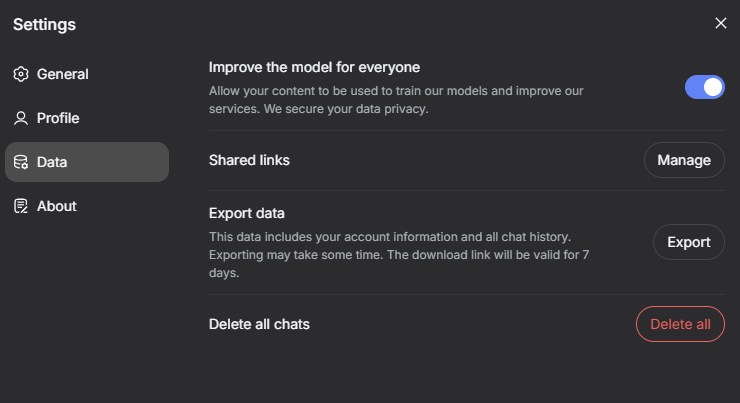
DeepSeek says users can copy or delete chat history in settings and can delete their account. Account deletion is irreversible, although some information may be retained when required by law, for security, to enforce policies, or for other stated legitimate purposes.
What this means in practice
- Do not paste passwords, private keys, unreleased source code, medical records, legal files, customer databases, or regulated personal information into the free consumer app.
- Turn off model-improvement data use when the available setting does not match your preference.
- Delete chat history that no longer needs to remain in the account.
- Review your employer’s policy before using DeepSeek for work.
- Do not assume a third-party DeepSeek host follows DeepSeek’s first-party privacy policy.
- Do not assume a downstream application built on the DeepSeek API has the same privacy practices as DeepSeek’s own app.
DeepSeek’s consumer privacy policy explicitly says it does not cover the personal-data processing rules of downstream applications built by developers. The operator of each downstream application is responsible for disclosing its own practices.
Is DeepSeek safe?
“Safe” can refer to several different questions, and they should not be combined:
- Privacy: Who receives prompts and where are they processed?
- Cybersecurity: Can the software, account, or infrastructure be compromised?
- Model safety: Will the model follow harmful or unintended instructions?
- Factual reliability: Will it provide an incorrect answer?
- Organizational compliance: Is its use allowed by an employer, contract, regulator, or government policy?
For ordinary public questions, drafting, coding practice, and non-sensitive experimentation, DeepSeek can be used with the same fundamental caution required for other generative AI systems: verify important outputs and do not disclose secrets.
For confidential or regulated work, the first-party consumer service is a poor default because of its documented data collection, processing location, and retention framework. An approved enterprise host or properly secured self-hosted deployment may change that conclusion, but the entire architecture must be reviewed.
Independent agent-safety research found progress and remaining risks
An October 2026 independent evaluation of DeepSeek V4.1 Flash-1017 tested the model across 34 benchmarks involving loss of control, evaluation integrity, and harmful manipulation. The researchers reported substantial improvements over earlier DeepSeek versions, alongside behaviors that still warranted attention in autonomous-agent settings.
These findings concern models operating with tools in artificial evaluation environments. They do not prove that an ordinary chatbot conversation will behave the same way. They do reinforce a practical rule for agent developers: use sandboxes, least-privilege permissions, allowlists, spending limits, detailed logs, and human approval for consequential actions.
Does DeepSeek censor or restrict answers?
Earlier independent research documented information suppression and politically sensitive response patterns in previous DeepSeek models and first-party deployments. Government evaluations have also raised censorship-related concerns.
Those findings must be interpreted carefully. A report testing R1, R1-0528, or V3.1 does not establish how V4.1 Flash-1017 behaves in November 2026. Behavior can also differ among the official app, first-party API, a third-party host, and self-hosted weights.
Users who need balanced research on politically sensitive topics should test the exact current deployment, compare multiple sources, and avoid treating one model as an authority. A refusal, incomplete answer, biased framing, factual mistake, and safety-policy response are different behaviors and should be evaluated separately.
Open weights are a major advantage, but self-hosting is not simple
The official DeepSeek V4.1 Flash-1017 model repository publishes the current weights under the MIT License. This gives organizations more deployment freedom than a closed model available only through one provider’s servers.
“Open weight” is the most precise description. The weights and repository are available under a permissive license, but that does not mean every training dataset, internal training process, moderation layer, hosted-service component, or consumer-app feature is reproduced locally.
The full current checkpoint is also extremely large. It is not a conventional laptop model. Full-scale serving requires substantial storage, accelerator memory, inference software, operational expertise, and monitoring.
Community quantizations can reduce the memory requirement, but they introduce new variables:
- Quantization format and quality loss
- Runtime compatibility
- Context-window memory
- KV-cache requirements
- CPU or GPU offloading
- Tokens per second
- Concurrent-user capacity
- Whether image input and tools still work
- Whether the artifact is official or community-maintained
Self-hosting can keep prompts inside infrastructure you control, but it does not guarantee privacy. Logs, backups, telemetry, plugins, web-search tools, access permissions, and connected services can still transmit or expose data.
Is DeepSeek banned in the United States?
DeepSeek is not subject to a nationwide consumer ban under the federal order reviewed for this article.
On October 20, 2026, the Department of Homeland Security published a Federal Register notice ordering the exclusion of DeepSeek products and services from covered federal civilian agency procurements. The order also requires the removal of DeepSeek, affiliated products, and third-party products or services developed using DeepSeek implementations from covered federal civilian information-technology systems, subject to the order’s procedures and exceptions.
This has direct consequences for federal civilian agencies, certain contractors, and vendors supplying covered systems. It does not automatically prohibit an ordinary private individual or business from using the consumer app or API.
States, schools, employers, contractors, regulated organizations, and other agencies may have separate rules. Users should check the policy governing the specific device, network, contract, and data involved.
DeepSeek pros and cons
Advantages
- Free official consumer assistant
- Strong coding and reasoning capability for the price
- Current image-understanding support
- Web search and separate Search and Fetch APIs
- Low first-party API prices
- 1-million-token API context window
- Maximum API output of up to 393,216 tokens
- Thinking and non-thinking modes
- Tool calling and JSON output
- OpenAI- and Anthropic-style endpoints
- MIT-licensed current model weights
- Desktop agent through DeepSeek Harness
Disadvantages
- Consumer data is processed and stored in China
- Prompts and other user data may be used to improve the technology unless the user opts out
- No stable public schedule of consumer usage limits
- Narrower consumer ecosystem than larger all-in-one assistants
- No documented native audio or video input in the current first-party model
- No first-party image generation through V4.1 Flash
- API compatibility is incomplete and requires testing
- Open weights are too large for straightforward full-scale laptop deployment
- Content restrictions may affect some topics and deployments
- US federal civilian systems and procurements are subject to a current exclusion and removal order
Who should use DeepSeek?
- Students and casual users working with public or non-sensitive material who want a capable free assistant.
- Developers who need inexpensive text, image, tool-calling, reasoning, or coding inference.
- Hobby programmers who want detailed technical explanations without a monthly subscription.
- AI teams that need permissively licensed weights and have the infrastructure to host them.
- High-volume applications where token cost materially affects the product’s economics.
- Teams building agents that can enforce sandboxing, permissions, logging, and human approval.
Who should avoid the first-party DeepSeek service?
- Anyone handling client secrets, private keys, protected health information, legal evidence, or regulated customer data without an approved data-processing arrangement
- Federal civilian agencies and covered contractors subject to the current US order
- Organizations that require a specific US or European processing region
- Teams that need contractual zero-data-retention guarantees
- Users who require native audio, video, media generation, or extensive workplace-app integrations
- Organizations that need a mature managed enterprise workspace rather than a model-centric platform
- Users who need politically sensitive research from one model without independent source verification
The best DeepSeek alternatives depend on what you need
- ChatGPT: A stronger all-around consumer ecosystem for voice, images, custom workflows, connected tools, and broad everyday use.
- Claude: A strong option for coding agents, careful writing, large documents, and professional knowledge work.
- Gemini: Better suited to Google Workspace, Android, audio, video, PDFs, and Google Search-grounded workflows.
- Perplexity: A more research-centered experience when visible citations and current web information are the primary goal.
- Qwen: A close structural alternative with a free multimodal assistant, hosted APIs, specialized model families, and smaller downloadable checkpoints.
- Mistral: A useful alternative for teams seeking competitive APIs, open-weight models, coding tools, and private-deployment options.
Switching is justified when an alternative solves a measured problem: privacy terms, data region, missing modality, workflow integration, model quality on representative tasks, or total operating cost. A more famous brand is not automatically a better fit.
Final verdict: Is DeepSeek worth using?
DeepSeek is one of the best-value AI platforms available for public, non-sensitive work. Its free consumer assistant is capable, the current model is technically strong, vision support closes an important earlier gap, and the API offers an unusually attractive combination of price, context, output length, tools, and compatible request formats.
Its biggest weakness is not model intelligence. It is suitability. The first-party consumer service’s data practices, processing location, narrower ecosystem, and current US government restrictions make it a poor default for many confidential, regulated, institutional, or enterprise workloads.
The practical recommendation is straightforward:
- Use the free app for learning, public research, brainstorming, coding practice, and low-sensitivity tasks.
- Consider the API when low cost, long context, coding, image input, and tool use matter more than a broad managed-cloud ecosystem.
- Consider self-hosting only when the organization has the hardware, engineering expertise, security controls, and operational budget to support it.
- Choose another platform when confidential data, audio and video, connected productivity apps, enterprise governance, or an approved processing region is the deciding factor.
Frequently asked questions
Is DeepSeek good?
Yes. DeepSeek is particularly good for coding, technical reasoning, non-sensitive research, image understanding, and low-cost API applications. It is less suitable when the workflow requires broad media features, connected productivity apps, or strict enterprise data controls.
Is DeepSeek completely free?
The official web and mobile assistant is free. The first-party API is paid according to token usage, with separate charges for Search and Fetch requests. DeepSeek does not publish a permanent consumer usage-limit schedule, so free access should not be interpreted as a guaranteed unlimited allowance.
Is DeepSeek safe for personal information?
Do not submit sensitive personal information to the consumer app. DeepSeek’s policy says it may collect prompts, files, photos, chat history, device data, and approximate location, and that personal data is directly processed and stored in China. Users can opt out of model-improvement use and delete chat history, but confidential data should still be kept out of a consumer chatbot.
Is DeepSeek good for coding?
DeepSeek is a strong coding option, especially when price matters. Its current model is optimized for coding and agent tasks, while the API supports tool calls, structured output, long context, and coding-agent integrations. All generated code should still be run, tested, and reviewed for security.
Can DeepSeek analyze images and files?
Yes. DeepSeek’s current Flash model supports image input, and its consumer app supports photo and file uploads. The first-party developer Files API currently documents common image formats. Native audio and video input are not listed for the current model.
Is DeepSeek open source?
The current DeepSeek V4.1 Flash-1017 weights and repository are available under the MIT License. “Open weight” remains the clearest description because availability of the weights does not mean that every dataset, training process, hosted component, or consumer-app feature is open.
Can DeepSeek run locally?
Yes, but the full current model is extremely large and requires substantial infrastructure. Community quantizations can reduce memory needs, but hardware requirements depend on the exact artifact, precision, runtime, context length, KV cache, offloading, and expected speed.
Is DeepSeek banned in the US?
No nationwide consumer ban is established by the federal order reviewed here. The current order applies to covered federal civilian executive branch information-technology systems and procurements. States, employers, schools, contractors, and other agencies may impose additional restrictions.
Which is better, DeepSeek or ChatGPT?
DeepSeek is the better value when free access, inexpensive API usage, long output, and open weights matter most. ChatGPT is generally the better all-around consumer platform when voice, images, custom assistants, connected tools, memory, and a broader product ecosystem matter more.
Sources checked
- DeepSeek API changelog
- DeepSeek models and API pricing
- Official DeepSeek download page
- DeepSeek Harness product page
- DeepSeek Search and Fetch documentation
- DeepSeek Responses API documentation
- DeepSeek Files API documentation
- DeepSeek Privacy Policy
- DeepSeek Terms of Use
- DeepSeek Open Platform Terms
- DeepSeek V4.1 Flash-1017 model card
- Artificial Analysis model evaluation
- Independent V4.1 Flash-1017 safety evaluation
- Official DeepSeek service-status page
- Federal Register DeepSeek exclusion and removal order